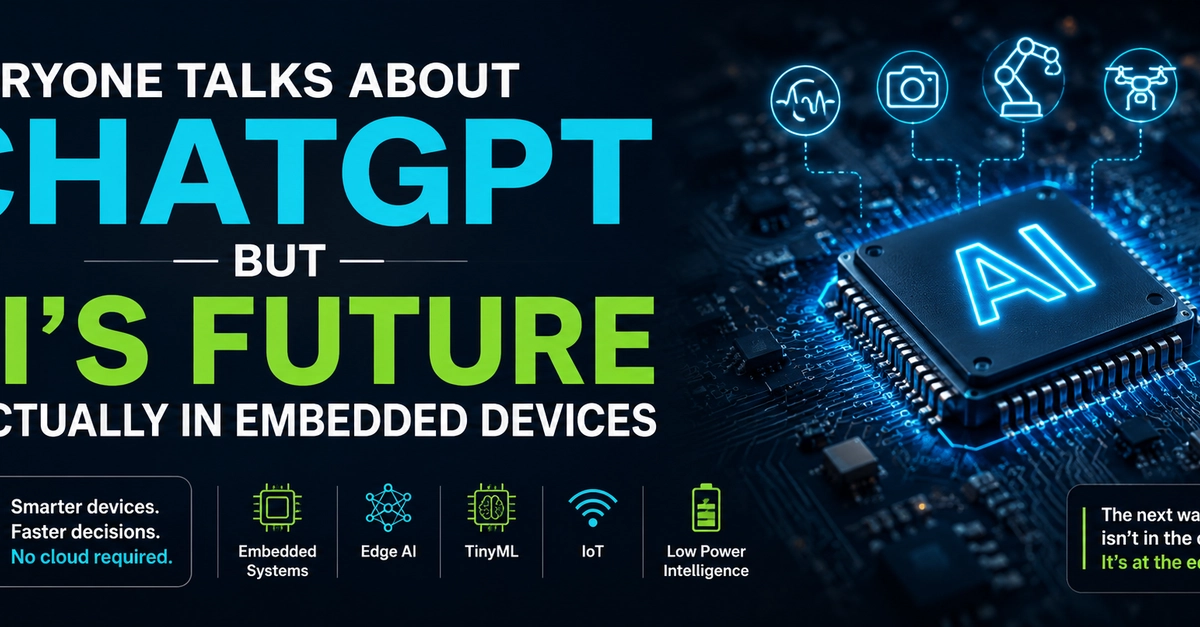
Cloud AI gets the headlines, but the next wave of intelligence is running on microcontrollers with kilobytes of RAM.
Ask most people where AI “lives,” and they'll point at a data center. ChatGPT, Claude, Gemini — enormous models running on racks of GPUs somewhere far away, reachable only through an internet connection. That mental model isn't wrong. It's just incomplete.
Because while everyone is watching the cloud, a quieter shift is happening much closer to the ground — on devices with kilobytes of RAM, no operating system in the traditional sense, and a current draw measured in microamps. The kind of hardware I work with every day.
I'm an embedded systems engineer. I spend my time writing firmware for ARM Cortex-M microcontrollers, building on Zephyr RTOS, and getting tiny devices to talk over BLE and NB-IoT. And from where I sit, the most interesting AI story of the next decade isn't the model that writes your emails. It's the sensor node that can make a decision without ever phoning home.
This post is my case for why. We'll look at where cloud AI hits a wall, what Edge AI really is, how ordinary microcontrollers are becoming intelligent, and — the part most articles skip — where firmware engineers fit into all of it.