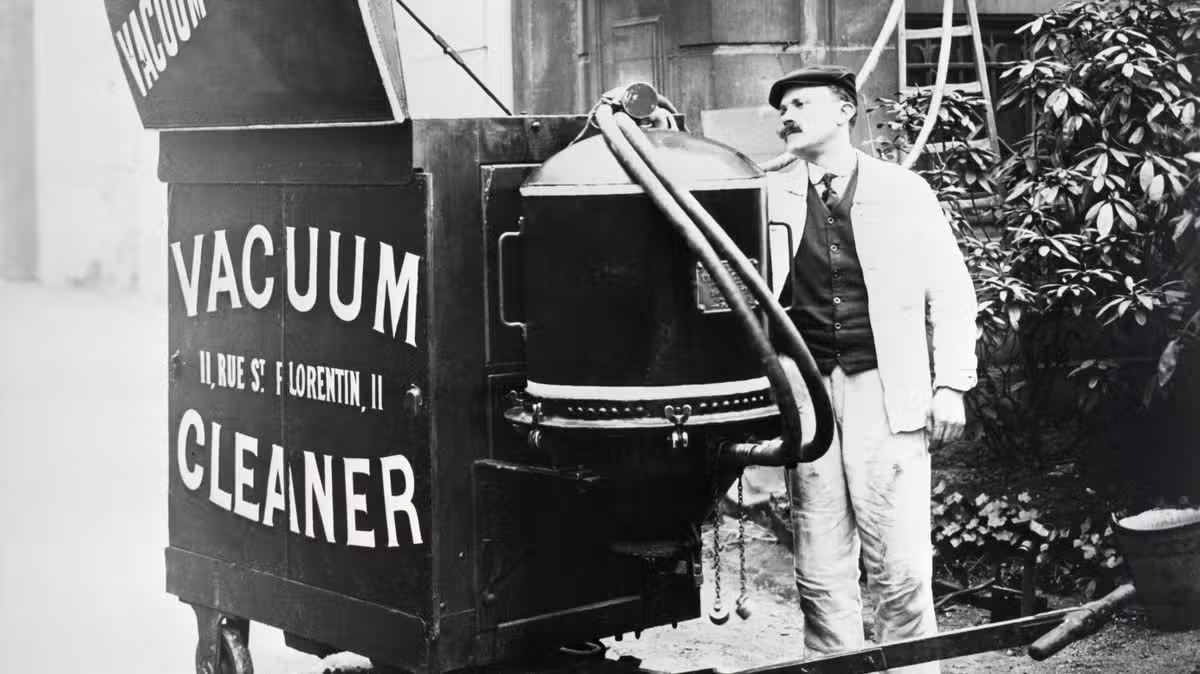
Next time you whizz your vacuum cleaner over your carpets, spare a thought for Puffing Billy. For it’s been 125 years since esteemed British engineer Hubert Cecil Booth invented the first motorised carpet cleaner… and it was a monster. The 1901 version of today’s upright, cylinder, bagless or even robot vac was a petrol-driven, horse-drawn machine, which used suction to pull dirt through a cloth filter.Because of its massive size, workers parked it on the street and fed hoses through people’s windows. Legend has it that Booth realised suction was the key to true cleaning, after placing a handkerchief over a restaurant chair, sucking air through it, and seeing the massive amount of dust trapped.Household historian Laura Humphreys says: “The original machines were far too large to use indoors. Booth founded the British Vacuum Cleaner and Engineering Company, offering a mobile cleaning service where his bright red, horse-drawn vacuums would park on the street and snake long hoses up to 100 feet into clients' windows.”Soon carpet cleaning became a posh party piece. Laura continues: “The novelty was an instant hit among London high society, leading to ‘vacuum parties’ where society ladies would invite friends over to watch the rugs being cleaned. Booth even used his invention to clean the carpets at Buckingham Palace for King Edward VII and Queen Victoria's households.”Puffing Billy was inspired by a manual carpet sweeper, patented in 1811 by British inventor James Hume, and combining a rotating brush and bellows to generate suction - but Booth’s motorised version was the great great grandparent to the 6.4 million vacuum cleaners sold annually in the UK today.Ironically, when more user friendly models came into play, there was a certain stigma attached to using them. Laura, who is curatorial lead (Collections & Digital) at the Science Museum Group, says they were considered to be lazy, as rugs no longer had to be taken outside and beaten. They could be cleaned where they were. She explains: ”Hard work was believed to be good for you. And the invention of the vacuum cleaner made housework less hard.“Books and periodicals said, ‘you should still be using a carpet beater.’ ‘You should still be using the old ways’. There was also a moral objection to them, as the thought was, ‘Physical labour is good for you’. ‘It's good for your servants to work hard’. ‘Don't make life too easy for them’.”In 1908, Ohio janitor James Spangler invented the first portable electric vacuum. It used an electric fan motor, a broomstick and a pillowcase. Heralding the modern era of carpet cleaning, he sold the patent to William Henry Hoover in 1908 and his company became so synonymous with this form of cleaning that "hoovering" became a universal term.But the machines were initially super expensive. Laura says: “They were huge industrial machines in the early 20th century. They start to come down to domestic scale around about the 1920s and you had brands like Hoover and Electrolux.”Rich families bought early models to tempt servants to work for them. Laura says: “Everybody tends to think of the Downton Abbey, Gosford Park army of servants in the stately home. But the vast majority of servants - mainly women - were actually working alone as a sole employee in a middle-class house.“In the 1920s, more employment opportunities began to open up for women. Therefore, cleaners became harder to get. Families needed to find new ways to do their domestic work and also attract servants. This is where a vacuum came in. You’d get adverts for servants mentioning the kind of technology they have in their home to help them.”The 1930s saw the invention of one of the UK’s biggest vacuum cleaners at Eltham Palace. Featuring an advanced, built-in, centralised vacuum cleaning system and installed by wealthy owners Stephen and Virginia Courtauld, the system used a large suction pump in the basement, connected to hidden wall outlets throughout the Art Deco mansion. Laura’s favourite cleaner, she says: “That was cutting edge and very much of the time that the palace was built.”The 1930s also introduced lightweight plastics like Bakelite to replace heavy metal bodies, streamlining shapes and lowering total weight. And the decade saw the invention of disposable bags by the firm Air-Way. Widely adopted in the 1950s, the multi-layer cellulose fibre bags eliminated the messy chore of shaking out reusable cloth sacks.In 1954, vacuuming took another hi-tech turn with the Hoover Constellation. Designed by Henry Dreyfuss, this spherical canister used its own exhaust air to float across the floor like a hovercraft. Then in 1969, the Hoover Company introduced power-driven wheels that moved the heavy upright machine forwards and backwards with minimal effort.The 1960s also popularised flexible canister designs, with long hoses and swivelling nozzles, making it easier to clean bare floors, stairs, and drapes. Then, in 1978, James Dyson came along. Dismantling his failing vacuum cleaner, he found a major flaw - dust was clogging the bag and killing the suction.Inspired by an industrial cyclone tower he’d built to separate paint particles from the air, he adapted centrifugal technology for the home and, 5,127 prototypes later, he created the world's first bagless vacuum. James says: “When I saw industrial cyclones sucking up sawdust, my instincts kicked in.”Dyson’s first cleaner went on sale in 1986 in Japan as the G-Force, while the first model sold as a Dyson launched in May 1993 in the UK. Within 18 months it became the biggest seller in the UK. James says: “Fifteen years of invention, frustration and determination was beginning to pay off. “At £200, it was three times the price of other vacuum cleaners, but he says: “Those choosing it recognised its technological advantage over existing designs.” And customers loved the fact they could see the dirt being sucked up, because of its transparent container. James adds: “They were fascinated by the sight of just how much dirt they had successfully cleaned up.”And now, in 2026, 125 years since its invention, vacuum cleaner technology features hot-water active mopping, AI-driven dirt/stain detection, and self-washing roller systems. Catrin Davies, Senior SDA Product Manager at Hoover and Haier UK & Ireland, says: “The archive photos show how tastes have changed – from the retro 1950s styles to the bold 1980s designs, and now chic examples in pastel colours. Modern consumers are making fashion-forward choices when they choose their vacuum cleaners.”Yet, while new household gadgets have many of us hooked, historian Laura says there is one tool that is still likely to give the latest vacuum cleaners a good beating. She says: Modern vacuums take just as much labour as the very first ones. Labour-saving technology is a marketing term. Want to truly save time? Buy yourself a carpet beater.”
Suspicious public fell in love with 'monster' that became our favourite gadget
Celebrating 125 years since Hubert Cecil Booth invented the vacuum, the appliance has evolved from a horse-drawn monster into high-tech device found in every home...
1,116 words~5 min read