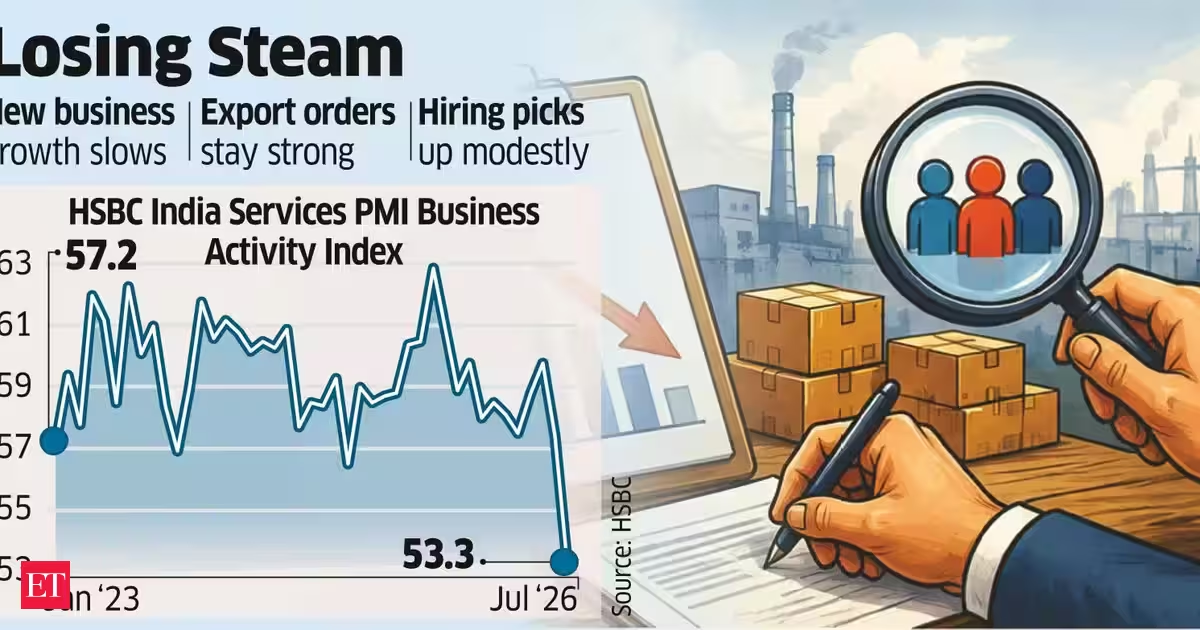
India’s private sector growth eased to over a four-year low as weaker demand and slowing services activity weighed on business expansion, according to a private survey released Friday.The HSBC Flash India Composite Purchasing Managers Index (PMI) fell to 54.3 in July from 57.1 in June. A reading above 50 signals expansion and one below indicates contraction. Growth was constrained by challenging market conditions, competitive pressures, order cancellations, reduced client enquiries and shortages of key raw materials, the survey mentioned.Manufacturing activity slowed to 53.9 in July from 54.2 in June, while the services PMI declined sharply to 53.1 from 57.4.“Renewed tensions in the Middle East have once again resulted in firms building buffers to manage the uncertainties around the longevity of the supply-side shock,” said Pranjul Bhandari, chief India economist at HSBC.“Finished goods and input inventories increased alongside a pick-up in purchasing volumes,” she added.Business confidence weakened to a six-month low in July, with the optimism index slipping further below its long-run average. While sentiment improved among manufacturers, it deteriorated in the services sector. Firms remained hopeful that market conditions and underlying demand would strengthen over the next 12 months.New order growth slowed to nearly a four-and-a-half year low in July, dragged by the services sector, where expansion retreated to the weakest in 53 months. Manufacturing, however, regained some momentum.Bhandari noted that both output and new export orders rose, even as the overall manufacturing growth eased slightly.Exports emerged as a bright spot across both sectors. International demand rose for manufacturers as well as service providers, with goods producers recording the stronger performance. At the composite level, export order growth was the strongest since March.On the inflation front, input costs across the private sector rose at a faster pace than in June, though they remained below the long-run average. Survey respondents cited higher fuel, labour, material and transportation costs as the key drivers. Input price inflation picked up in both manufacturing and services.“Price pressures firmed, with output charge inflation gathering pace and signalling a renewed push to protect margins,” noted Bhandari.Output price inflation increased to its fastest pace since April as companies passed on rising costs to customers.Employment continued to expand for the seventh consecutive month in July. Hiring gathered pace from June, although the overall rate of job creation remained modest. Service providers added jobs at a faster rate than manufacturers.The survey also noted that firms continued to recruit despite indications of spare capacity across the private sector.
India's private sector growth hits over four-year low
India's private sector growth slowed significantly in July, reaching a four-year low. Weaker demand and services activity constrained business expansion, impacting overall economic momentum. Manufacturing and services sectors both experienced a slowdown, with new orders declining sharply. Exports offered a bright spot, showing increased international demand for goods and services. Firms increased inventories and purchasing volumes amid supply chain uncertainties.
407 words~2 min read