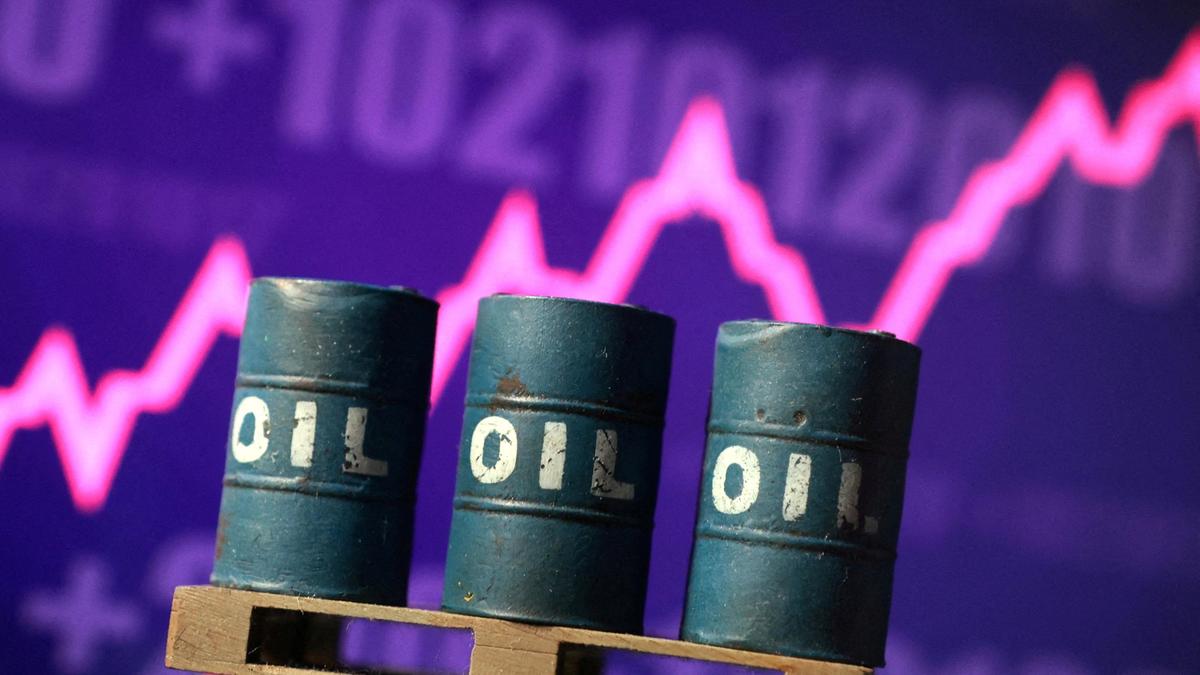
Brent crude futures traded above $100 a barrel following escalating tensions between the US and Iran in West Asia.At 9.32 am on Friday, September Brent oil futures were at $100.66, down by 0.03 per cent, and September crude oil futures on WTI (West Texas Intermediate) were at $91.95, down by 0.26 per cent. August crude oil futures were trading at ₹8,895 on Multi Commodity Exchange (MCX) during the initial hour of trading on Friday against the previous close of ₹9,024, down by 1.43 per cent, and September futures were trading at ₹8,428 against the previous close of ₹8,580, down by 1.77 per cent.A statement by US Central Command said that its forces successfully completed the 13th straight night of strikes against Iran at 9 pm ET on July 23.It targeted Iranian military command centres, drone storage facilities, communication networks, coastal surveillance sites, and maritime capabilities to further diminish the threat Iran poses to civilian mariners and commercial vessels transiting the Strait of Hormuz.The statement said that the international waterway remains open for transit despite recent attacks from Iran’s Islamic Revolutionary Guard Corps. “Commercial vessels continue to freely navigate the strait with US military support,” it said.In their Commodities Feed for Friday, Warren Patterson, Head of Commodities Strategy of ING Think, and Ewa Manthey, Commodities Strategist, said oil prices surged on Thursday, with ICE Brent breaking above $100 a barrel for the first time since May.Further escalation in the Persian Gulf and fears of a widening conflict are putting a significant amount of oil supply at risk. Houthi attacks on Saudi vessels in the Red Sea have the potential to widen this conflict, leading to further escalation, they said.US President Donald Trump said he will hold Iran responsible for attacks on vessels in the Red Sea, while suggesting a ratcheting up of attacks against Iran. Market fears will be centred around the risk of energy infrastructure in the region being targeted once again.“With little-to-no sign of de-escalation, the market is likely to take the path of least resistance for now. This suggests oil prices will only continue to move higher. The key question is at what price level pressure begins to build on the Trump administration to return to the negotiating table. If Trump’s previous spikes during the early stages of the war are any guide, pressure to de-escalate will likely grow significantly if, and when, Brent nears $120 a barrel. For Iran, it’s less about where oil prices are trading and more about how long they can endure a collapse in oil revenues amid the US blockade,” they said.Mentioning that the potential supply disruptions facing the market now are larger than at any time during the war, they said not only have oil flows through the Strait of Hormuz essentially dried up, but there are clear risks to Saudi oil flows from the Red Sea. In June, Saudi crude oil exports from Yanbu in the Red Sea averaged roughly 4.6 million barrels a day.“In addition, we’re seeing disruptions to Kazakh oil flows from the CPC terminal in Russia, amid alleged Ukrainian attacks on tankers. Export volumes from this terminal in recent months have exceeded 1.7 million barrels a day,” they said.In a post on Truth Social, Trump said: “Please let this statement serve to represent, until further notice, that from this point forth, any and all damages done to Ships, Cargo, or anything related thereto, will be paid for by Iranian Money that the United States has in its possession, and controls. These damages may be very substantial but, nevertheless, this is the fair and equitable thing to do.”Published on July 24, 2026
Brent crude hovers above $100 a barrel as tensions escalate in West Asia
Brent crude prices surpass $100 a barrel amid escalating tensions in West Asia, signaling potential further increases ahead.
603 words~3 min read