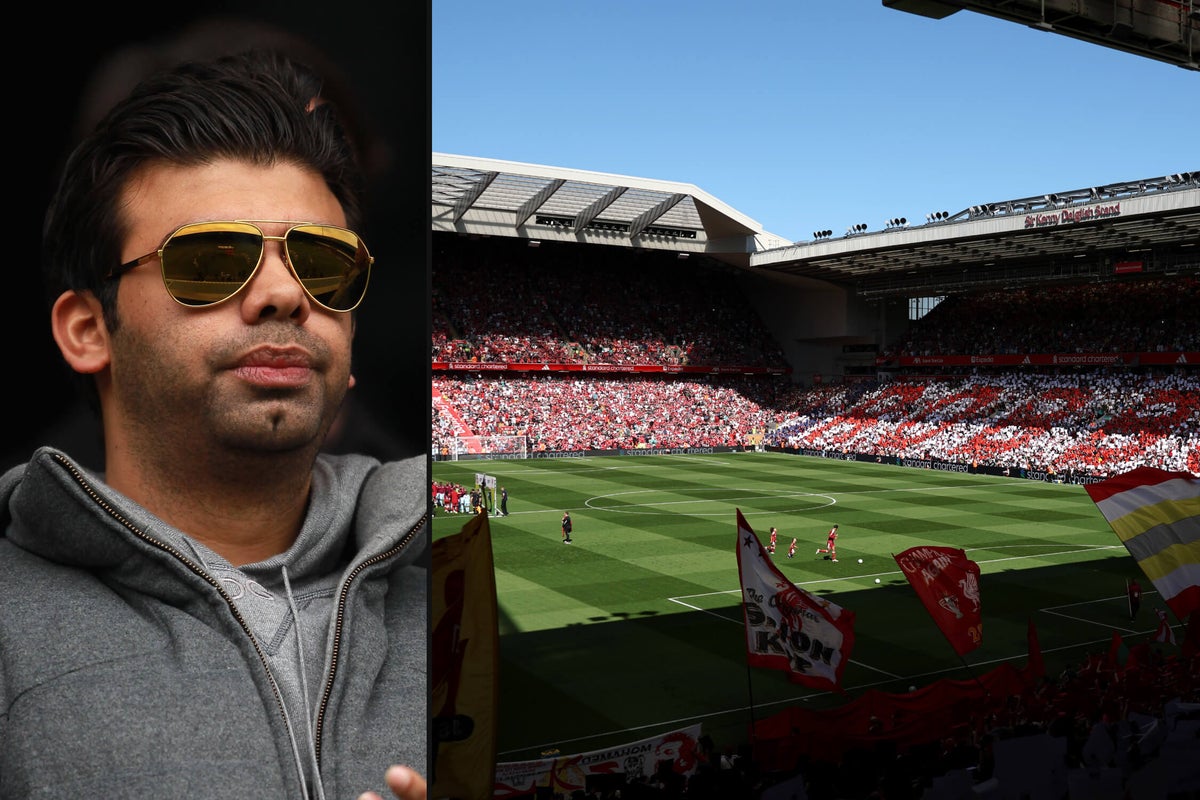
This was meant to be a fairly straightforward story.As most Liverpool fans will not have heard of Amit Bhatia until Wednesday, when it was first reported that the British-Indian entrepreneur is leading a group which would like to buy a stake in that club, I was asked by my editors to whip up an intro.At this point, the steer from Fenway Sports Group (FSG), the Boston-based syndicate which has owned Liverpool since 2010, was that Bhatia’s group was in talks for a similar deal to the one FSG struck with Dynasty Equity in 2023, when that American investment firm bought about three per cent of the club for just under £150million ($200m).For what it’s worth, nobody asked for a profile of Dynasty Equity three years ago as investment firms are quite dull, and FSG selling three per cent stakes is nice work if you can get it but makes no difference as to who makes the decisions at Anfield. And if that is what is happening with Bhatia’s group now, well, this deal is only more interesting than Dynasty’s because Bhatia is more interesting than Dynasty.But what if his group wants more? What if Bhatia is not the most interesting person in his group? What if FSG is not just realising some of the huge paper profit it has made on that 2010 punt and this is the beginning of the end for John W Henry and friends?Those questions got louder when reports started to suggest Bhatia’s group is talking about a 30 per cent stake in Liverpool, and they began screaming when the UK’s Sky News claimed the group has asked Amazon founder Jeff Bezos if he wants to join the gang. After all, why would Bhatia’s group need the world’s fourth-richest man to chip in for a $200million season ticket unless it needed some of his $250bn-plus fortune to buy the whole shooting match?So, you can see how this one evolved from being a rundown of Bhatia’s life and times to something that might provide some answers to the biggest questions Liverpool fans will have about their club right now: where are we going, and who is taking us there?Here is what I can tell you for certain: only Henry and his most senior colleagues at FSG really know, and they are not telling anyone else. I am also not sure they have made their minds up, either.But that is clearly a cop out, no pun intended, so let me lay out some scenarios I have discussed with several football finance contacts over the past 48 hours. None wished to speak on the record, by the way, as some of them have existing connections to Bhatia or FSG and do not wish to spoil them, while I suspect the rest might like to make connections of their own one day.Amit Bhatia (centre) watches Queens Park Rangers play in the Championship in 2011 (Warren Little/Getty Images)The first thing to say is Bhatia’s group wants more than three per cent. This deal is similar to Dynasty’s only in that it is a potential minority investment which will leave FSG still in charge. So, even if the stake is as large as 30 per cent, it is not like Sir Jim Ratcliffe’s “Friends with benefits” deal at Manchester United.However, it would appear that a 30 per cent stake is at the top end of what the group is discussing with FSG, although the consensus number among my panel of experts was more like eight to 10 per cent, on an overall valuation for the club of £4.5billion ($6bn). A significant amount of money, then.But there is a big difference between these stakes in terms of cost and intention. At 10 per cent, most investors are saying they like the sector, and the place of the business concerned in that sector; but they are also saying they trust the majority owners and are happy to come along for the ride. On the flip side, the majority owners are delighted that someone has recognised how clever they are and pleased to share the burden of growing the business.But at 30 per cent, you have spent too much to not want a say, particularly as you are now on the hook for nearly a third of any future costs, too.Football history is full of examples — Alisher Usmanov at Arsenal, John Textor at Crystal Palace, perhaps even Bhatia at Queens Park Rangers (more on that in a moment) — showing the frustrations of being a large minority owner without much power.Unless, of course, 30 per cent is just a stepping stone to overall control — a journey we have seen several times before elsewhere.This is where the panel of contacts I spoke to divided.On the one hand, you have a group of investors, which now numbers more than 30, who initially came together to buy baseball’s Boston Red Sox, their famous home stadium Fenway Park and New England Sports Network, a local cable and satellite TV business, in 2002.The three principals — the aforementioned Henry, a commodities trader turned investor, TV executive Tom Werner and investment banker Mike Gordon — are now, respectively, 76, 76 and 61 years old. They have families, but there is no obvious succession plan at FSG, which therefore makes it look like an investment with a fixed horizon.Tom Werner (left), Mike Gordon and John Henry celebrate Liverpool’s title success in 2025 (Carl Recine/Getty Images)Strengthening this case are the facts that, in November 2022, FSG announced, via The Athletic, that “under the right terms and conditions, we would consider new shareholders, if it was in the best interests of Liverpool as a club”.Three months later, Henry, who has rarely talked publicly about Liverpool since having to apologise to fans for trying to take the Premier League side into a breakaway European Super League in April 2021, spoke to the Boston Sports Journal.“Will we be in England forever? No,” he said. “Are we selling LFC? No. Are we talking with investors about LFC? Yes. Will something happen there? I believe so, but it won’t be a sale.”As those talks culminated with the Dynasty deal in September 2023, Henry’s answers to the last three questions he posed were entirely accurate. But what about that first one?He is now three years older than when he said FSG will not be in England forever, and it is widely known around Anfield that he has lost interest in the day-to-day business of the club, and European football more broadly, ever since the ESL’s embarrassing collapse.Furthermore, FSG has recently demonstrated its willingness to offload a major asset, by selling the Pittsburgh Penguins for $1.7billion, five years after buying the National Hockey League franchise for $900m. That is a fine return, but nowhere near as good as the 1,500 per cent profit FSG is sitting on at Liverpool, having paid £300m to rescue them from near bankruptcy.FSG recently sold ice hockey’s Pittsburgh Penguins (Thearon W. Henderson/Getty Images)Some of my contacts have also pointed out that the valuations for English football clubs, even ones as special as Liverpool, have not exactly raced away since Dynasty bought its stake and the likes of Chelsea, Everton or Bournemouth all changed hands in recent years. European football’s failure to keep a lid on costs means that profits are rare and the only way to make good money is on the way out.And, just to add one final piece of evidence to the case for this being the beginning of the end, Liverpool fans will know only too well that the club are at something of a crossroads, as FSG has recently decided it is not building a farm-team system and several senior figures have just left or are about to leave, most notably head coach Arne Slot, chief executive of football Michael Edwards and sporting director Richard Hughes.Add all of that up, throw in last season’s disappointing campaign, and this looks like an open-and-shut case of sell, sell, sell. Right?There is, however, an alternative view, which I will explain more briefly.One, FSG has said it is not looking to give up control. Two, Henry and Werner are 76 years old, not 86. Three, FSG is only two years removed from joining a $1.5billion joint venture with golf’s PGA Tour, an investment with a very indeterminate timeline. Four, FSG is only one year removed from its biggest single-season investment in playing talent and has just hired a new head coach, Andoni Iraola. And five, it was only in February this year that Liverpool announced record revenues of £703m. They even managed to post a small profit of £8m.Given all of that, the growing interest in premium sport shown by the global streamers, the inexorable rise of sports gambling and the fact that, to borrow Donald Trump’s favourite adjective, the beautiful game has never been “hotter” in the United States, is now as good as it is going to get for FSG and Liverpool?While you ponder those arguments, let me add one more chip that could be used by either side in the debate: India and its burgeoning economy.The club that truly becomes India’s football team (sorry, Blackburn Rovers, it is unlikely to be you) should burst past a valuation of £4.5billion.Andy Murray, Kevin Pietersen and U.S. businessman John Tyson join Amit Bhatia (second left) on the iconic Swilcan Bridge during a round of golf at St Andrews (Warren Little/Getty Images)That, however, brings us to what, or who, this story was meant to be about: Bhatia.He is either FSG’s plan to help Liverpool achieve that, or Liverpool is Bhatia’s plan to do it.If you are pushed for time, Bhatia is the 46-year-old son-in-law of Indian steel magnate Lakshmi Mittal, who was once ranked as high as third in Forbes’ global ranking of billionaires but has now slid all the way to 73rd with only $31.1billion to his name.Educated at posh schools in India and London, Bhatia studied economics at Cornell University in New York state, before stints at blue-chip banks in New York and London. He married Mittal’s daughter Vanisha in 2004, the same year he set up venture capital firm Swordfish Investments.Now known as AyBe Capital, that firm owns shares in 25 companies in the health, media, property, tech and sports sectors, including stakes in cricket’s London Spirit franchise (along with several other Indian tech bros), former England cricket star Kevin Pietersen’s YouTube channel and TGL, the indoor golf league co-founded by Rory McIlroy and Tiger Woods.AyBe used to have shares in a 26th company, Queens Park Rangers of the second-tier Championship, but Bhatia announced on Wednesday, just as news of his interest in Liverpool was breaking, that he was handing those over to QPR’s majority owner Ruben Gnanalingam, ending a 19-year relationship with what he always described as his “local club” in west London.Bhatia is also chairman of the Breedon Group, a construction-materials company that owns quarries and cement factories in the UK, U.S. and Republic of Ireland, as well as being a founding partner at Summix Capital, a real-estate investment firm.He is pretty busy, then, but not too busy to have fun.If you have a little longer to research this fella, take a look at his Instagram page. You will see that he recently played golf in Surrey, south of London, with LeBron James (an FSG shareholder, no less), much to the amusement of his mates, who include Pietersen, Indian cricket great Sachin Tendulkar (a regular golf partner), former QPR and current Newcastle United director Jamie Reuben and Jamie Redknapp, the son of ex-QPR boss Harry Redknapp and a former Liverpool and England player.He has lots more famous friends, but I will let you find them on your own.
Amit Bhatia, Liverpool and the potential of India: Is this the beginning of something spectacular?
The Mittal family-backed consortium is in discussions with Fenway Sports Group to buy a minority stake in Liverpool, but may want more
2,774 words~13 min read