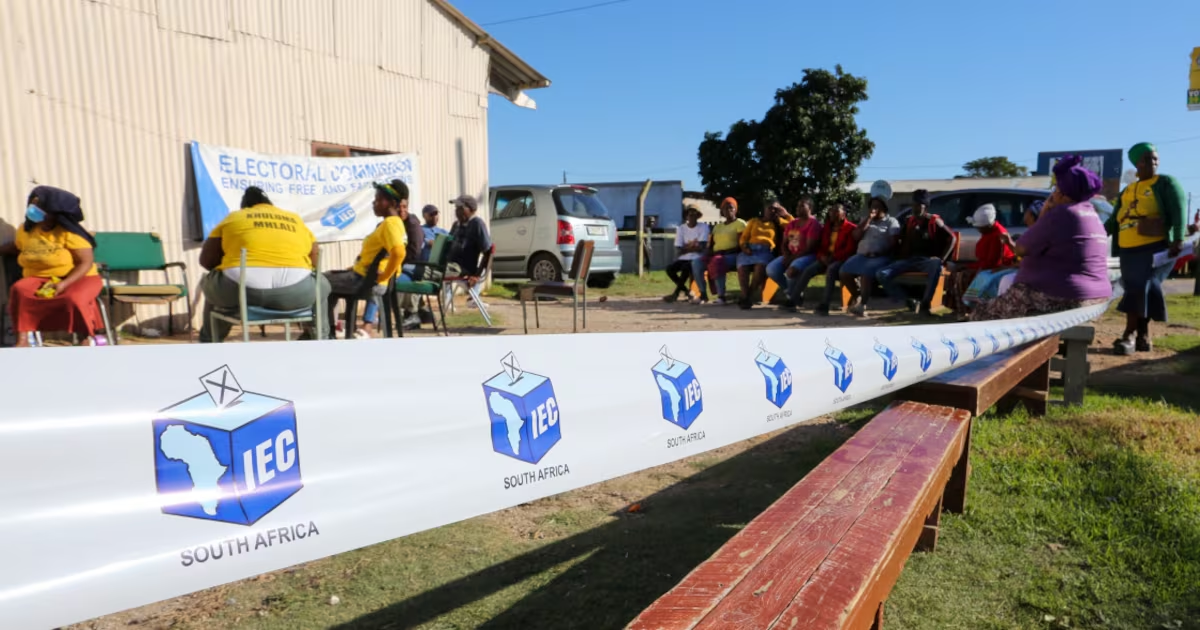
If the anchor tenants of the government of national unity (GNU) are looking for shared policy proposals to take their coalition into the future, they could do worse than revisit the challenge of money and politics. Five years after the Political Party Funding Act (PPFA) came into force it has brought transparency for those transactions parties were always happy to disclose and silence on many of those that actually shape how the country is governed. The act’s architecture seemed sensible enough in 2018. Donations above a R100,000 threshold were to be disclosed, a R15m cap was placed on what any single donor could give in a year and donations from foreign governments and state-owned entities were banned outright. But then the Electoral Commission of South Africa, tasked with policing all this, had its budget cut by about R800m over three years to 2025, at precisely the time when it needed more capacity to chase disclosures. Splitting donations below the threshold, routing money through trusts and business associates and receiving it in kind rather than by transfer were all routinely adopted by the parties. The numbers behind the PPFA architecture were then rewritten in depressing but predictable circumstances. In May 2024, days before the national and provincial elections, parliament passed the Electoral Matters Amendment Act, one of whose effects was to strip the disclosure threshold and donation cap out of the regulations entirely, leaving the president to determine new figures at his leisure. This created an open invitation ― as My Vote Counts put it in a court application ― for donors to give as much as they liked behind a veil of secrecy while the election campaign was under way. The Western Cape High Court wisely reinstated the old figures on an interim basis to give parliament time to do its job properly. Parliament’s idea of doing its job properly was to double both numbers. In August 2025 President Cyril Ramaphosa signed off on a disclosure threshold of R200,000 and an annual cap of R30m. So the trajectory here was to gut the numbers before an election, get caught, restore them under court order, then legislate them upwards anyway. Each step made it easier for large donors to give more money, more privately, to the parties best placed to reward them ― the ANC and DA, but also small megarich parties such as Rise Mzansi. Sceptics believe reform is unlikely because the weaknesses in this law are not merely administrative oversights waiting to be fixed. They believe thresholds will surely just be periodically renegotiated by the very parliament that wrote the ineffectual law in the first place, in whatever direction presently suits the biggest parties. However, there are two reasons why the interests of GNU parties may be shifting. The first is that the role of money in internal party elections ― something the PPFA does not regulate at all ― has become increasingly destabilising. Up to half a billion rand was spent by the CR17 campaign in 2017. That big donors and lobbyists also seem to play a key role in determining who leads the DA points to the ubiquity of the challenge. It also suggests that donors may already exercise unregulated and untransparent influence over the formation of coalitions and the policy compromises they strike. The second and more important change is the rapid growth of the illicit economy in South Africa, with the consequence that assorted criminal enterprises and mafias, most prominent among them the R27bn illicit tobacco industry, have moved from funding internal ANC factions to sustaining major political parties outside the GNU, such as the EFF and MK party. This suggests that the ANC and DA could now benefit together from better designed funding regulations and stronger enforcement. • Butler teaches public policy at the University of Cape Town.Business Day
ANTHONY BUTLER | Party funding law changes spark secrecy concerns
Increased thresholds raise fresh questions on political transparency
635 words~3 min read