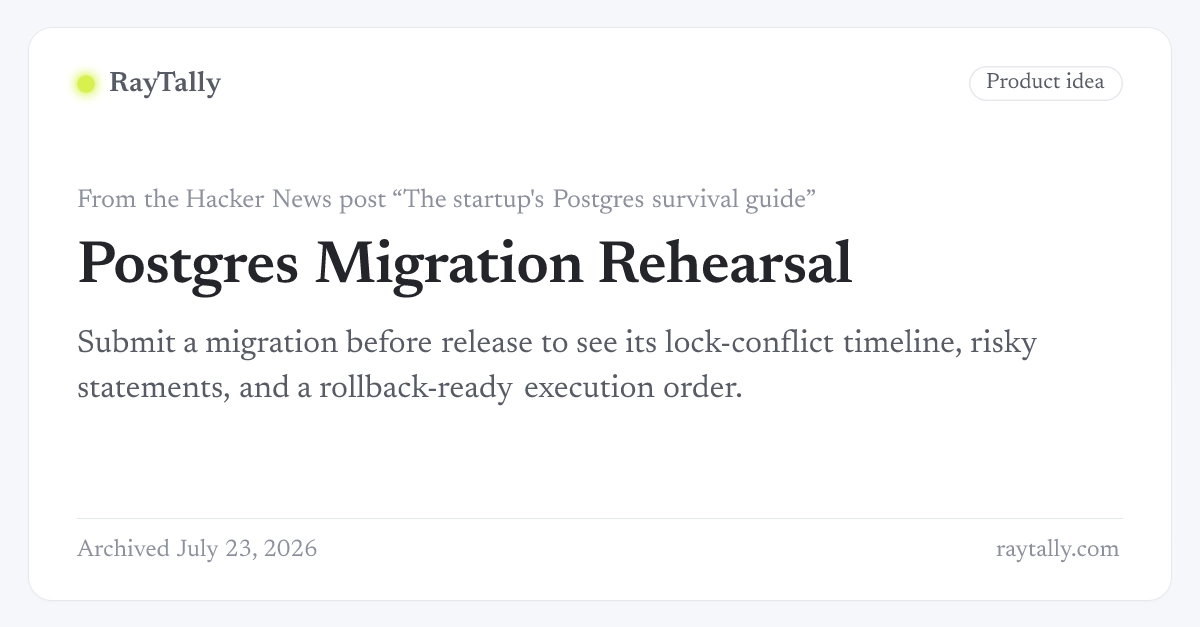
A migration can look tiny in a pull request and still be the riskiest line of a release. A column change, an index, or a constraint can turn into waiting writes, a blocked deploy, and an on-call decision made with very little evidence. Teams without a dedicated DBA often have lint rules and review checklists, but they still lack an answer to a practical question: what will this exact sequence do while the application is busy?
A Hacker News discussion around a startup Postgres survival guide put that question in front of a technical audience on July 22. In RayTally's July 23 signal snapshot, the discussion ranked sixth on the front page, with 301 points and 164 comments at that observed time. That is a bounded observation of attention, not proof that a product category has demand. The more durable signal is the implementation gap: static guidance can flag dangerous patterns, but it cannot show a team a plausible blocking chain or a safe point to stop.
Product direction: rehearse the change, not production
The useful product is deliberately narrow. A backend lead uploads a migration, the current schema, and anonymized table-level facts such as row counts, indexes, and access volume. The service creates an isolated Postgres environment, generates placeholder data, runs the migration under controlled concurrent reads and writes, and captures pg_locks and pg_stat_activity.