The success of the FCNR (B) scheme depends on the possibility of leverage
| Photo Credit:
adventtr
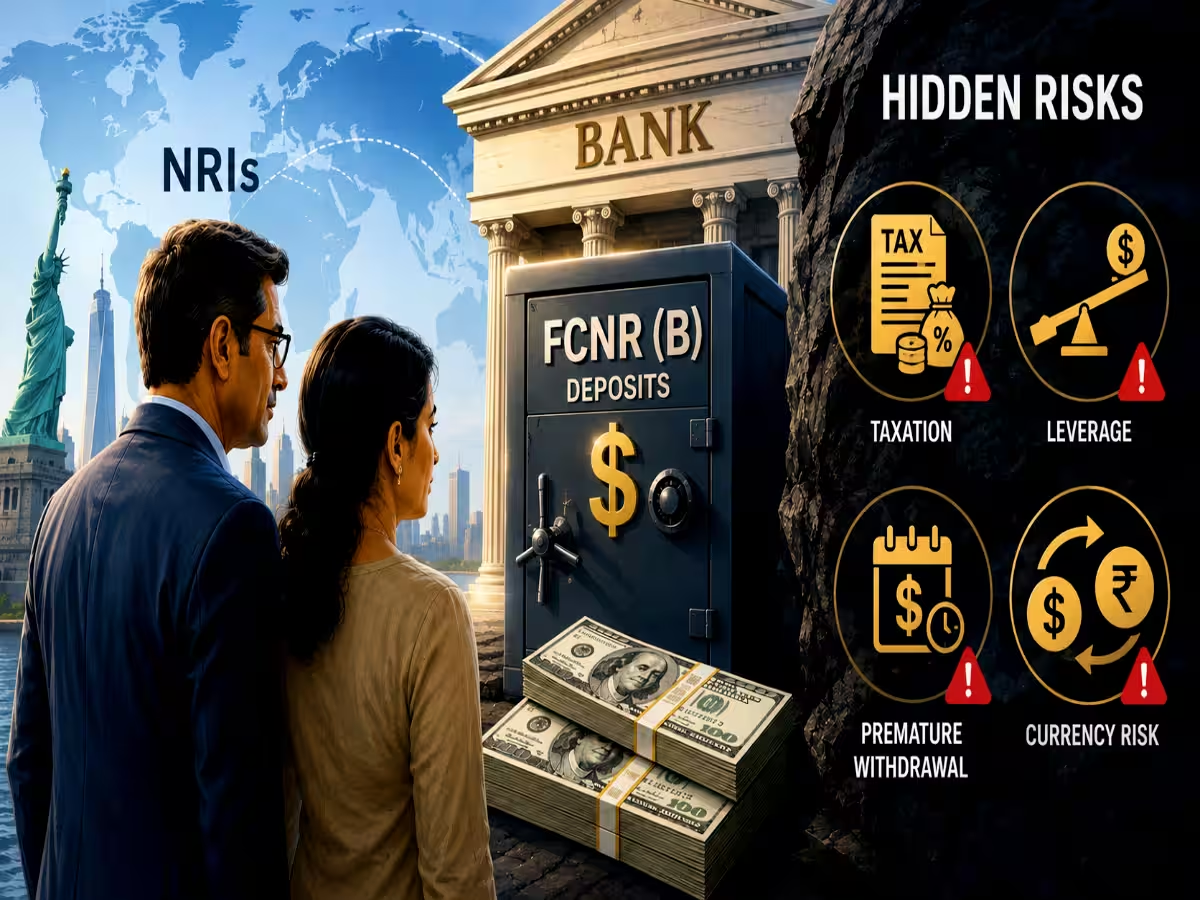
The long ranging ramifications of the new arsenal in RBI’s toolkit, the FCNR(B) deposits could be serious. The scheme by itself is straightforward: garner NRI dollar deposits, strengthen reserves, thereby prevent rupee depreciation. Estimates put the amount of capital inflow expected to exceed $50 billion (Reuters, June 5, 2026), though initial response has been less than $18 billion. However, several facets of the scheme have important repercussions for future rupee strength.In trying to attract capital inflows, are we mortgaging the future? Former RBI Deputy Governor SS Tarapore once remarked that “providing exchange rate guarantees” is a sin for central banks (Business Standard, October 25 1997). In our bid to support the rupee, have we implicitly promised an exchange rate trajectory?Who gains?First, to make the scheme lucrative for the NRI, ceilings on interest rates have been removed (RBI, June 17, 2026) — some banks are offering an interest rate as high as 7.5 per cent on FCNR(B) deposits, significantly above the domestic deposit rates.Second, the leverage permitted by RBI (RBI FAQ, June 23, 2026) allows customers to take loans against these deposits, with leverage being offered anywhere between nine and 19 times presently to attract deposits (Bloomberg and banks’ inputs). Conservatively, an NRI with a $1 million deposit can borrow $9 million against it, investing $10 million, earning 7.5 per cent on the total investment (see Table).Third, for banks, the deposits (though not the interest payments) are hedged against future depreciation, with the central bank bearing the hedging cost (RBI, June 8, 2026).Finally, as banks in India are struggling to mobilise deposits, this is a much-needed source of funding: every dollar swapped with the RBI provides approximately ₹95 of rupee liquidity that can be deployed for domestic lending (see Table).The concernsFirst, for both NRIs and banks, the success of the scheme depends on the possibility of leverage. To obtain the funds for leverage, the domestic banks are borrowing from overseas markets. With a large number of Indian banks accessing the global markets to avail of dollar funding, the lending cost is being pushed up. An increase in borrowing costs in global markets puts pressure on the margins for Indian banks. Moreover, banks must deploy the funds successfully as these deposits are priced higher than domestic deposits.Second, of greater concern is the central bank’s balance sheet. The FCNR(B) inflow today will be converted into an outflow of dollars five years down the line. Even with an optimistic estimate that the RBI will have enough reserves in future, it is nevertheless a promise to provide dollars in the future. Implicitly, the central bank is committing to meeting future dollar demand, effectively increasing dollar dependence.Third, RBI will have a growing short dollar book, already inflated with interventions till date (Chart 1). The FCNR inflows will take care of the present concerns, pushing short position to future. If we calculate the RBI’s net short forward commitments as a percentage of reserves, it has increased substantially, amounting to close to 20 per cent of Foreign Currency Assets (FCA). In other words, around 80 per cent of the reported FCA remains unencumbered for future intervention.As the RBI’s short dollar position expands, its contingent foreign currency liabilities swell: as BIS (2019) argues reserve adequacy needs to be assessed after accounting for the overall foreign currency position. Experience from South Africa, for example, suggests how large forward dollar commitments effectively weaken reserve buffer (BIS, 2019, p.6, 252-253).We compare the Import Cover (Foreign currency Assets/ Average Monthly Merchandise Imports) with an Effective Import Cover [(Foreign Currency Assets−Net Short Forward Position)/ Average Monthly Merchandise Imports in months] in Chart 2. In recent months, effective import cover has fallen as we have intervened in spot and forward markets. With the FCNR deposit inflows, the short dollar book of RBI will further increase, impacting the effective reserve adequacy.SS Tarapore, the former RBI Deputy Governor, a vociferous supporter of central bank autonomy and the architect of India’s baby steps into capital account convertibility, elucidated the three sins of central banking: paying interest on CRR balances, providing exchange guarantees, and low-cost automatic monetisation of the fiscal deficit.In the FCNR-like schemes however, the central bank bears cost of regulatory requirements and implicitly promises future dollars. Are we then securing the present, with a mortgage on the future, and prioritising the exchange rate trajectory over monetary policy concerns?Trivedi is Associate Professor, National Institute of Bank Management, and Das is ICICI Bank Chair Professor, IIM Ahmedabad. Views are personalPublished on July 24, 2026