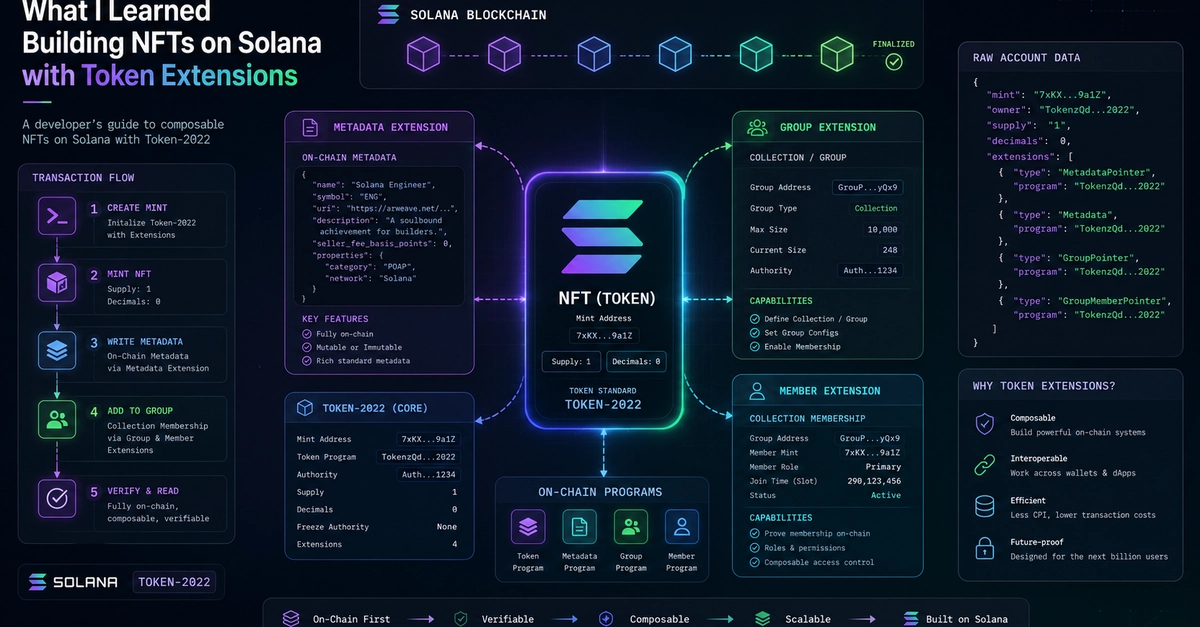
A week ago my Solana tokens were just random strings of characters. No name, no rules, no personality. By the end of this week I had built tokens that charge their own fees, tokens that refuse to move at all, and one token that does both a job and a favor at the same time. Here is what building on Token Extensions taught me that no Web2 platform ever could.
Where I Started
Coming from a Web2 background, my mental model of a "token" was basically a row in a database with a balance column. If you wanted that token to have a name, you joined it against another table. If you wanted a transaction fee, you wrote middleware that intercepted the transfer request before it hit the database. If you wanted something that could never be resold, you wrote an if statement in your application code and hoped every client respected it.
Solana's Token Extensions Program throws that whole model out. A mint can carry its own name and symbol directly on the account. It can enforce a fee on every transfer without a single line of custom backend code. It can refuse to move at all, and that refusal happens inside the program itself, not inside code I wrote. Every rule I used to build by hand turned out to already be a flag.