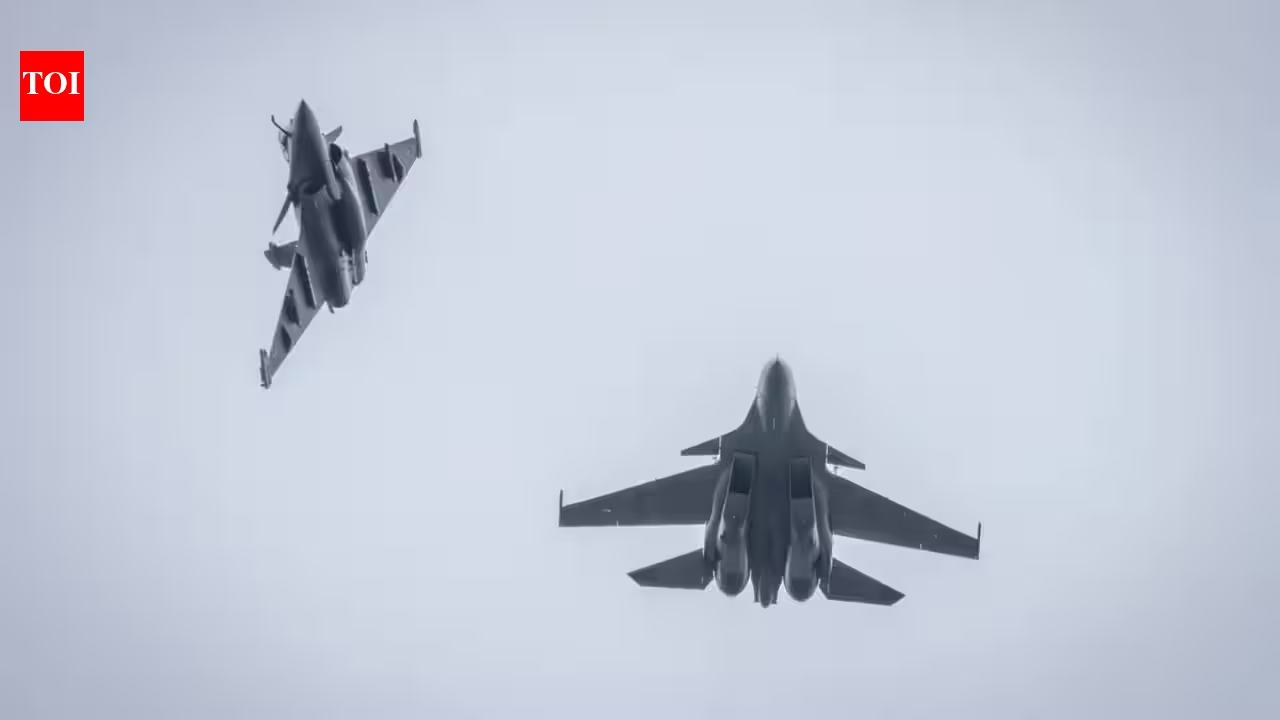
A total of 56 offset contracts worth $13.215 billion have been signed since the inception of the offset policy up to date. These obligations have to be met till 2033, says MoD (file photo)
| Photo Credit:
Parliament’s Public Accounts Committee (PAC), in a report tabled in both the Houses, has sharply criticised the Ministry of Defence (MoD) over persistent defaults, and procedural lapses in implementing the Defence Offsets Policy which mandates that foreign Original Equipment Manufacturers (FOEMs) after winning capital procurement contracts exceeding ₹2,000 crore must invest 30 per cent of the deal value back into India’s domestic defence, aerospace, or internal security sectors. This was meant to give a fillip to the indigenous military industrial ecosystem.In its 50th report titled “Management of Defence Offsets,” which is based on the Comptroller and Auditor General (CAG) audit findings on the same subject, the parliamentary watchdog stated that a “strategic transition” is required in the two-decade-old policy, rather than “persisting with piecemeal modifications” that have occurred from 2006 to 2020 (further revisions are ongoing).The MoD informed the PAC, headed by Congress MP KC Venugopal, during evidence that a total of 56 offset contracts worth $13.215 billion have been signed since the inception of the offset policy to date. These obligations have to be met till 2033.Furthermore, under 26 ongoing offset contracts representing total offset commitments of $9.91 billion, foreign vendors have submitted discharge claims worth $5.46 billion — approximately 55 per cent of total ongoing obligations. This leaves close to 45 per cent of offset obligations unfulfilled, primarily because several offset projects planned at the time of contract signing failed to materialise in later years. The Committee noted that such failures highlight deep-seated inadequacies in the MoD’s contract management and planning.The PAC also pulled up the Ministry for diluting the core objective of the Transfer of Technology (ToT). Under the Defence Offsets Policy 2020, foreign vendors were given wide flexibility to discharge obligations through five distinct avenues—including direct purchases/exports, FDI/joint ventures, ToT to Indian enterprises, ToT to government institutions, and technology acquisition by DRDO, it stated.The panel also observed that the present cap of ₹2,000 cr or more is considered for defence offsets, which leaves a lot of military purchases outside the purview of the policy aimed at bringing in high-tech ToT to the domestic players. “The committee are of the considered opinion that the Ministry may explore the feasibility of making defence offsets universal for every defence capital acquisition without any threshold, although with a lower per cent of offset obligation than the current 30 per cent.”“A comprehensive and holistic orientation of the Defence Offset Policy must be undertaken to ensure its alignment with the needs of the technological landscape and requirements of the domestic defence industry,” the report stated, adding that focus should be on attracting ToT and not on production and services.“Furthermore, policies starting from the Defence Procurement Procedure (DPP) 2011 introduced incentive multipliers (of up to 4x) to promote MSMEs and DRDO technology transfers. The Committee observed that despite these multipliers being active for over a decade, the policy has failed to yield significant outcomes in core technology transfer.”Agreeing with the MoD’s recent submission, the PAC recommended dispensing with all existing multipliers except retaining a multiplier of two (2x) specifically for investments in Maintenance, Repair, and Overhaul (MRO) facilities within notified defence industrial corridors and key critical technology areas.Published on July 23, 2026