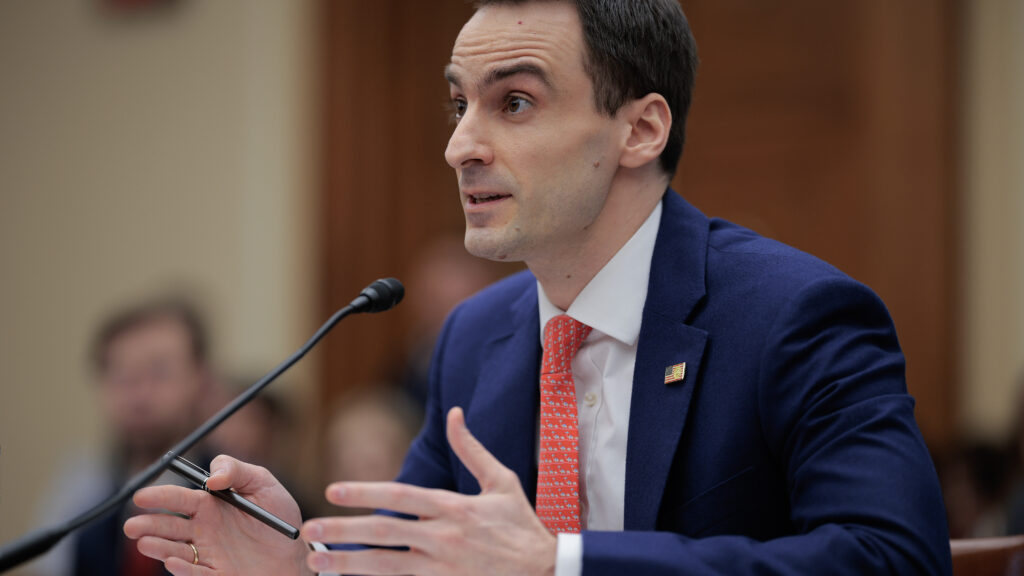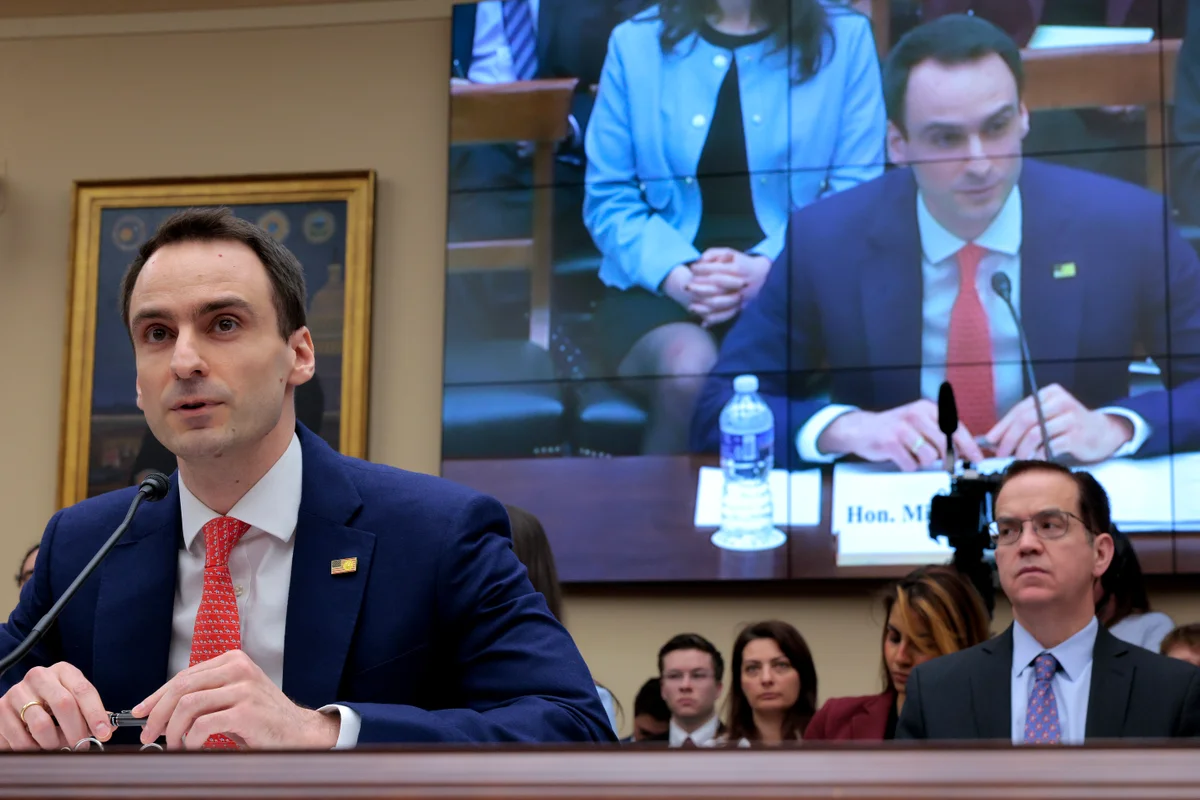
A new White House report, "Science: The New Golden Age," criticizes U.S. science and recommends reducing funding for research universities so that it can he reallocate directly to individual scientists and new mission-driven organizations.gettyAfter criticizing the current state of science in the United States, a new White House report, released this week, calls for reduced funding for the nation’s research universities and argues that the government should re-allocate much of that money to the “individual scientist” instead of “legacy institutions.”Written by Michael Kratsios, the director of the White House Office of Science and Technology Policy, the 90-page report, entitled Science: The New Golden Age, contains several recommendations for revamping what it calls “an increasingly calcified system." The report contains many good suggestions for how to reward innovation, speed up the application of research findings and open up the nation’s scientific enterprise to broader participation. However, questions remain as to how the report will be used. Will it be weaponized against elements of science that this administration disfavors, or will it serve as a blueprint for additional well-informed scientific advances? In what will surely be a contested claim by many scientists, Kratsios, who has a BA in political science from Princeton, argues that “though our investments in research have grown, scientific productivity has slowed. We have become dependent on a narrow set of legacy institutions. Our incentive structures reward conformity over bold inquiry.” Kratsios, who once served as an intern for Senator Lindsey Graham and then later chief of staff to venture capitalist Peter Thiel, outlines his vision for how to usher in the promised Golden Age. Among numerous proposals, he argues that:The U.S. research system should prioritize individual scientists over legacy institutions. Because “too much of our research enterprise has come to serve itself rather than the scientists within it," Kratsios writes that "federal funding agencies should support a broader range of performers, including a new generation of mission-driven research organizations, to expand our scientific horizons. And these agencies should organize themselves around the interdisciplinary frontiers of science today, rather than the academic silos of the last century.”Leaving aside questions about what it actually means to fund individual scientists as opposed to the institutions where they work, the suggestion that major universities are not increasingly organizing their research enterprise into interdisciplinary teams, centers and institutes shows either a fundamental misunderstanding or a deliberate distortion of how our leading universities operate. As several critics have suggested, this recommendation appears to be aimed at a long-standing Trump administration objective, which is to curtail the rate of indirect cost reimbursement the federal government pays to universities. Several courts have ruled against prior efforts to do so, but there is more than one way to skin this cat. If judges block the government from imposing an arbitrary cap on indirect costs, don’t send grant money to the institutions to begin with. Mission accomplished.Second, Kratsios writes that “the Federal Government should fundamentally change how research dollars are allocated, distributed, and assessed. Instead of a one-size-fits-all approach, the government should fund more flexible types of grants, including fast-track grants, long-horizon grants, and new mechanisms that allow reviewers to champion radically unconventional proposals.”Anyone with much knowledge of either the National Science Foundation or the National Institutes of Health, the two leading federal sources of scientific grant funding, knows how many different funding mechanisms these two agencies have introduced in recent years. If you don’t have that understanding, visit their website to see the multiplicity of grants they offer. In fact, the report itself, mentions several of the innovative grant competitions offered by federal agencies. Kratsios wants to diminish the use of standard peer review as a means of selecting grant recipients, claiming, without evidence, that while it “has a long and time-honored history of distinguishing good science from bad, it struggles to distinguish the exceptional from the merely good." Instead, he wants to improve peer review by possibly emulating Denmark’s “golden ticket” system, where individual reviewers "champion unconventional proposals lacking consensus support." That approach could help rescue high-risk breakthroughs that traditional peer review might reject, but it’s also easy to see how it could lead to the greater political influence over grant awards that the Trump administration has been seeking. In what is a particularly puzzling recommendation, Kratsios calls for a de-emphasis of the “life sciences" while placing more investments in areas like the physical sciences, robotics, nuclear energy, semiconductors, space research, and quantum sciences. Finally, Kratsios wants to plough much more funding into AI, correctly recognizing that “AI will accelerate and radically transform the way we do science.” He wants to “reengineer” American science for the AI age. The newly funded projects in the Genesis Mission illustrate this AI for science priority. AI may very we’ll be a good bet for the future, but its success depends largely on the basis science that underpins it.While the report has garnered praise from some scientists and entrepreneurs, particularly those who could stand to gain from its multiple calls for the government to help spur commercialization of new technologies, many scientists and policy makers have expressed alarm over the potential for it to add to the weakening of science and universities seen during the second Trump administration, including the defunding of research the administration dislikes and the dismissal of scores of scientists from federal agencies. In her opening statement at yesterday’s House Committee on Science, Space, and Technology hearing examining the report and the administration’s research priorities, Representative Zoe Lofgren (D- California), criticized the Kratsios report, saying “That title is stunningly ironic, as this administration is systematically destroying U.S. science, while our allies and adversaries alike look on astonished.”Science quoted this criticism by Keivan Stassun, an astrophysicist at Vanderbilt University: "The administration’s vision is all motherhood and apple pie—who could be against ‘discovery science?’ But under the hood it’s really a vision for faster technology development and commercialization while underinvesting in the fundamental research, expert peer review, and scientific workforce that make those advances possible. You don’t get more apple pie by cutting down the apple trees.”In the New York Times, Jeremy M. Berg, Director of the Institute of Personalized Medicine at the University of Pittsburgh and former National Institute of General Medical Sciences during the Bush and Obama administrations, said the report was “tremendously misinformed," adding “I think they’re trying to turn it into a venture capital model. Why the federal government should be investing in that, I don’t know.”Kratsios cast his Golden Age report as a necessary update to Vannevar Bush’s 1945 Endless Frontier report, in which universities were recommended for a key role in leading U.S. science. And while the report does suggest universities should continue as important players in the preparation of scientists and the pursuit of scientific knowledge, it risks being used by the administration to buttress its continuing attempts to marginalize the influence of the nation’s leading research universities. If so, the report’s smart ideas could be outweighed by its several potential negative effects.
White House Science Report Calls For Reducing University Research Funding
A White House report calls for reduced funding for universities and argues that the government should re-allocate much of the money to the “individual scientist” instead.
1,161 words~5 min read