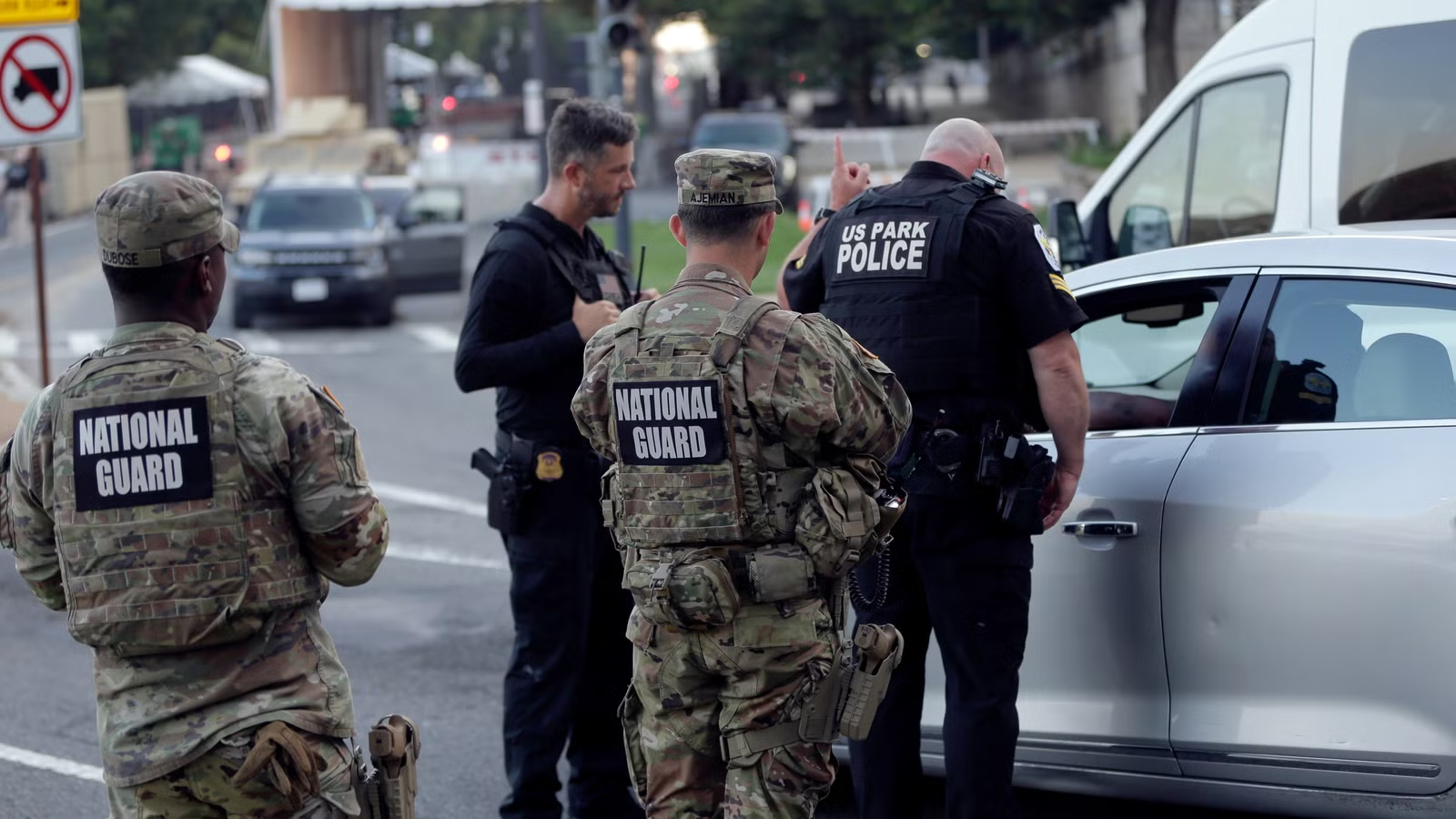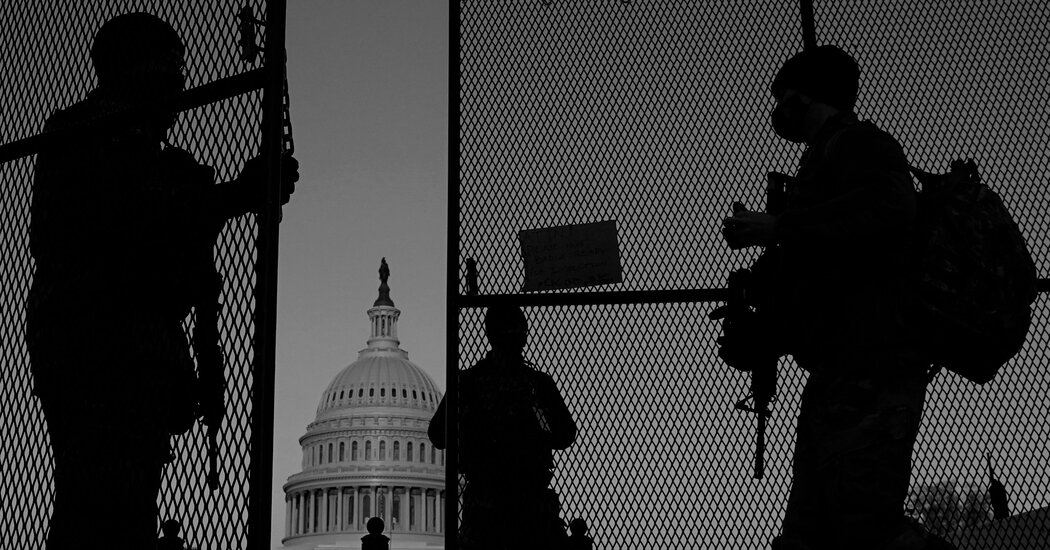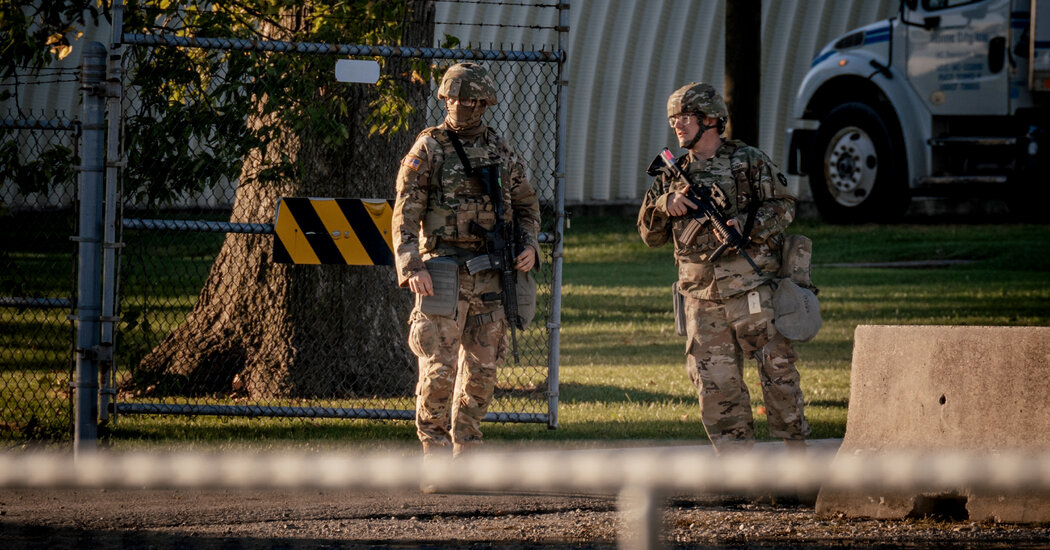
On today's podcast, Executive Editor Natalie Orpett sits down with Liza Goitein and Joseph Nunn of the Liberty and Security Program at the Brennan Center, and Lawfare Senior Editor Loren Voss. They talk about the state laws governing the National Guard—what they allow, what they prohibit, and what it means for domestic deployments in the United States. What is the National Guard allowed to do, especially when operating in a hybrid status where the mission is defined by the president but the governor retains command and control? State laws are complex, varied, and sometimes facially unconstitutional. Click the button below to view a transcript of this podcast. Please note that the transcript was auto-generated and may contain errors.Transcript
[Intro]Elizabeth Goitein: Soldiers are, are trained to fight and destroy an enemy. They are not trained to deescalate conflict in a way that respects constitutional rights. So using them for law enforcement is dangerous. It's dangerous to public safety, it's, it's dangerous to the soldiers themselves.Natalie Orpett: It's the Lawfare Podcast. I'm Natalie Orpett, executive editor of Lawfare, with Liza Goitein and Joseph Nunn, both at the Liberty and National Security Program at the Brennan Center, and my colleague, Loren Voss, a senior editor at Lawfare.Joseph Nunn: If you're a person who cares about national security, you should be concerned about domestic military operations pulling personnel, resources, time, and attention away from all of the military's other responsibilities.Natalie Orpett: Today we're talking about the state laws governing the National Guard, what they allow, what they prohibit, and what it means for domestic deployments in the United States.[Main Podcast]So let's begin by setting the scene a little bit. We're here to talk about the National Guard and that's in part because there have been a number of high-profile deployments happening domestically. There's Los Angeles, Chicago, here in D.C. But as we've been tracking at Lawfare, there are actually quite a few more, and for folks who are interested, you can look on our website for current deployments of the National Guard. All over the country they're under different legal authorities, and they are deployed for several different purported purposes.So I wanna start at the very highest level before we dig in. And Loren, I'm gonna come to you first. Just remind everyone, you know, what is the National Guard, how are they different from the regular forces, and what is this business about state active duty versus Title 32 versus Title 10 status?Loren Voss: When we think of the National Guard, they are originally the National Guard of their states, right? And that means when they are in state active duty status, they respond to their governors. Their command and control goes to their governor. What missions they do fall under state law, whether that be the Constitution or, or statute.They can also be federalized under Title 10, and that is what your active duty military does. And so your active duty military operates under Title 10, but your National Guard can as well, and then their command and control goes through the president. And that's what you saw in Los Angeles that's what you saw try to happen in Portland and in Chicago.Now, what makes this tricky is there is this, what we call hybrid status, called Title 32, and in that status they retain the governor as, as the command structure, but they are doing a federal mission. They're also getting federal funding for this mission. And so in that status, we call it a hybrid- Status because they technically still respond to their governor, but they're doing a federal mission. That is what you're seeing happen in, in Washington, D.C., that's what you're seeing in Tennessee, and that's what you're seeing in Louisiana right now.Natalie Orpett: Okay, so that's a really helpful framework, and today we are going to be focusing on two of those three statuses the state active duty, which is the regular militia as you were describing, Loren, and Title 32, this hybrid status that presents, as we will talk about, a lot of legal challenges.And this brings me to you, Joseph and Liza, and the work that you all did with colleagues at the Brennan Center, a really Herculean effort to compile state laws regarding the National Guard. So as Loren was describing, the sort of default status of the National Guard is under state control. Makes sense entirely that it would be controlled by state law. But I wanna talk a little bit about why that is and why it matters. Before that, although I suspect it will be very much related, can you just tell us why did you undertake this effort to compile state laws?Elizabeth Goitein: Sure. We actually had the idea for this project several years ago. The Brennan Center's been working on emergency powers since 2016, 2017. And we really see domestic deployment authorities as a type of emergency power because in ordinary circumstances, the military isn't deployed domestically. The military gets deployed domestically when there is some kind of crisis, whether it's a natural disaster or whether there is civil unrest at a level that overwhelms the capacity of civilian law enforcement.So we really do see this as a form of emergency power, and we initially started out looking at the laws that govern how the president can use the federal armed forces. We were looking at the Insurrection Act, the Posse Comitatus Act, Chapter 15 of Title 10. I don't wanna get too jargony, but just basically all the federal laws that, that govern how the president can use the armed forces.But the reality is that most of the time the military is deployed domestically, it's being deployed, it's, we're talking about the National Guard being deployed by governors. That is by far the bulk of domestic deployments of the military. And when that happens, it's happening under state law and, and state constitutions.So we wanted to turn to that. We just ended up, there were so many things to focus on, even just within the president's use of the military, that that sort of went on the back burner for a while. And then last year when we started seeing these deployments of the National Guard under state command and control in D.C., in Memphis, in New Orleans, in completely unprecedented ways under Section 502F we realized that this really needed to come to the front burner so we doubled down and produced this resource.Natalie Orpett: It was very prescient. So I think the 502F is a statute we've talked about quite a bit in other Lawfare podcasts, but let's just remind people of that statute. Joseph, can I turn to you? Explain what that is why it's relevant here, and what it has to do with Title 32, hybrid status.Joseph Nunn: So as, as Loren was setting up a, a few moments ago, Title 32 status is this r- middle ground where the National Guard is under state command and control still, but they're receiving federal funding, federal benefits, all of that stuff.Section 502F is the authorizing statute for Title 32 status. It's, in its sort of basic form, it's been around for a very long time, since if memory serves, the 1960s, I think 1964. 502 was conceived as allowing Congress to foot the bill for all of the training requirements that it imposed on the state's National Guards, which seems a fair and sensible deal. Congress is saying, "You have to train your National Guard in such and such way with such and such frequency, but we're going to pay for it."Over time, as Congress added the subsection F and then expanded subsection F, the ways in which Title 32 status can be used have changed and moved away from just training missions to include sort of operational duties.In 2006, most importantly, Congress added section 502F2A, which is really what most people are talking about when they say 502F, but 502F2A takes a long time to say. This allows a governor to deploy his or her National Guard to support a federal mission at the request of the president or secretary of defense And that's almost the entirety of what the statute says. There is very little in the text itself to indicate what Congress intended to authorize or didn't intend to authorize.We do know from the statute's legislative history, however, that Congress was not intending, I think, to authorize literally anything that the president could lawfully ask the National Guard to do. Instead, the focus was on the Guard's traditional, sort of traditional function in responding to things like natural disasters and facilitating federal funding for those sorts of missions, and also to facilitate federal funding for other specific National Guard functions that are already authorized elsewhere in Title 32, things like support for counter-drug operations that are also authorized by 32 U.S. Code Section 112.Elizabeth Goitein: I mean, one of the reasons why this resource is necessary is because the Trump administration has not taken this narrow view of Section 502F that we think is, is more consistent with congressional intent, but has instead interpreted it as an open-ended authority to use the National Guard through a willing governor to further pretty much any policy or, or action or mission that the president would like, including suppressing protests or in this case, responding to street crime, which is what is the supposed rationale in D.C. and in Memphis and New Orleans, something that, that is never properly a military function.And that, this started with the first Trump administration. So Trump invited governors of 11 states, or at least 11 states agreed to send their National Guard forces to D.C. to police the protests against the killing of George Floyd. And, and that was unprecedented to use 502F to suppress civil unrest.And then in this administration, obviously, the, President Trump has really doubled down on using 502F in partnership with willing governors to involve the military in policing street crime, or at least that's the ostensible purpose. I live in D.C. The National Guard in D.C., they're everywhere. In every neighborhood, there's almost 5,000 National Guard forces in D.C. right now. They're pretty much just standing there.Natalie Orpett: Well, they did buy lemonade from my kid's lemonade stand this weekend.Elizabeth Goitein: Oh, how nice. That only, that only cost the taxpayer about a million dollars that day. So, but your kid got a buck out of it, so that's good. But, but and I, and I don't mean to say that because they're doing nothing, it's somehow not problematic to have them here. I mean, and, and they're not doing nothing. That, that's, that's overstating it. They, they are doing some things that are, that are concerning.But if nothing else, it is a show of military force on the streets of D.C., and there is a reason for that. There is a reason why the president wants people in the city to see the military everywhere they go. This is an attempt, among other things, to normalize the use of the military as a kind of domestic police force, even though there's really nothing for them to do here in D.C.Natalie Orpett: One of the things that is really significant about 502F and makes it a useful tool for any executive that should wish to use powers expansively for domestic use of the military is that because the National Guard are still in a state command and control situation, the Posse Comitatus Act, which is of course the legislation that we are all familiar with at this point that restricts the use of military force for law enforcement purposes, by its own terms does not apply. That statute applies to federal officials not to state officials. And while entitled to 32 status, National Guard are not federalized. That only happens under Title 10.Loren, I wanna turn to you to, to just talk a little bit more about what it means, perhaps what it is supposed to mean versus what it is looking like, to be under command and control of a state governor and yet pursuing a federal mission. I mean, how does that work? It's, we, we I think in a layman's sense think of command and control as someone who is, you know, there is a chain of command where someone is aware of what's going on, on the ground and is issuing orders accordingly, but that seems like what's not happening if there is a federal authority that is running operations.Loren Voss: Yeah, so the first thing I'll say is that it really varies based on the circumstance, but the original concept behind it was basically that you were getting federal funding to do a mission that we thought, you know, the National Guard should be doing, for example, some of the natural disaster relief type stuff. And so the funding was coming in federally, but all of the guidance and oversight on what you were doing where and how, and the control was happening at the state level.For some of the other missions, I think, you know, Joseph mentioned the counter-drug mission, or, you know, there's also a, a homeland defense mission in Title 32, those types of things. You might sometimes see, like, a partnership between active duty and National Guard. You might even have, like, a dual status commander that oversees both. But the idea would be that, like, the structures are separate.But what I will say, you know, people throw out the phrase “command and control,” right? Like, there, there's actually various different pieces of command and control there. And so what we're seeing and what's coming up in, like, the D.C. context is, you know, administrative control, which is like, you know, the paperwork type administrative side of the house.You have tactical Control and then operational control. You know, tactical, so that's like, you know, the people on the ground while you're conducting a mission. Operational is like, "This is how we're doing it. This is how we're structuring it. Here's our priorities." And what you're seeing in D.C. is administrative control is staying with the governors or s- or so they say, so like the paperwork, the movement.But both tactical and operational control for the D.C. deployment is going through the D.C. National Guard and that federal chain. And so you have, you know, basically D.C. National Guard and that joint task force and federal authorities saying, "National Guards, this is how we're going to use you. This is going to be your missions. Here is where you're going to go. Here are the rules that you're going to follow. Here's what you're going to do when, you know, if something goes wrong, here's the steps."And so they're at, you know, a very strong control in a way that you wouldn't think when you hear, oh, “command and control retain, you know, is retained by the governor.” And on the ground, it actually looks very different.Elizabeth Goitein: And that is not necessarily unique to D.C., although D.C. is unique in that the president is always in command and control of the National Guard, even when it hasn't been technically federalized. And so other states, when they send their National Guard forces to D.C., they are coordinating with the D.C. National Guard, and that means that they're basically reporting up through a federal chain of command.But even in other states, to the extent that a deployment of the National Guard in Title 32 status might be part of a joint task force operation that includes federal law enforcement. For example, in, in the best case scenario, under Title 32502F, Guard forces might be acting if not under sort of the tactical command and control of the federal government, sort of operationally the mission is being defined by. And so National Guard forces are to some deg- some degree acting at the direction of the federal government, the president or Secretary of Defense. And that's why it's so concerning that the Posse Comitatus Act does not apply. And instead, Guard forces are, any constraints on their activities would have to come from state law. And as our project, as our compendium shows, in general, to generalize, some states are different, but the, there are fewer limitations on the use of National Guard for, for law enforcement purposes under state law than under federal law.Natalie Orpett: Right. So I want to turn to that now. I think, you know, we've set up the tension that I think exists between, you know, as Loren was describing, in a realistic, on-the-ground sort of way, a lot of the rules of engagement, for lack of a better term, that the National Guard are being presented with while on a federal mission under Title 32 are coming from a federal chain of command, but they're still operating under state law.And that is, as you say, Liza, where this compendium becomes very useful because if there is not a Posse Comitatus Act, for example, or there are not other sorts of restrictions at the federal level or if, as we're seeing now, the federal authorities are interpreting certain statutes extremely broadly to allow more than critics might think is reasonable under the statute, the only other mechanism for sort of serving as a counterweight would be these state laws.So let's talk about what you guys found in this report. You've sort of previewed that there are fewer restrictions than one might think, but talk about, first, what sorts of restrictions were you looking for? What were the sort of categories of state laws that you were thinking about in compiling this report? Joseph, can I come to you on that?Joseph Nunn: Yeah, absolutely. One thing this compendium doesn't do is capture every single state law that mentions the National Guard, because that, that would just be sort of overwhelming and not a super useful resource. So, you know, the, we don't, most states have either a sort of a copy of or modified copy of the Uniform Code of Military Justice in their state laws. We haven't included those. We haven't included laws r related to, like, retirement and benefits.As you teed up, we're, we're focused on laws that relate to how the Guard can be used, and we centered our inquiry on a, a few things. One, how does the state or territorial law address basically when, where, and why the governor can deploy the Guard, or put more simply, deployment criteria? The second thing, and, and then I'll sort of go through them in more detail, is law enforcement powers. What, what law enforcement powers do the Guard have when they're deployed, and what restrictions, if any, are on those? Third, the question of martial law. And lastly, the sort of somewhat separate question, but still important, about state defense forces.We focused on these points because we think they're, they're really the key ones. The first one being probably the most important overall is, does state law articulate you know, a set of specific circumstances when the governor can deploy the National Guard, or does it instead leave that question up to the governor's discretion? In most states we found, perhaps unsurprisingly, that the reality is somewhere in the middle, though there are a few on either ends of that spectrum.Law enforcement powers was probably the most challenging thing to code, partly because in a kind of running theme from this project, the law is often quite ambiguous and vague. All states at least imply some kind of authority to use the National Guard for law enforcement. Relatively few states clearly articulate the boundaries of, of that power, and no state or territory has an equivalent to the Posse Comitatus Act.A subsidiary question when we're talking about law enforcement powers is whether members of the National Guard are considered peace officers under state law. A peace officer being a term for someone who's kind of a general law enforcement authority to, you know, do things like make arrests. And here there was a lot of variety. Some states have pretty strict rules about what kind of National Guardsmen can be peace officers. Say, maybe only qualified m- military police, MPs, can be peace officers. Others, to use two examples, Missouri and Arkansas, make every member of the National Guard a peace officer by default whenever they're on duty, regardless of whether that National Guardsman has any training related to law enforcement. So there's a sort of huge variety there as well.On the question of martial law, martial law has no established definition in American law, but the term generally refers to a power that, in an emergency, allows the military to push aside and supplant civilian authorities and to exercise jurisdiction directly over the civilian population. That kind of power is very difficult to reconcile with the United States Constitution. The Constitution is, you know, premised on the idea of civilian control of the military. It is premised on the idea of there being a set of rights and guarantees that are inviolable.That said the Supreme Court has, in a set of now very old cases, recognized a state power to declare martial law if doing so is authorized by state law. Again I should emphasize that those cases are, are very old. I don't think it's entirely clear that they're still good law, especially looking with a sort of modern eye at the Constitution and how we understand it now. And there was a period of time in American history between roughly the start of the Civil War and the end of World War II, where it was not uncommon for state governors to declare martial law in that roughly 80-year period. No state governor has declared martial law since the governor of Maryland did in 1963, but many states still have laws on the books that authorize the governor to declare martial law. So that was another thing we wanted to capture.And then this, this final area of focus was state defense forces. State defense forces are a, a kind of auxiliary militia that Congress allows the states to maintain under 32 U.S. Code Section 109(c). They cannot be federalized, and they also cannot receive any federal funding. As a consequence of that second fact, they tend to be very small for those states that do maintain them, and they're often entirely volunteer organizations. Volunteer not in the sense of you sign up for it, but in the sense of you don't get paid. And for a number of state defense forces, you actually have to pay for your own uniform.But whether a state authorizes them or maintains one is still significant because they are the only category of military force in our country that there's essentially no federal oversight or influence of. And, you know, the fact that the, the states that do maintain them tend to keep them pretty small and sort of don't typically use them for anything nefarious, is a, a choice that's being made in a kind of relative vacuum of law that I think makes them still significant to pay attention to.Natalie Orpett: Okay, so, I wanna zoom out for just a second because I think we've referenced several times this wall that is supposed to exist, except with a very few exceptions, between military and law enforcement. And I wanna just give voice to why that matters, right? More than as a tradition in American life, you know, roots in the Revolutionary War and British control of the colonies and all of that. Sure. Yes. But we still care about this. It's 250 years later.So let's just articulate a little bit, what are the concerns with having the military involved in law enforcement? What does that mean, and why is it something that is of such concern right now? We have these deployments under 502F, for the most part, where the military, meaning the National Guard, do seem to be doing much more law enforcement type activities, including things like immigration enforcement and crime reduction or crime control, as you said, Liza, in, in D.C. What is the objection really to the military undertaking these sorts of activities? Liza, let me come to you first, but I'd love to hear from all of you on that.Elizabeth Goitein: Yeah, yeah. So the principle that the military should not be involved in law enforcement goes back hundreds of years in Anglo-American law and thought. It is not it, it actually isn't something that we came up with in this country, but it's something that has been a driving principle since the founding.It's the principle that's enshrined in the Posse Comitatus Act, which was passed in 1878, but it's been around for so much longer than that, and you can find it you can find it built into the Constitution to some degree. Although certainly Congress can authorize the use of the pre- it can authorize the president to call up the militia to execute the law in, in certain circumstances. But the general principle that as a, as in normal times, the military should not be used for law enforcement, is really a core value as well as a legal principle in this country.And the reason for that is because, if an army can be turned inward against the people, it can very quickly become an instrument of tyranny and oppression And even if the military isn't being used expressly for that purpose, it can still chill the exercise of constitutional rights by the people. So that, that's the f- the f- the fundamental concern here and, and the fundamental role that this separation of military and civilian law enforcement plays is to protect democracy and individual liberty.Now, there are also practical reasons for it. Soldiers are, are trained to fight and destroy an enemy. They are not trained to deescalate conflict in a way that respects constitutional rights. So using them for law enforcement is dangerous. It's dangerous to public safety. It's, it's dangerous to the soldiers themselves.And one point that I want to sort of flag as far as that's concerned is something about the evolution of the National Guard, because of course, the Posse Comitatus Act applies to federal armed forces, active duty armed forces, also the National Guard when they're federalized. But one of the reasons why you, maybe why you don't see equivalents to the Posse Comitatus Act in state law, you know, these laws in the states and their constitutions certainly are, are very old, and they predate a kind of evolution in the National Guard.Historically, there's been a, a significant distinction in the mission and culture of the National Guard and the active duty armed forces. The active duty armed forces are, you know, professional soldiers who are ready at a moment's notice to deploy overseas and do battle. National Guard forces historically have been seen as citizen soldiers. They, you know, they have regular jobs during the week, and then they train on the weekends. They have always been a reserve force that could be used overseas when necessary, but that was pretty rare. If you look, for example, at the Vietnam War fewer than 1% of the troops that were deployed in that war were drawn from the National Guard.Things have changed significantly since the Vietnam War. After the end of the draft, the Defense Department set about to really integrate the National Guard and the reserve forces into the armed forces as a whole, and particularly starting in the late '90s, intensified that effort so that today, National Guard forces not only train alongside active duty armed forces and have that sort of same training, but they increasingly are deploying overseas and in combat roles.And, you know, if you look at, you know, post 9/11, for example, almost a half of the troops that were deployed in Iraq and Afghanistan were National Guard or, or reserve forces, and that has really changed the nature of the National Guard. I think over a million National Guard members actually have done these combat tours at this point.And so to the extent that part of the concern about using the military for law enforcement is because they come into that role with the mindset and training and experience of battle, that is increasingly true for the National Guard as well. So, so that's, that's another reason why it's important that states maybe rethink the limitations on the roles that the National Guard can play domestically.Natalie Orpett: Loren, any other thoughts on the distinction between law enforcement and military and why, why there has been this prohibition or why it's important?Loren Voss: No, I think Liza did a good job of, of tracing the history back, but just, you know, as Americans, the, the power and size of the military as it exists today and the idea of using that domestically in any situation that's not an extreme circumstance, right? I think is just one that, that gives, you know, Americans pause.And so I just, you know, think that we need to be aware of what it means when you can use the military domestically and, and trace that history and understand why that risk exists, not just from a legal standpoint, but as Liza said, from, from a practical standpoint of how we've used the military and what the military is trained to do and what, you know, they're used to doing, and how different that is to being on the streets of an American city without an enemy, instead thinking about things like American citizens going about their daily life. I think people realize that in some sense, but I don't think people always realize all of the risk that's associated with that.Natalie Orpett: Joseph, how about you? Any thoughts on this?Joseph Nunn: A, a couple quick things to add. One, which is a, I, I think a principle that was running through everything that Liza and Loren said, is that I think we can take it as a first principle that in a free society, the coercive power of the state should be limited. The government's actual physical capacity to use coercive force should be limited in a, in a free society. And there is no greater force multiplier than the military. The ability to bring military forces into the domestic sphere massively increases the government's capability to coerce its citizens, and I think that is, in itself, a problem and is something that should be carefully confined to emergencies.Moving to an issue that I think is of secondary importance, but still worth mentioning, is, you know, as Liza and Loren said, domestic law enforcement is not the military's job. They, in fact, have another job that many people think is rather important, and every military service member who is deployed domestically in response to something, whatever it is, is doing that instead of whatever their ordinary job is. And I think if you're a person who cares about national security, you should be concerned about domestic military operations pulling personnel, resources, time, and attention away from all of the military's other responsibilities.Natalie Orpett: Yeah, I think these are all great points. The, the only one that I'll add as a, a former criminal defense lawyer is there is a significant problem, this is not only a lack of, of training, but just a, a practical aspect as well of having military members who are not trained in the law being involved in things like arrests, right? There are individuals, criminal defendants have due process rights.I saw National Guard detaining someone outside of Dupont Circle Metro not that long ago. That person's case will become very difficult. It, it is just an area of crossover that is difficult if you are, as, as Liza, you said, in a sort of battle mindset. You're not exactly thinking about due process rights of the people that you're engaging with and, and that's on top of the chilling effect that you were describing.Elizabeth Goitein: Going back to Joseph's point also about what the military is not doing when, when they're doing whatever they're doing right now, there, there is, there is the sort of national defense component. Are they engaged in the training that they would otherwise be engaged in, in, in terms of being ready to respond to, to foreign threats or threats from, from foreign enemies of the country, you know, or, or, you know, being deployed overseas where, where they would otherwise be deployed overseas?But, but also, the National Guard is not being used right now to step in in a civil unrest situation that has exceeded the capacity of civilian authorities on a temporary basis, right? You know, for, for a few days or however long as it takes to respond to this civil unrest, to support civilian law enforcement, and then go back home. Instead, we are seeing these extended and seemingly indefinite deployments. President Trump just said that the National Guard is going to stay in D.C. until January of 2029. Interesting month to choose.And, you know, these, these are, these National Guard members have jobs in their communities, in these other states that they are coming from. They are teachers. They're healthcare workers. They are you know, storekeepers. They serve vital roles in their communities, and they're being pulled away from those roles for extended periods of time for so-called crime control purpose, basically to, to present a show of military force on the streets of D.C. And that, that is harming the communities that they are coming from not to mention, of course, their families that they are being asked to leave for these extended periods of time.Loren Voss: Yeah, I just wanted to add something quickly. I mean, we were talking about the situations that they may be put in and, you know, they may not necessarily be thinking about certain rights. But I just, you know, want to put out there that, you know, by and large, you know, these National Guard people, these active duty troops are good people. They want to do the right thing.The issue here is one, is sometimes the law is more complex than is, is clear especially when it funnels down to, to the tactical level, and that they are, you know, not prepared for these situations. You know, if you ask somebody what's the difference between arrest and detention and what are you allowed to do, you are probably not going to get the legally correct answer in many circumstances because as we've said, you know, this is not the, the core function, the war fighting function that we've seen in, in so many cases. And so they're not trained on these types of things, or it's, you know, one hour a year in a classroom, right? And those types of things.So I don't, I just don't wanna overlook the fact that I think, like, these are genuinely good people trying to do the right thing, but we are putting them in very, very difficult situations without the appropriate resources and oversight, and so, you know, we're not setting them up for success.Elizabeth Goitein: Yeah. And I, you know, I talk to the National Guard forces that I see around D.C., I ask them where they're from. I have often asked them, "Is this what you thought you would be doing when you made the choice to serve? Is this what you thought you would be doing?" And almost to a person, the answer has been no. They have answered the question, and they have said no. This was not their idea of what service was going to look like.Natalie Orpett: Let's go back to the report, the compendium that you all put together at the Brennan Center, and what you found—where the laws, in your mind, are the most problematic given this tension that we're seeing right now, and what you think should be done about it. Joseph, let me start with you on that.Joseph Nunn: So we came away, in terms of our analysis of all of these laws, we, we came away with three general themes that are all concerning in their own way. The first is that state and territorial law governing use of the National Guard is simply often vague and underdeveloped. And particularly with respect to the Guard's participation in law enforcement, there's often just not a lot of law there to interpret. But, but even, even beyond the question of law enforcement, if you look at a state like, Wisconsin, for example, or New York is another example, in both cases there just isn't a lot of law, and the law that is there is, is often quite vague.And I think, you know, we're all lawyers, I don't need to tell any of us that, you know, the vagueness in the law is a problem and that, you know, creates room for mischief, room for miscommunication and misunderstanding. So I think, you know, a, a crucial thing that a lot of state legislatures need to do is simply to review their laws and make sure that they clearly articulate when the governor can use the National Guard, what the governor can use it for, and particularly when the Guard can participate in law enforcement.A second theme, and this one kind of surprised me though in retrospect maybe it shouldn't have, is that a few states have laws on the books that clearly violate protections guaranteed by the U.S. Constitution. So I'm gonna give a couple of specific examples here. There's a law in Illinois 20 Illinois Compiled Statutes 1805/84, that purports to allow the National Guard, whenever it is deployed in response to civil unrest, to arrest any person or persons in view without process and to then detain them indefinitely. And I said purport intentionally because whatever Illinois law says, no, you can't do that because of the Fourth, Sixth, and Fourteenth Amendments and also the constitutional right to petition for the writ of habeas corpus. So, you know, that is a law that I think is unconstitutional on its face, but still on the books.Another sort of out there example, in Iowa. Iowa Code Section 29A.46 purports to allow the governor to set up military tribunals to prosecute civilians in areas that the governor has placed under martial law. Now, this authority I think conflicts with both the Sixth and 14th Amendments. Obviously, there is this extant Supreme Court case law about the idea of declaring martial law and suggesting that states can do so.Where the Supreme Court has almost always drawn a hard line of prohibition when it comes to martial law in its few cases, is the idea of prosecuting civilians by military tribunal. In cases like Ex parte Milligan and Duncan v. Kahanamoku, which admittedly both involve federal declarations of martial law, the courts found that that was not permissible. I think they would probably make the same ruling even in a theoretically permissible state declaration of martial law, that even if martial law could be declared, that that is taking things too far. So I think those are, those are two examples of really kind of shockingly out there laws.But I'll mention with the Iowa law that it also violates the Iowa Constitution, and this ties into a, a broader theme. Many of these states that have a statute authorizing the governor to declare martial law also have a provision in their state constitution stating that the military is, shall be, or must be subordinate to the civil power. And that sort of constitutional provision is, in my view, not compatible with an authority to declare martial law. Iowa is one of those states. There are 13 states that have that statutory-constitutional conflict, particularly involving statutes authorizing martial law.Tennessee is one state where the conflict is even more stark, where rather than the const- the state constitution framing it as the military shall be subordinate to the civil power, the Tennessee Constitution actually says that declaring martial law in those terms is prohibited. Yet a Tennessee statute purports to allow the governor to declare martial rule. Martial rule is a term that is synonymous with martial law, so that's another statute that is unconstitutional on its face and yet is on the books. So those, those are the kind of three primary themes that emerge.The generally underdeveloped, sparse law, a few states having laws that in my view, conflict with the U.S. Constitution, and a lot of laws, a lot of states having laws authorizing martial law that conflict with their state constitution.Elizabeth Goitein: I think the thing to me that was most striking about these laws was that there wasn't a single state that had an equivalent to the Posse Comitatus Act. And remember, the Posse Comitatus Act isn't a, a flat prohibition on, on using the military for law enforcement. It's, it's a clear, what we call a clear statement rule, that's, to, to use lawyer jargon, which is basically, if the president uses the military for law enforcement, it has to be pursuant to an express authorization by the legislature.And, and that's not a case by case authorization. It's not like every deployment has to be pre-authorized. It just means is there a statute that sets forth conditions that are met in that circumstance, right? That's what the Posse Comitatus Act is. There is no state that has a law that saying that a governor's deployment of the National Guard has, for law enforcement, has to be pursuant to an express statutory authorization.And that to me is, is really surprising because whatever authorization the state came up with, legislative authorization could be as broad as the state wanted, right? It, it's not, it isn't a draconian limitation to say that the deployment has to be pursuant to express authorization by the legislature. It, it, it's up to the legislature in that situation. But state legislatures have, to some degree, just abdicated that role to the governor, and I, I was surprised by that, that it was so uniform.Joseph Nunn: And, and that ties neatly into the, the reforms we're proposing because, you know, one thing, the first thing that we would encourage state legislatures to do is to enact state-level versions of the Posse Comitatus Act that are, you know, undoubtedly customized to suit their circumstances.And as Liza was acknowledge, the idea here is not to prevent the National Guard from ever being used for law enforcement. I think we all agree, I would imagine almost everyone agrees, that the National Guard does have a legitimate role to play in law enforcement under certain circumstances. The goal here is simply to flip the presumption so that instead of a world where the governor has broad authority, broad discretion to decide when, where, and why to use the National Guard, it is instead a case of the governor can only use the National Guard for law enforcement pursuant to specific statutory authorizations that have been acted by the state legislature.The second sort of reform that we're encouraging states to look into is to emulate or adapt a bill recently enacted in Virginia. So the Virginia bill, which is HB286 it does four main things. First, it requires the adjutant general, the adjutant general being the highest ranking military officer in any state's National Guard, to submit an annual report that details the status and activities of the Virginia National Guard with particular attention paid to federal funding and the use of National Guard resources by federal authorities.The second thing it does is it slightly narrows the governor's deployment authority in one area. This is, th- this amounts to basically striking out, but not limited to following the word “including” at the start of a list of authorized deployments. So it's, it's not an enormous change, but it'll slightly narrow the aperture.Third, the law reinforces Virginia's already strong prohibitions on election interference by emphasizing that the National Guard may not be used to violate those laws. And lastly, it directs the creation of a working group to consider additional reforms.Those are not dramatic changes. And, you know, the Virginia bill, it's not a panacea, and it, it doesn't even represent a huge shift in state law. But it does do something that I think is very important, where it starts the process of the Virginia State Legislature reasserting an interest in and control over the Virginia National Guard. There is an attitude in many state legislatures of, "Oh, the National Guard? That's not our business. That's the Pentagon's business. You know, what, what do we have to do with the National Guard?" But that's simply not true, and that's not in line with how things have always worked in this country.And I think it's important to understand that the various National Guards did not replace the state militias, they are the state militias. And within, you know, the broader history of Anglo-American law, the tradition of legislative control over the military is more than 800 years old. In the same way that oversight of the Federal Armed Forces is a primary duty of Congress, oversight of the National Guard and its activities is a duty of state legislatures.What is so encouraging about this Virginia bill is that it, it starts this process of sort of reasserting that legislative role in overseeing the National Guard, its activities its funding, all, all aspects of its operation, which is something that state legislatures should absolutely be doing.Natalie Orpett: Yeah, and Loren, I wanna come to you on, on what takeaways you have from all of this, or what you found surprising. But I, I will just note that one thing I also wanna add to the oversight and the involvement of the legislature that you were just describing, Joseph, is one thing we have found particularly in Loren’s work mapping current domestic deployments, is a sort of, to me at least, shocking lack of information and transparency about the details of these deployments, including basics like under what legal authority are these deployments happening?Is it Title 32? Is it Title 10? Is it 502F? Is it something else? Also lack of definition of what the mission is. You know, how are you to determine if your state National Guard is operating according to state law as they are required to do under Title 32 if you don't even know what they're doing and you can't figure it out? So I think the, the report that you're describing that's required under Virginia law could do some work to, to rectify that situation.But with apologies for that intervention, Loren, what sorts of things did you find interesting from this compendium?Loren Voss: I think what was most surprising to me was the conflict with constitutional provisions. I had already known from various states, right, that the, the laws were old, they were vague. But the idea that there are still statutes on the book at the state level that are just clear violations of our constitutional rights is to me something that, that just shows you, like, the priority in reform in this space. I know that there are so many different reform and protection efforts going on now, but that to me is just, like, a very, very clear example of, of risk that this Brennan Center, you know, work has found that I don't feel like is adequately being addressed.And I know, you know, Joseph mentioned, you know, what has happened in Virginia, but I'm talking about, you know, some of, some of these other areas where, you know, there's, there's clear risk to, to constitutional rights in such a way, and I, I just, you know, would really encourage people to be tracking that and, you know, even looking up what your state is, what your state laws are in this compendium and seeing what it is, because I don't think anyone realized quite how acute that risk was until this came out.Elizabeth Goitein: And I think, you know, we can't count on, you know, the remedy of going into court and saying, "This violates the Constitution," I mean, you know, you might imagine, well, what's the rush to, to take care of these conflicts because of course the Constitution is going to prevail. And so you can just go into court and the judge will say, "No, this is unconstitutional," so why don't we just let the courts take care of that?The problem with that is, first of all, courts can take a while and, in the meantime, these forces are deployed doing something that is unconstitutional, that violates the rights of the people. But also, it can be difficult to get into court with some of the jurisdictional sort of standing issues and, and other issues that sometimes make it difficult for, for people to vindicate their rights in court. And so it, it really is important for legislatures to clean up their laws and get rid of statutes that plainly violate either the U.S. Constitution or their own constitution.Joseph Nunn: Following on what, what Loren closed with, I would, I would encourage folks listening to, to look up the resource and, and, and check their own state. The, something we haven't mentioned is the resource includes a very cool interactive map that—I did not make the map, which is why it's I can say that it's very, very cool—that allows you to sort of filter the various states by certain parameters and also click and see a summary of your state's laws. And I think in most places that you might live, you will find something interesting, whether it's that your state's laws are, you know, concerningly sparse whether that they grant concerningly broad discretion, or maybe you will find something really shocking, like the sort of Illinois and Iowa statutes that we mentioned.Elizabeth Goitein: Or sometimes, not, not most of the time, you might actually find that there is legal protection in those laws that might mean that what the National Guard is doing in your state is something they shouldn't be doing, and that's pretty much what happened in Tennessee which is that Tennessee is one of the few states that actually has very strict limitations on the use of the National Guard within the state. And the deployment of Guard forces in Memphis, the, the lower court found was in violation of those laws. Now, that, that ruling has been placed on hold pending appeal, but-Joseph Nunn: Yeah, it, it's ironic. Tennessee is ironic because of the martial law issue I mentioned earlier, but the, and it, it kind of highlights some of the, this sort of sometimes tension between statutes and constitutions where the Tennessee Constitution is among the strongest in terms of placing limits on how the National Guard can be used within Tennessee, but there are some statutory issues that the legislature needs to address.Natalie Orpett: Okay, Loren, I'm gonna give you the last word to talk about your and my and our colleague Molly's recent obsession with what all of this means for the upcoming elections. As we've touched on, there are some serious loopholes and concerns about whether all of this can mean that there will be National Guard involved with elections, and I'm wondering now with this complement of thinking through state law which is not something that we had talked about in our pieces, what do you think all of this means?Loren Voss: Yeah, I mean, the, the first thing I would say is when most people talk about restrictions on, on military intervention at, at polling sites, they're talking about restrictions that have to do with the federal military. And so as Joseph said, Virginia just, you know, made a modification for, for what the National Guard could do in their state statutes around elections.But in many states, they can indeed use their National Guard and state active-duty status to do things that are election related. And in fact, during COVID times, we saw a number of states do that because they didn't have enough personnel to, to work the sites. Granted, you know, they were doing a very narrow role, right? They weren't trying to deal with interference, right? Or, or those types of things. But you could see legally National Guard and state active duty doing things that are election related.But then we get into the, the even more complicated bucket, which is the Title 32 bucket, and there is a lot of questions about what kind of legal argument could be made under 502F to, to support willing governors using their National Guard in some way at election sites, with the argument being that while in Title 32, as we discussed earlier, they're not part of the federal military and then that some of these prohibitions don't apply.What I would say, though, is that the main prohibition that people talk about, 18 USC 592, also known as, like, “Troops at Polls,” while it says, you know, no Army or Navy, it also talks about federal civil officers, right? So if it was a Title 32 mission and you had the Secretary of Defense or the President being the one to say, "This is the federal mission that you will do," they would still be in violation under 592, even if the troops that were there were National Guard responsible to their governor.And so all that to say, there is a lot of concern that arguments could be made, that things could happen that would be confusing to people on the ground. And as Liza said earlier, you know, it takes time for these things to be, to be figured out and hashed out in court. And elections are, are short, right? Even the counting that happens after, you don't have, you don't have the months. So I, I just think that the concern there is valid, and it's something that we should all be paying attention to.Elizabeth Goitein: I think, you know, a lot of attention is paid to, to this particular Troops at Polls law, Section 592, because it specifically mentions troops or other, or “other armed men.” I guess armed women are okay. I don't know.But every state has laws, and there is federal law that prohibits voter intimidation by anyone. It's not specific to federal troops. It's not specific to state National Guard forces, but it applies to them. It applies to everyone.And these laws do not depend on the intent of the deployment. It's just about the effect. If voters are intimidated, the law has been violated, and these laws can be enforced, u- unlike Section 592, these laws can be enforced through private action, through private lawsuits.So whatever the laws in our compendium say about how governors can use National Guard, they cannot use National Guard, the National Guard to intimidate voters because that would be a violation of state and federal law, and that law can be enforced.Natalie Orpett: Okay. I think that's a great note to end on. I think it really underscores this broader trend, this broader theme that we've talked about, which is that the National Guard legal parameters and framework is very complicated. It is a patchwork that is extremely hard to track up until the Brennan Center did this work of compiling all of these laws that have heretofore been extremely difficult to sort out. And there is quite a lot of work to be done, quite a lot of concerns that we've identified, and quite a lot that could be done at the state legislature level to rectify that.So, we will put a link to the Brennan Center's work in the show notes. You can find it on their website. It's called “State and Territorial Laws Governing the National Guard.” And I want to thank you, Liza, Joseph, and Loren, for joining me today.Joseph Nunn: Thank you so much for having us.Elizabeth Goitein: Thanks, Natalie.[Outro]Natalie Orpett: The Lawfare Podcast is produced by the Lawfare Institute. If you want to support the show and listen ad-free, you can become a Lawfare material supporter at lawfaremedia.org/support. Supporters also get access to special events and other bonus content we don't share anywhere else. If you enjoy the podcast, please rate and review us wherever you listen. It really does help.And be sure to check out our other shows, including Rational Security, Allies, The Aftermath, and Escalation, our latest Lawfare Presents podcast series about the war in Ukraine. You can also find all of our written work at lawfaremedia.org. The podcast is edited by Jen Patja, with audio engineering by Noam Osband of Goat Rodeo. Our theme song is from Alibi Music. As always, thank you for listening