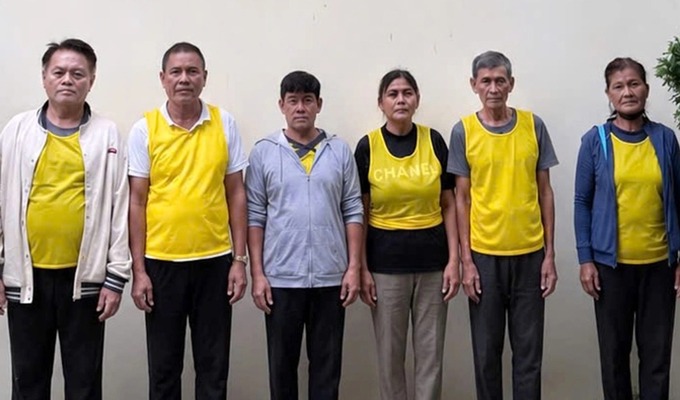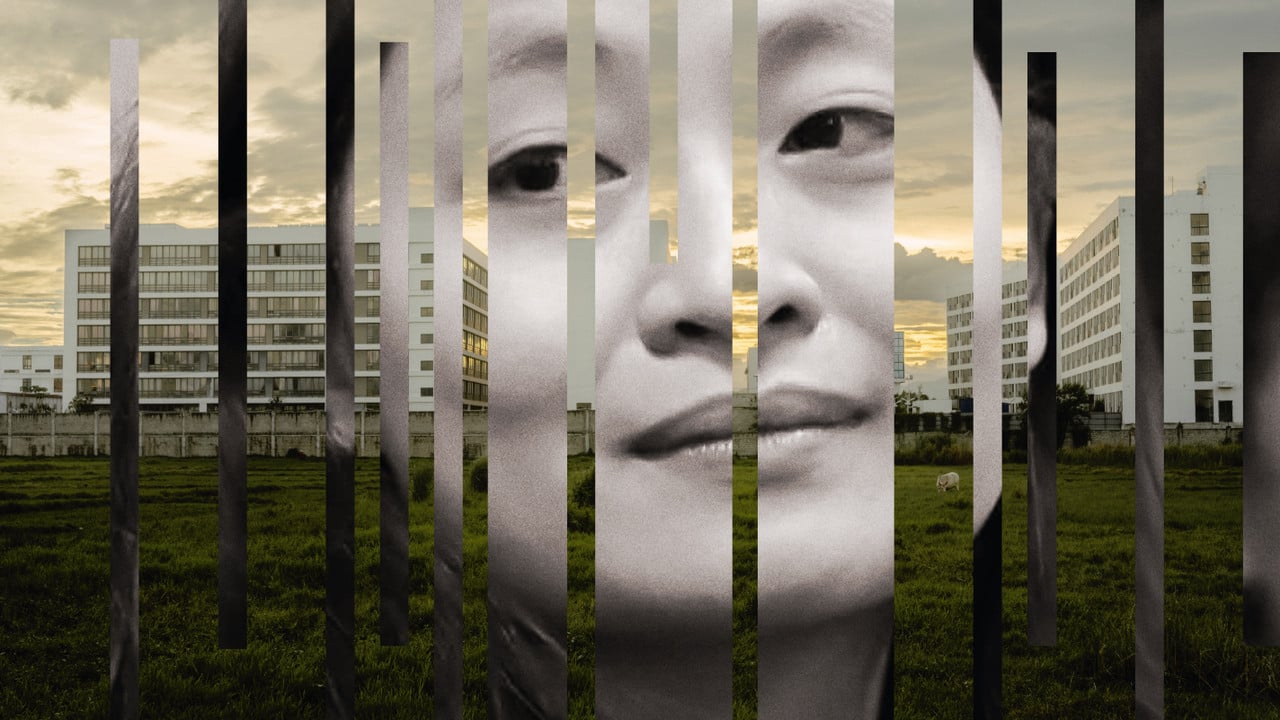
Your browser does not support this video. July 23rd 2026 By Sue-Lin Wong and Lian Buan Just off the main highway leading north from Manila is a town of about 80,000 people called Bamban. Until recently most Filipinos hadn’t heard of it. At first glance Bamban looks like any other provincial town in the Philippines. Low-rise buildings and corrugated-iron shacks selling vapes crowd the edges of the road; occasionally a cart trundles by selling susong pilipit—freshwater snails cooked in coconut milk. In the centre are some gleaming, brightly lit shops—not a common sight in such towns. There’s Jollibee (a local fried-chicken chain), 7-Eleven, kfc and McDonald’s. These all arrived in the past few years, after a dynamic millennial named Alice Guo (pronounced “Gwor”) became the town’s first female mayor. Guo was a local girl who’d done well. As she told it, her parents were both Filipinos who owned a piggery near Bamban. Guo worked for them and helped the business grow, diversifying into fisheries and chicken farms. Fortunato Meija, now 70, a former town councillor in Bamban, had become friends with Guo years earlier when they were both volunteering on a local official’s re-election campaign. He admired her grit and enterprise. Guo was young and pretty, with a smooth, round face, long, shiny hair and glasses. She seemed to prefer discussing business with town elders—whom she addressed as lolo (grandfather) or tito (uncle)—to hanging out with people her own age. “I remember asking her, how are you getting so rich?” Guo just said she had a new business partner In 2021 Guo suddenly seemed to have a lot more money. She had taken on more responsibility in the family business, but that didn’t seem to account for her flashy new car, or the fact that she had started travelling around the region by helicopter. “I remember asking her, how are you getting so rich?" said Fortunato. Guo just said that she had a new business partner. She told her friends the car was borrowed. The same year, Guo announced she was going to run for mayor. This was a bold move. Bamban had been governed by the same small clique for decades; departing incumbents tended to endorse their successors after striking backroom deals. Outsiders didn’t seem to stand a chance. But Guo was undaunted. Her campaign materials played up her youth, leaning heavily into the cute. One video showed the mayoral candidate waking up beneath a Sesame Street duvet while Cash, her fluffy Pomeranian, bounced on top of it. Bubblegum pink was her signature colour: she drove a pink car and sometimes flew to rallies in a pink-striped helicopter. The next year Guo won the election. Her victory heralded a renaissance for Bamban. Town mayors have broad powers in the Philippines, which include the regulation of local businesses and oversight of the municipal police force. A mayor’s degree of energy and competence affects a town's prosperity. Most local politicians aren’t known for their work ethic. Guo, however, carried out her duties from dawn to dusk. The results were soon tangible. “We saw more investment coming in, the price of land and property increased too," said Fortunato. Jollibee set up shop in Bamban in December 2022, and other chains opened soon after. Guo power (Top to bottom) A pink bench installed during Alice Guo’s term as mayor. Investment in Bamban increased after Guo took office, with branches of McDonald’s and KFC opening there. Fortunato Meija, a former town councillor, met Guo through local politics The town centre wasn’t the only part of Bamban being redeveloped. In the fields behind the mayor’s office, a cluster of 36 gleaming buildings had sprung up shortly before Guo was elected. Word went around that it was a call-centre complex. The buildings, some of which were seven storeys high, looked jarringly modern against the low-rises of Bamban. The complex was surrounded by a wall topped with barbed wire. More than 100 locals had been hired to do cleaning and maintenance work there, though strangely no one had been recruited to man the phones. Nobody thought much about that. The people of Bamban loved their mayor. Displays of generosity are common among Filipino politicians, but Guo distributed nicer things with less restraint. During her first Christmas in office she told people to line up outside the call centre, and handed out thousands of pink bags full of ham, fruit juice, spaghetti sauce and bread. Councillors were given bottles of Johnnie Walker. One day in February 2024 a young Vietnamese man named Minh Duc Nguyen leapt out of a second-floor window in one of the call-centre buildings and bolted through a gap in the wall. A security guard saw what happened and aimed his gun at him. But Nguyen kept running, across a riverbed, over the fields and into the first private property he could find. It was a farm, and the owner, a 76-year-old man called Santa Maria, took Nguyen in. Later that day the police showed up at Santa Maria’s gate. They had brought an affidavit for Nguyen to sign, promising not to file a complaint against the company running the call centre. Santa Maria took the document to Nguyen, but the young man refused to put his name to it. Bubblegum pink was Guo’s signature colour: she drove a pink car and sometimes flew to rallies in a pink-striped helicopter Santa Maria (whose first name has not been made public) found the police’s behaviour odd. He rang his pastor, who called someone he knew in the Presidential Anti-Organised Crime Commission (paocc), a small but powerful agency founded in 1998 and led by former police officers. Winston Casio, a senior investigator at the paocc headquarters in Manila, was told to drive to Bamban and find out what was going on. Casio saw the local officers as he approached the farm entrance, and was surprised to spot a police colonel from Manila among them. The police asked Casio to lead them into the farm. “I said ‘no, because obviously the farm-owner does not trust you enough to allow you in. If they trusted you, you’d be inside the farm by now,’” Casio said. Santa Maria let the paocc team in and took Casio to Nguyen, who was pacing around, agitated. Nguyen was desperate to get out of town, but Casio begged him to first give a statement about what had been going on inside the call-centre complex. Nguyen eventually agreed. “He said he wanted to help his friends who were still trapped inside,” Casio recalled. Over the next three hours, Nguyen told Casio a story that would shake the Philippines. It involved criminals so powerful that they could buy off representatives of a democratically elected government, and so well-connected they could disappear across borders. And Bamban’s young mayor was part of the conspiracy. Nguyen’s saga had begun a few weeks earlier when he heard about an opportunity to work as a chef in the Philippines. The job paid 60,000 pesos (just under $1,000) a month, around four times as much as the average wage in Vietnam. When he arrived at Manila airport he was whisked away to Bamban and placed inside a building in the call centre. The building was filthy, caked in nicotine stains made by the chain-smoking Chinese supervisors. Nguyen had not been brought there to cook, he quickly learned. Bamban’s “call centre” was in fact a scam compound: one of hundreds that have sprung up in South-East Asia in recent years. Scambuster The buildings inside the scam compound were surrounded by a high wall (top). Winston Casio, formerly a senior investigator from the Presidential Anti-Organised Crime Commission, led the raid on the compound. Here, he speaks on video call to the Vietnamese worker who escaped through a gap in the wall (middle and bottom) Workers in scam compounds are ordered to form online relationships with victims around the world and trick them into giving away their money. The presence of these crime hubs across South-East Asia dates back to the 2010s, when the Chinese government began cracking down on crooks and money-launderers in Macau, a gambling hotspot. The criminals scattered and set up businesses abroad, mostly in countries with high levels of corruption such as Cambodia and Laos, or where the rule of law has broken down, such as Myanmar. But they also found ways into the region’s democracies. The offshore gambling industry in the Philippines was an inviting entry point. Internet gambling is prohibited in China, and for years the Philippines hosted online-casino operators offering Chinese punters the opportunity to play baccarat and poker. The businesses' legal status was murky, and in 2016 Rodrigo Duterte, then the president, decided to legalise them so long as they registered as a Philippine Offshore Gaming Operator (pogo). Supporters of Duterte’s pogo policy said it would create jobs and tax revenue. In practice, a shady sector of the economy was given a licence to expand just as Chinese gangsters were looking for new projects. pogo-owners surged into multiple areas of business, some legitimate, others not. Scamming, which uses a lot of the same software as gambling, proved very profitable, especially after the world moved online during the pandemic. Duterte’s government did little to stamp out such activities. The Bamban complex was registered as a pogo, and overseen by the sector’s regulatory body, which even had an office in the compound. The most notorious scam practised at compounds like Bamban’s is a long con known by Chinese criminals as “pig-butchering”. Scammers pose as attractive strangers on social media and dating apps, spend months building relationships with people, then persuade them to “invest” in fraudulent schemes, often involving cryptocurrency, until their savings are gone. At that point the scammers disappear—the pig has been butchered. Minh Duc Nguyen leapt out of a second-floor window in one of the call-centre buildings and bolted through a gap in the wall Reeling in victims is a numbers game: scammers can message dozens of social-media users before they find one willing to enter into a conversation, and of the people willing to chat only a few will hand over money. Relationships with the victims (or “customers”, as staff are encouraged to call them) require round-the-clock nurturing. A big scam farm may employ thousands of workers, all putting in long hours. Often the different stages of a scam are run from different centres. The one in Bamban seems to have specialised in identifying and baiting victims before handing them over to a compound in Cambodia to be “processed”. Globally, the scam industry is thought to be worth about $500bn a year. Some scammers are willing participants: compounds do sometimes pay their staff, and the wages tends to be higher than the average in South-East Asia. But to operate at scale, bosses also rely on human-trafficking networks. People from across the region are brought under false pretences to places like Bamban and forced to stay there. When Nguyen asked to leave, or complained about his living conditions, he was beaten. “I was slapped so hard that I was not able to eat for two days,” he said in his affidavit. He was also tortured with electric shocks. Screams echoed through the compound, but never seemed to reach the streets outside. Casio, the investigator from the anti-organised-crime commission, was well aware of the scam problem in the Philippines. A bespectacled man with a calm demeanour and a penchant for philosophical digressions, he was an academic criminologist before he started working for paocc over a decade ago. By the time Ferdinand “Bongbong” Marcos took over from Duterte as president in 2022 it was clear to experts that organised criminals had penetrated the online gambling industry. Marcos vowed to fight them, and Casio became the public face of his crusade. The girl from Fujian Guo testifies in front of a Senate committee (top). She Zhijiang, a Chinese tycoon imprisoned in Bangkok, alleged that Guo was a Chinese spy (middle). Former Philippine president Rodrigo Duterte appears before the Senate (bottom) This made him a target for assassination. Suspicious cars would linger outside his office and he took to sleeping there to prevent anyone from following him home. When I first visited Casio at his work in 2024 I was struck by the profusion of contemporary art on the walls—he had retained an aesthete’s flair, even while hiding from gangsters. He was also funny and self-deprecating. “I only do this because I have the financial independence to be able to protect myself,” he once told me when I suggested he was being brave. “But I’m not saying I’m incorruptible…if you pay me a billion pesos, I’d say yes.” In the summer of 2023 Casio and his colleagues secretly joined Telegram channels on which the managers of scam compounds in the Philippines shared videos. Some of these showed them torturing their staff—and were apparently posted as a boast. The methods used to keep the “employees” in line haunted Casio. “You’ve got someone who is fully naked being electrocuted, his balls were being electrocuted,” he told me. “Another man was fully naked, his penis was being electrocuted, he had chilli sauce placed inside his rectum…Gruesome is an understatement.” Some of this grisly footage had been posted from Bamban, and Casio had been trying to build a case for authorising a raid on the complex there. Nguyen’s testimony helped him get it over the line, and on March 12th 2024 the paperwork was signed off. Casio planned to travel to Bamban early the next morning. Some scammers are willing participants. But to operate at scale, bosses also rely on human-trafficking networks That night he got a phone call from his boss telling him that people in the complex had somehow got wind of the planned raid and were escaping. Casio and his team jumped into a car and tore up the motorway (“like ‘Mad Max'”, he recalled). When they arrived they found dozens of rooms with computers still running, and more than 2,000 phone banks. The supervisors had already left, but they hadn’t been able to destroy all their records. As Casio’s team began rummaging they found multiple documents with Guo’s name on them, including a housekeeping bill and an electricity bill for 15m pesos. It turned out that Guo owned part of the land on which they stood, co-owned the property company that rented the buildings to the scam centre, and had applied for the centre’s pogo licence in 2020. Moreover she had 36 bank accounts, through which more than $76m had moved between 2006 and 2024. She had also sent over a million dollars to addresses in China. There was clearly more to the local farm-girl’s story. The Philippines is a young, flawed democracy. Colonised by Spain and America, then subjected to a brutal Japanese occupation during the second world war, it became independent in 1946. During the cold war America saw the new state as a bulwark against the spread of communism in the region, and backed its dictator, Ferdinand Marcos, the current president’s father. During 20 years of kleptocracy Marcos became fabulously rich while his security forces carried out extrajudicial killings and torture. He was overthrown by a largely peaceful “people power” revolution in 1986. The country is far better governed now, but corruption remains a big problem and power is still mostly held by a few families. The Philippines has a long history of trading with its neighbour across the South China Sea; the world’s first Chinatown was established in Manila in the 16th century. But in recent years China has harried ships in Philippine waters in support of its expansionist claims, creating tension between the two countries. Duterte had close ties to Chinese businessmen, and declared himself pro-China, but when Marcos junior was elected the political pendulum swung the other way. Senators took advantage of the new climate to investigate pogos and organised crime. When news broke that the mayor of Bamban was implicated in a scam compound, she was summoned to testify at their hearings. The Philippines has a long history of trading with its neighbour across the South China Sea Risa Hontiveros, one of the senators, identified several discrepancies in Guo's family’s birth and marriage records. When Hontiveros tried to grill her on them Guo shrugged or retreated into vagueness. Her refrain was, “I don’t know, your honour.” “Her sheer evasiveness, opaqueness just hooked my curiosity,” said Hontiveros. “She couldn’t tell us simple details and memories about her parents, her childhood.” Clips of Guo squirming in the Senate became memes and were remixed into club tracks. Over the following months Hontiveros and her colleagues found out that Guo didn’t obtain a Philippines birth certificate until she was 19. The certificate said that she was the child of two Filipino parents, but senators couldn’t find any evidence that these people existed. Digging further into government records, senators discovered that the birth certificate was fraudulent. Guo had actually been born Guo Huaping in Fujian, a province in southern China. She first entered the Philippines when she was eight years old, travelling with her parents—both Chinese citizens—on a Chinese passport. She attended Grace Christian College, a school in Manila for Filipino-Chinese families. Her old classmates later told Filipino journalists that when they first met her she could only speak Mandarin. Shortly after senators unearthed her true identity, Guo stopped responding to requests to appear before the committee. A subpoena was issued and ignored, so the Senate ordered her arrest. Police went to all her known addresses, but she had vanished. It turned out she had been spirited away to Malaysia, then Singapore, then finally to Indonesia. In September 2024 she was arrested near Jakarta, the Indonesian capital, and returned to the Philippines. Small town blues Children from Bamban relax in a basketball court (top). Pink hats embellished with Guo’s name were distributed during her mayoral campaign. Posters declaring support for the young politician were visible throughout town long after her arrest (middle). Farmers harvest peanuts in fields near the town (bottom) But even with Guo back in the country, senators were no clearer on how and why a Chinese girl had become mayor of a Philippines town. A few weeks later, Al Jazeera published an interview with a Chinese tycoon called She Zhijiang. At the time he was in prison in Thailand, accused of running an illegal gambling business. He claimed to be a Chinese spy, and said he had evidence that Guo was one, too. By then the Philippine lower house had also started looking into Guo. Representatives summoned her from jail to answer questions. When asked about She’s claims in the documentary, Guo became unusually animated. “I’m not a spy,” she insisted. Guo promised to sue Al Jazeera and She. But the Chinese-spy label stuck: Philippine politicians fumed at the supposed plot, and continued to refer to Guo as an asset of the Chinese government. To date, these claims have not been backed by persuasive evidence, and they seem unlikely to be true. The Chinese government takes a dim view of scammers, who often prey on Chinese citizens. It has even executed some scam bosses. The fact that Guo didn’t flee to China also casts doubt on the espionage theory. Had she been a spy it would presumably have been safest to go home once her cover was blown, whereas Guo bounced around South-East Asia. But if she wasn’t a Chinese spy, then who was she? And who was she working for? Screams echoed through the compound, but never seemed to reach the streets outside In the summer of 2025 I went to Bamban with the Filipino journalist Lian Buan to find out more about Guo’s rise. We decided to start by looking in the places where she had spent her childhood. No one answered the buzzer at the family pig farm near Bamban. But business records showed that her family also had an embroidery business in a nearby town called Marilao, so we headed there. In rural parts of the Philippines, the smallest unit of government, roughly equivalent to a British village, is the barangay. Journalists often begin their searches at the barangay hall. We went to one close to the address we’d found for the Guos' firm, qjj Embroidery. The hall was a rather dismal concrete building, but we met two elderly barangay workers there who enthusiastically escorted us to the factory. On the way they told us that Filipino-Chinese had bought a lot of the land in the area over the past few years, attracted by the proximity to Manila. Only a tiny fraction of the 113m people in the Philippines are ethnic Chinese, but they play an outsize role in the country’s economy. Most of its billionaires and owners of large conglomerates have Chinese ancestry. The qjj Embroidery factory turned out to be inside a compound. A man appeared at its locked, metal gate to ask who we were, before racing away on his motorbike. He returned a few minutes later to say there was no one who could speak to us. Abandon hope Many workers were trafficked into the compound and forced to live and work there We went to another barangay hall we had been told about, where we found the captain, Orestes (“Resty”) L. Jacinto, sporting a yellow polo shirt with resty chairman embossed on the front. Jacinto was the first person I’d met who'd known Guo in her teenage years. Guo’s parents had already established their factory when he first became captain in 2007, he told me. They lived on the second floor. As far as he was aware, the Guos were a typical entrepreneurial, Chinese-immigrant family. Alice was the only one who could speak Tagalog, the national language of the Philippines. He remembered her as “focused on her business, like many Chinese people”. She would invite Jacinto along to the company’s Chinese new-year celebrations. When the barangay hall held Christmas parties, she donated lechon (roast pig) and electrical goods for prizes. Guo seems to have enjoyed showering locals with gifts. Filipinos sometimes say that there are two kinds of people: those who are kuripot (stingy with money) and those who are galante (generous). By the time Guo was in her 30s, there was a lot more money to be galante with. After she won the race for mayor of Bamban, she treated dozens of local politicians and council workers to a holiday on Boracay, an upmarket beach resort. “We rented a boat to tour the island, we bar-hopped,” recalled Fortunato, who attended the trip. Her 200 campaign volunteers were treated to three days at Subic Resort, a less fancy but still popular holiday spot. In December 2022 Guo hosted a Christmas party for the police force. A photo of the event shows her dressed in a long, black dress, standing in front of bags of rice and Christmas hampers. As Casio’s team began rummaging they found multiple documents with Guo’s name on them It’s hard to say exactly how much local policemen and other officials benefited from Guo’s largesse. But the impunity with which the scam business was allowed to operate became clear to me when I was allowed to read records in the Bamban police station. The first warning that the town was home to a conspiracy involving human-trafficking and fraud came in December 2020, when 332 foreigners were arrested at the compound for immigration violations. In October 2022 a Vietnamese victim was rescued at the request of the Vietnamese ambassador to the Philippines. In February 2023 police arrested 381 people on suspicion of committing fraud, but the case fizzled out. Not until Casio came along in 2024 did anyone mount a proper investigation into the compound. In 2025 several town councillors, including Fortunato, were indicted for graft for authorising a pogo which turned out to be a scam business. Fortunato denies committing a crime, and says he plans to fight the charges. Casio thinks prosecutors should look beyond the town council. “Alice Guo was not able to do this overnight. She was able to do this because she co-opted a good number of corrupt government officials,” he said. “And they need to be held accountable for these crimes against the people.” Business as usual Pedestrians and bikers weave through a busy shopping market in Bamban (top). Local farmers and their buffalos work in the nearby fields (middle). A feed-mill factory dominates the skyline (bottom) When Casio’s investigators raided the compound they didn’t just find grotty workers’ quarters. There were also palatial residential villas, an Olympic-sized swimming pool, shops and a dim sum restaurant. Some of the bosses' rooms were piled high with bottles of luxury spirits such as Louis XIII cognac, as well as boxes of Rolex and Patek Philippe watches. Local police officers showed me around one especially luxurious villa. bmws and Mercedes-Benzes stood outside. Inside the vast entrance hall was a grand, wooden altar featuring 11 Chinese deities. Beneath it in the basement there was a karaoke room big enough for a party of 50. On the top floor was the biggest bedroom I had ever seen, which opened onto a balcony with its own swimming pool. The man who slept there, Casio told me, was the owner of the villa, a Chinese businessman from Fujian province called Huang Zhiyang. Huang, who is suspected of having links to other scam operations in the Philippines, appears to have been a senior figure at the Bamban compound. Casio’s team later found cctv footage showing that Huang had escaped through a secret tunnel in the basement just as the raid was starting. The businessman then left in a helicopter. He hadn’t had time to pack properly: boxes of antacids were still piled up in his bathroom. His sitting room was strewn with English-language textbooks. “Alice Guo was not able to do this overnight. she was able to do this because she co-opted a good number of corrupt government officials” Huang was clearly very rich. But in other respects he doesn’t seem to have been a traditional mob boss. When we think of organised crime, we tend to imagine the familiar, hierarchical structures of the 20th century, with tattooed gang members at the bottom and powerful godfathers at the top. China’s triads were a classic example of this. But in recent years the triads' activities have evolved into something more like a criminal gig economy. Organised-crime experts believe that “angel” investors in China provide the backing for scam compounds (though their names have never been made public). A loose network of criminal entrepreneurs like Huang use the investors’ money to pursue profit-making opportunities such as scamming. Sometimes these entrepreneurs co-operate, sometimes they’re in competition. Rather than maintaining an army of loyal footsoldiers, they rely on a fluid labour force of exploited and trafficked workers to carry out their schemes. The first clue linking Huang to Guo was a document unearthed by prosecutors showing she sold him land in Bamban in 2019. Both Casio and Sherwin Gatchalian, one of the senators who investigated Guo, suspect that she was something like a fixer for Huang and possibly other bosses: finding and buying land, and smoothing over relationships with local authorities. “She opened the doors for all those individuals (from China) to come in,” said Gatchalian. In exchange they seem to have given her protection and a cut of the profits. Casio believes that a Chinese-born adviser to Duterte called Michael Yang paved the way for pogo operators to thrive. According to Casio it was Yang who sold Duterte on the idea of legalising the sector. Art of the steal Ransacked desks and filing cabinets lie empty in the compound (top). Casio’s team found computers still running, and stacks of documents which the compound’s managers hadn’t had time to destroy (middle and bottom) Yang had moved to the Philippines from China in the 1990s and set up a series of businesses there. Congressional investigators found that he was a partner in several of these with a man called Lin Weixiong. Lin reportedly subcontracted one of his companies' operations to a firm called Brickhartz. Casio’s team found piles of documents belonging to Brickhartz in the Bamban compound, including bills and employee profiles. Both Lin and Yang have been accused by Filipino politicians of links to organised crime. When reached for comment, Yang’s lawyer said, “I am 100% certain that Mr Yang never had any dealings with Alice Guo per se. He may have had some business contact with a person who set up a company in the compound, but it was fleeting and inconsequential. Mr Yang has consistently asserted that he was not involved in the pogo business in the Philippines, and the absence of any cases filed against him to this date is more than sufficient proof of the same.” It’s not immediately clear how someone like Guo would have come into the orbit of big players such as Huang and Yang. Guo told the Senate that she met Huang through her piggery, which seems implausible. “He had many restaurants and I sold him pig meat,” she said. “He was nice and I suggested he build something on my property in Bamban.” Gatchalian believes Guo’s father, Guo Jianjiang, could be the key to the mystery. Guo Jianjiang had established a number of businesses in Fujian province in China with his brother before leaving for the Philippines in the late 1990s. Organised-crime experts believe that “angel” investors in China provide the backing for scam compounds Senators couldn’t find much about Guo Jianjiang’s activities in the Philippines, but they did notice that from around 2016—the year Duterte legalised pogos—he started making a lot of international flights. Southern People Weekly, a Chinese news site, reported that his destinations included Thailand, Japan, Singapore, Australia, Taiwan and Hong Kong. Evidence unearthed by the Organised Crime and Corruption Reporting Project (occrp) suggests that Guo Jianjiang may have had a connection to Yang through his brother. The occrp found news clippings showing that Guo’s uncle attended an event in Hong Kong in 2019 at which both Yang and Lin, his associate, were present. The event was a community-association meeting for expatriate Chinese from Liu Kang, a village in Fujian province. Yang, Lin and Guo’s uncle were all sponsors of the event: Yang and Lin each donated HK$50,000 (around $6,000), while Guo’s uncle proffered hundreds of jars of ginseng powder and Peruvian maca, herbs valued by Chinese businessmen for their reputed effects on virility. Guo’s father was also an active patron of the community association, donating 400,000 yuan (around $60,000) over the course of a decade. Both Gatchalian and Casio think Guo’s father may have orchestrated her entry into Chinese organised crime. Their version of events is informed speculation rather than a definitive account, but it’s as good a theory as any of Guo’s perplexing story. Gatchalian's hypothesis is that Guo Jianjiang played a long game, waiting until his daughter had mastered Tagalog and assimilated into local life before introducing her to his contacts in the Chinese underworld. Guo Jianjiang’s response to such suspicions is unknown: in July 2024 Senate investigators tried to reach him through Guo's lawyers but to no avail. Ghost town Plants have overgrown the courtyards, and the luxury villas where the bosses lived are now deserted (top and middle). At least one of the villas had a hidden escape tunnel in the basement (bottom) Gatchalian believes the Guo case points to a fundamentally different kind of corruption problem from the ones Filipinos are used to. A conventionally dodgy firm might buy off a politician or two to grease a specific contract. The globalised Chinese scam-boss network has far more elaborate aims. “They are organised, they have money, they are sophisticated,” said Gatchalian. “And they studied the Philippines very well.” Casio and Gatchalian say Guo is probably not the only mayor working for the network. Gatchalian has even heard of scam bosses marrying Filipinas, then encouraging their wives to go into politics so they can be used as proxies. So far these stories involve only local government. But Gatchalian fears the network is making inroads into national politics. “Once they have voices in here, in the Senate or Congress or even the executive side it's…very difficult to make decisions.” There is an idea in Philippine society dating back to the pre-colonial era that governing well is about bolstering people’s sense of material well-being, or kaginhawaan. Perhaps this explains why Guo remains astonishingly popular in Bamban. People seem either not to believe or not to care that their mayor was mixed up in human-trafficking and scamming. People seem either not to believe or not to care that their mayor was mixed up in scamming and human trafficking When I visited in 2025, more than a year after the story broke, there were still banners around town showing support for Guo. Leonardo Ding Anunciacion, then the acting mayor of Bamban, was surfing his predecessor’s popularity. On July 12th—the day listed in Guo’s false birth certificate as her birthday—he posted an old photo of himself and the former mayor on Facebook. In it, the pair are holding a cake iced with dollar signs. The caption reads: “Happy birthday to an amazing person”. In November 2025 Guo was sentenced to life in prison for facilitating fraud and human-trafficking. But almost everyone else who enabled the crimes in Bamban—the torture of hundreds of trafficked workers, the theft of tens of millions of dollars—has got away with it. Huang Zhiyang was last heard of in Taiwan. Before that he had been in Cambodia. To this day, the Philippine government has not applied for an Interpol red notice against Huang (which would request other countries to locate him). The list of those with questions still to answer includes the officials at the bureau of immigration who signed off on Guo’s fake paperwork years before, and the government’s own pogo regulators, who did nothing to hold the scam bosses accountable despite having their own office in the compound. (Neither department responded to a request for comment.) The entire police force of Bamban was “relieved” of their duties after the scandal broke. This doesn’t mean they were fired, however. According to one member of the new police force, the old officers simply took a refresher course and then were posted to other stations in the province. Home comforts The master bedroom in Zhiyang’s villa is still strewn with his possessions (top). The villa boasted an elaborate shrine in the entrance hall, and an underground recreation room (middle and bottom) “I used to be very passionate about fighting pogos,” said one government employee. “But I’ve become dispirited because I now realise that all the government officials who should be prosecuted for enabling Alice Guo and her counterparts are not going to be prosecuted.” For a long time the one government agency which seemed determined to fight the scam bosses was the paocc, where Casio worked. Its relentless, well-publicised probes turned public opinion against the scam industry so effectively that in July 2024 Marcos announced he was banning pogos. It’s more than other countries infiltrated by the scam network have done. But the problem is far from solved. Many scam hubs have relocated to remote regions in the north of the Philippines, where they are less likely to garner police attention. “No one wants to talk about it because they’re very well protected,” said Casio. In 2025 the Marcos administration moved Gilbert Cruz, the head of the paocc, who had overseen so many raids on scam centres, to a job at the department of transport. Casio received a letter reminding him that his position at the paocc was conditional on Cruz's tenure there. The entire police force of Bamban was “relieved” of their duties after the scandal broke Casio feared the agency was being turned into a "paper tiger" because it had inconvenienced people with powerful connections, and decided not to fight for his job. (The new leadership of the paocc strongly disputes the allegation of ineffectiveness, saying that the organisation supports the campaign against organised crime and citing a long list of recent measures taken, including the proposal of a new anti-pogo law.) Casio still frets about all the loose ends. Shortly after he left the paocc, I had a conversation with him that underlined how powerless organised-crime investigators were becoming. He told me that a few of the big scamming companies had successfully rebranded as legitimate businesses, but were continuing to run scam operations behind the scenes. I asked why no one was investigating them. He said he didn’t want to report the companies to a law-enforcement agency only to find out too late that it had already been penetrated by scammers. “I’d rather not put my neck on the line,” he said. “I don’t know who to trust.” ■ Sue-Lin Wong is The Economist’s Asia correspondent. Lian Buan is a former correspondent at Rappler, a leading Philippine news site Photographs by Geric Cruz Additional images: REUTERS / AFP / GETTY
The mayor of Scamtown
People thought Alice Guo was a Chinese spy. The truth was much darker
6,166 words~28 min read