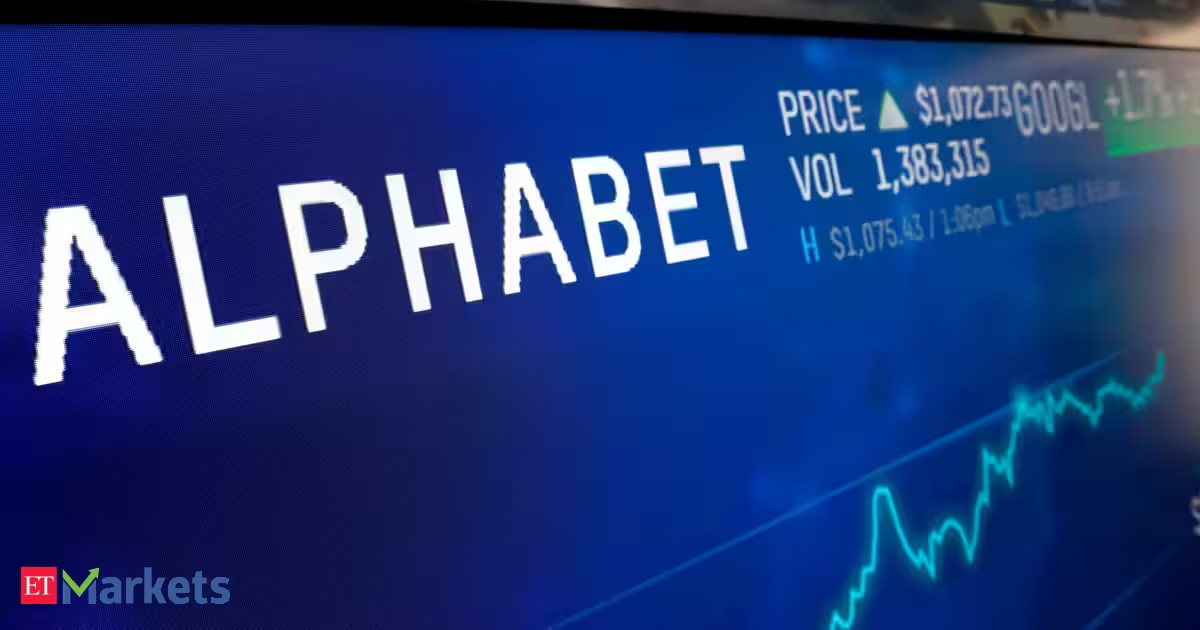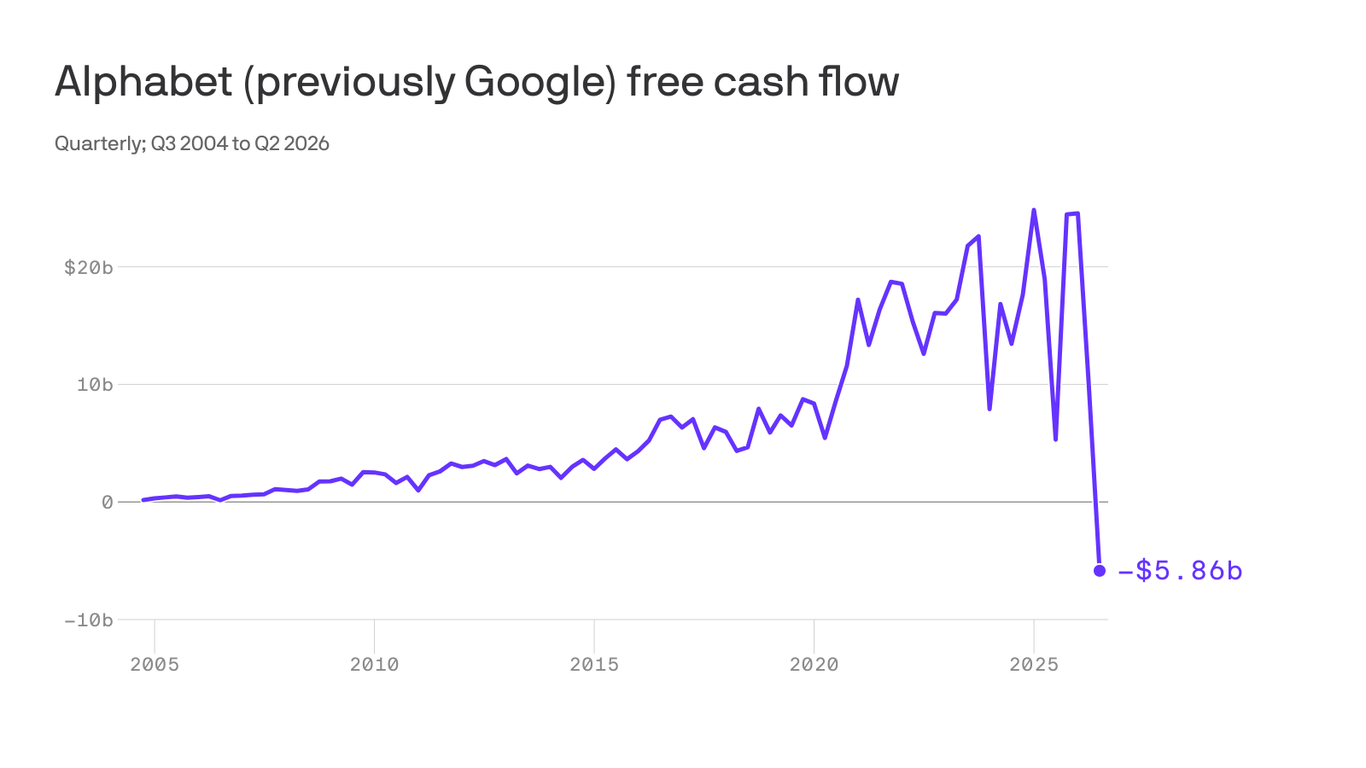
Data: FactSet; Chart: Matt Phillips/AxiosAlphabet shares slumped Wednesday after the search giant and AI power player reported results that were, at first glance, pretty darn strong. Why it matters: Alphabet is the first of the hyperscalers to report results this earnings season. The stock reaction could reflect investors' more cautious posture toward the AI narrative that has dominated the market in recent years. The big picture: Alphabet's second-quarter results were better than what Wall Street analysts expected for revenue and earnings per share, as well as some other metrics.Yes, but: Its stock still slid after hours. Reality check: There was no clear takeaway on exactly what investors didn't love. Here are a few guesses. Alphabet raised guidance for capital expenditures to between $195 billion and $205 billion for this year, up from previous guidance of $180 billion to $190 billion. (Wall Street was expecting $187.1 billion, according to FactSet.) Its operating margin — a measure of how profitable a company's core business is — rose 1.6 percentage points, to 34%, compared with the quarter a year ago. That's good. But it's also down from the first quarter, doing little to ease concerns about the profitability of recent AI investments.And finally, there's the striking sight of Alphabet — née Google — one of the most cash-generative entities in the history of American capitalism, posting a quarter of negative free cash flow, reflecting the impact of the company's massive capital expenditures. That includes almost $45 billion in Q2, double what it spent in the same quarter the previous year.According to FactSet data, that's the first time the company has recorded a quarter of negative free cash flow — meaning it spent more than the business generated — since then-Google went public back in 2004.Stunning stat: Alphabet's net income gain was overwhelmingly a result of an unrealized investment gain on equity securities worth $99 billion. (The company didn't detail what securities led to the gain, but it was known to have been an early investor in SpaceX back in 2015.)The bottom line: The numbers were good. But they weren't spectacular enough to ease the worries about how all this AI spending will ultimately work out.
What worried investors about Alphabet
It's the first of the hyperscalers to report earnings, and investors may be growing leery of the scale of AI spending.
TL;DRAI
Alphabet exceeded Q2 expectations but posted negative free cash flow for the first time since 2004, raising capex guidance to $195-205B. The stock decline reflects investor skepticism on whether massive AI capex will deliver proportional margin expansion and cash generation.
362 words~2 min read