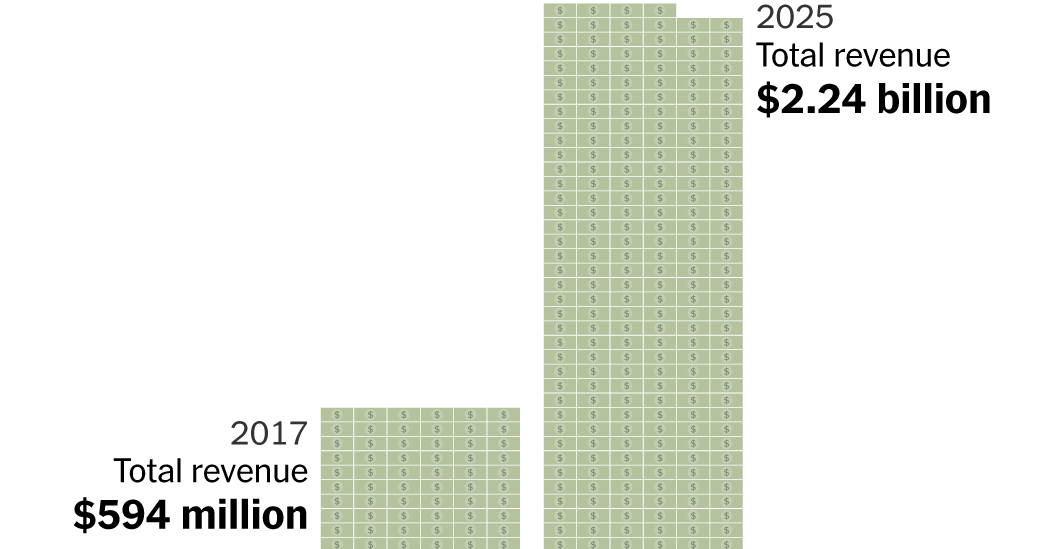
In his first term, President Trump presided over the largest business empire of any president in modern U.S. history. A grid of 60 rectangles representing the $594 million that President Donald Trump’s businesses made in 2017. Mr. Trump’s financial disclosures do not pinpoint his net worth, but they paint a clear picture of how much money he takes in each year. In 2017, most of the revenue his businesses generated — nearly 90 percent — came from his domestic golf and real estate portfolio, a longstanding focus of his family business. The same grid with 53 of those rectangles highlighted, representing the $528 million that Mr. Trump made on domestic golf and real estate in 2017. But by the first year of his second term, the president’s business holdings had transformed. Next to the grid of Mr. Trump’s 2017 revenue, a new, much larger grid is displayed. It contains over 220 rectangles representing the $2.24 billion Mr. Trump’s businesses earned in 2025. His businesses expanded primarily in areas in which he wields immense power and influence, like cryptocurrency. The 2017 grid disappears and the 2025 grid remains. In the 2025 grid, all of Mr. Trump’s revenue categories are highlighted, showing how Mr. Trump’s cryptocurrency revenue dwarfs his revenue in every other category. Mr. Trump earned nearly $800 million from his family’s crypto firm, World Liberty Financial. A subsection of 80 rectangles is highlighted in the crypto section of the grid, representing the $799 million Mr. Trump’s family crypto business, World Liberty Financial, earned in 2025. And he made another $636 million from his $TRUMP memecoin, a novelty currency. In 2017, he did not earn any money from crypto. A subsection of 64 rectangles is highlighted in the crypto section of the grid, representing the $636 million Mr. Trump earned in 2025 through his $TRUMP memecoin, a novelty currency. Foreign golf and real estate projects, including several in the Middle East, were also lucrative for Mr. Trump, bringing in $125 million. The crypto section of the grid fades back and 13 rectangles are highlighted, representing the $125 million Mr. Trump’s businesses earned from foreign golf and real estate projects in 2025. Those deals earned more than double the revenue that foreign golf and real estate brought in 2017. In his first term, Mr. Trump prohibited his family business from doing new foreign deals, but the company agreed to several new overseas projects while he was out of office that are now generating revenue. And in his second term, he no longer prohibits the company from signing these types of deals. The much smaller 2017 grid is brought back next to the larger 2025 grid. Six rectangles in 2017 are highlighted representing the $60 million that Mr. Trump made from foreign golf and real estate projects that year. That portion of the grid is half the size of the $125 million that he made in 2025. Legal settlements were another significant source of revenue for Mr. Trump last year. He received up to $117 million, largely from media and tech firms, including CBS and Meta. The proceeds of some settlements were donated to his presidential library and a nonprofit supporting the National Mall. The 2017 grid disappears again. Now a subsection of 12 rectangles in the 2025 grid are highlighted showing Mr. Trump’s revenue of $117 million from legal settlements. Mr. Trump made about $17 million from merchandise and publishing in 2025. The money came from a slew of Trump-branded items like watches, and from books such as a special-edition Bible he marketed. The settlement rectangles fade back. Now a subsection of 2 rectangles in the 2025 grid are highlighted showing Mr. Trump’s revenue of $17 million from merchandise and publishing. Though the revenue streams from merchandise and publishing made up a small fraction of his overall earnings, they totaled nearly 18 times what he made from them in 2017, after accounting for inflation. The 2017 grid is brought back again, in order to compare the 2025 merchandise revenue to the 2017 merchandise revenue. The 2017 merchandise revenue of $950,000 is highlighted on the grid, but it is a small sliver of a single rectangle, compared to the 2 rectangles highlighted for merchandise in 2025. By comparison, his domestic golf and real estate businesses saw modest revenue growth, up about 4 percent from 2017. They represented only about a quarter of his revenue last year. The 2017 and 2025 grids are both shown. The revenue that Mr. Trump made from domestic real estate and golf is highlighted in both. In 2017, 53 rectangles are highlighted, representing $528 million. In 2025 that has grown to 55 rectangles, representing $549 million. As president, Mr. Trump has blurred the lines between his family's business ventures and his office. In an interview with The New York Times this year, he justified his actions by saying that despite limiting his company’s dealmaking in his first term, “I got absolutely no credit.” The 2017 and 2025 grids are both shown. None of the rectangles in the grids are faded anymore. The total revenue amounts for each year are shown above the grids. $594 million for 2017 and $2.24 billion for 2025.A White House spokeswoman, Anna Kelly, said in a statement that Mr. Trump “was a massively successful businessman prior to becoming president, which was why he was elected to office in the first place.” The White House has said that the president acts in the best interests of the American people and that there are no conflicts of interest between his financial holdings and his actions as president. Methodology Mr. Trump’s financial disclosure forms show exact revenue for his highest-earning assets, but figures from some less lucrative properties are reported in ranges. In those instances, The Times used the range minimums in its calculations. The Times inflation adjusted 2017 figures to 2025 dollars, and converted foreign currencies to U.S. dollars.Most dollar amounts displayed are rounded to the nearest $1 million. Boxes shown in the charts represent amounts rounded to the nearest $10 million. Revenue classified as “other” is not labeled. It accounted for about $5 million of Mr. Trump’s revenue in 2017 and roughly $1 million in 2025.The forms record Mr. Trump’s personal cut of the revenue collected from various business ventures. The forms do not disclose whether his assets turned a profit or loss. The Times’s tallies do not include earnings from Mr. Trump’s investment assets, such as stocks and bonds, which the forms report separately from his business income.One line item in Mr. Trump’s 2025 disclosure mixed settlements with other business-related revenue. The Times included that revenue in the settlements tally. Some businesses that The Times categorized as domestic golf and real estate are U.S.-based entities that may have received some money from foreign properties.
How Much Money Has Trump Made as President?
See how President Trump and his family’s business empire has transformed from his first term.
1,129 words~5 min read