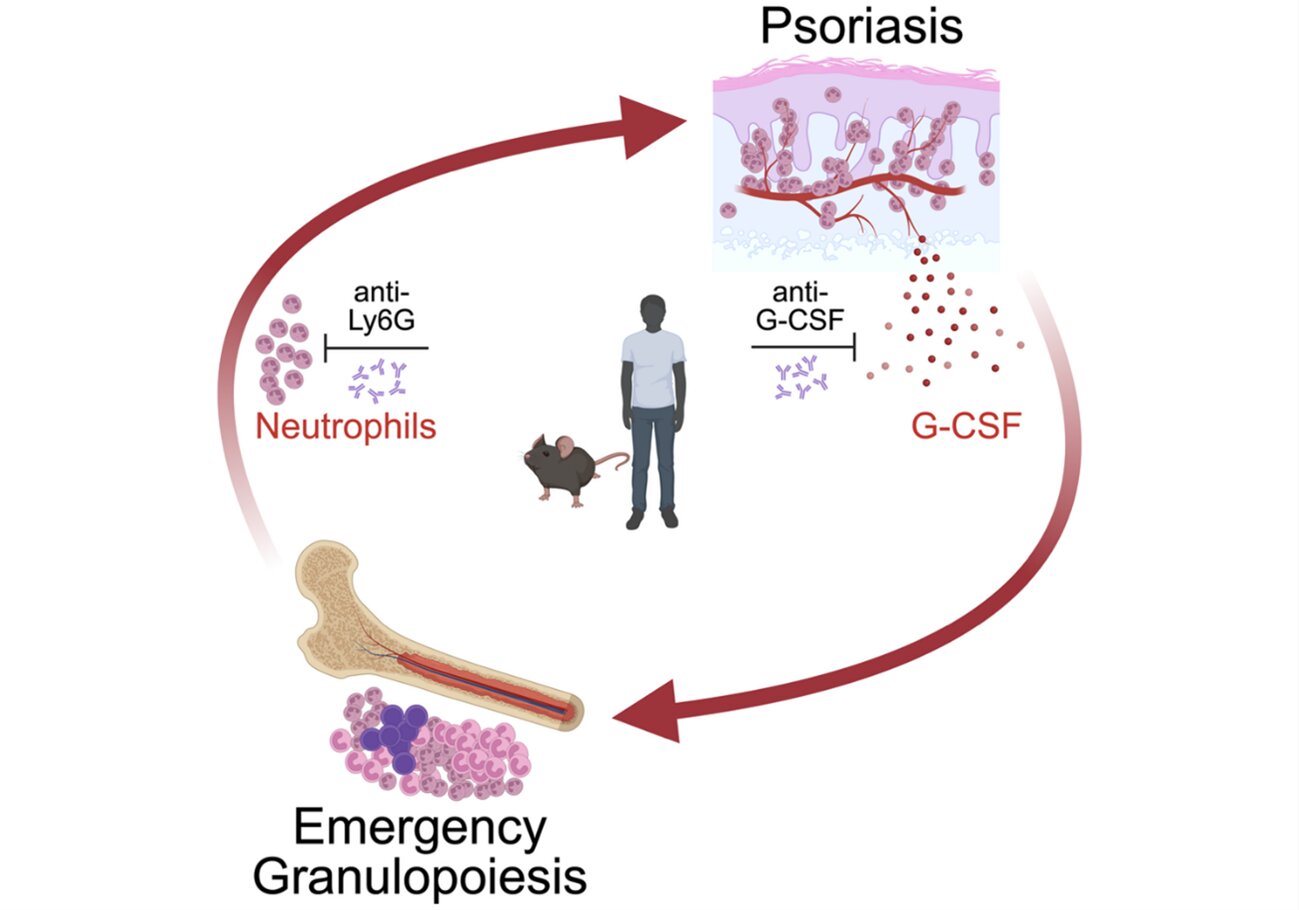
Schematic overview of the pathological skin-bone marrow axis driving psoriasis. Credit: Kosasih T et al., EMBO Molecular Medicine (2026), licensed under Creative Commons Attribution 4.0 International (CC BY 4.0)
Psoriasis is a chronic inflammatory skin disease affecting more than 60 million people worldwide, characterized by painful red patches, scaling and skin thickening. While existing biologic treatments largely focus on calming hyperactive T cells in the skin, complete disease resolution remains challenging.
Now, a research team led by scientists at Kumamoto University has uncovered a hidden communication network between the skin and the bone marrow that drives psoriatic inflammation. Published in EMBO Molecular Medicine, the study highlights a crucial, previously underappreciated role for neutrophils—first-line immune defense cells—and proposes a promising new target for future therapies.
Skin-bone marrow pathological connection
A hallmark of psoriatic skin is the heavy accumulation of neutrophils, which form tiny microabscesses and exacerbate inflammation. Because these cells are naturally short-lived, the body must continuously replenish them through a process called granulopoiesis in the bone marrow.