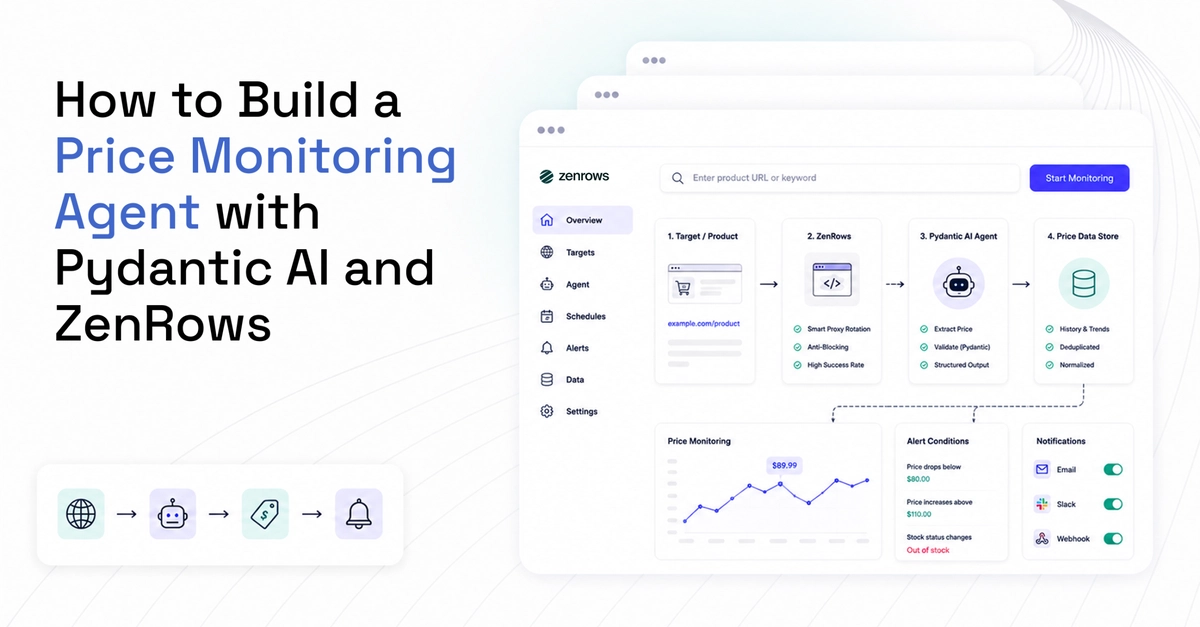
Most price monitoring systems look simple on paper: point a scraper at a product page, ask an LLM to extract the price, and store the result in a database. The problem arises when the same workflow runs continuously against heavily protected targets such as Amazon and Walmart. At scale, reliability becomes the real challenge. The why comes down to two failures that happen quietly: retrieval and extraction. Retrieval fails when a protected site returns a blank JavaScript shell, incomplete data, and a block page instead of the product data. Extraction fails when the LLM returns a field in a data type or shape that your downstream database write action does not expect. Both failures pass for normal output, so the pipeline keeps running and drops records downstream without raising an error.
This tutorial shows you how you can build a price monitoring agent using ZenRows and Pydantic AI. ZenRows retrieves the page and returns product details with a 99.93% success rate against protected websites, while Pydantic AI extracts and validates LLM output against a defined schema. The tutorial walks through the two-step pipeline from a single product page to a multi-site price monitoring run across Amazon and Walmart, two heavily protected e-commerce sites.