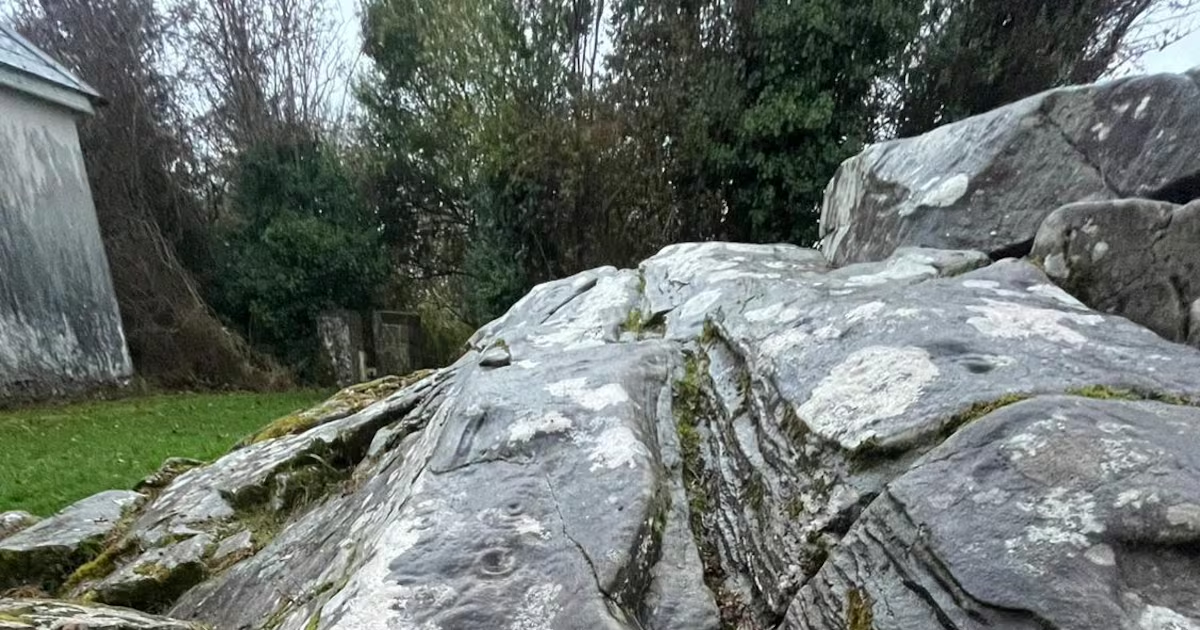
After a weekend in Westport last autumn, I wrote about the convoluted side trip involved in visiting a local ancient monument, the Boheh Stone.My iPhone directed me to the place, a few kilometres outside the town, accurately enough. It’s just that when we got there, it didn’t seem to realise we had arrived. And as viewed from a car, at least, the signposting at the site was no help.The phone then suggested a wild-goose detour along winding country lanes that brought us back to the same place from a different direction. At which point, I got out and investigated on foot.Sure enough, the great monolith – a listed national monument with carvings that may be 6,000 years old – was indeed only a few steps away, incongruously located in the side garden of an abandoned 1970s bungalow.But it turns out that my difficulties in finding the place were not representative of general experience.For walkers anyway, the Boheh Stone (it is also spelt Bohea Stone) is very much on the map of local hiking and pilgrim routes. And according to reader Emily Bracken, this has become a big problem.Emily is an interior designer, now working on a master’s degree in design, focused on “symbolism, ritual and culture”.She is also a daughter of the late Gerry Bracken, who back in the early 1990s noticed something very unusual about the Boheh monolith, beyond the many carvings (250 at least) with which it is covered.On clear days, the stone is a viewing point towards Croagh Patrick, a few miles away to the northwest. But twice a year, around April 18th and again on August 24th, its site is also perfectly aligned with an extraordinary solar phenomenon.Then, seen from Boheh, the setting sun seems to rest briefly on the conical summit of Ireland’s holy mountain, before “rolling down” the side.This and the stone’s multiplicity of designs – mostly of the “cup and ring” type, found on prehistoric monuments all over western Europe – suggest the monument was a pilgrim marker not just for Ireland’s early Christians, but for people long before them.Bracken’s Rolling Sun theory (which has lent its name to the Westport literary festival I was attending in October) surmises that, in millennia past, the dates of the phenomenon coincided with two crucial times of the agricultural year: the sowing and harvesting of crops.I had to take the solar phenomenon on faith the day we visited the site. It was a murky, late-autumn evening on which the sun and Croagh Patrick were equally invisible. A friend and I had the forlorn-looking rock and its decrepit surroundings all to ourselves.The existence nearby of a cillín – an old burial ground for unbaptised or stillborn children – may have added to the sense of desolation.But Emily assures me that at other times of the year, the monument is all-too-well visited by tourists. And one of the things many of them do, alas, is clamber onto it, in hiking boots gritted from their travels.She points to a recent picture on one local website of a group of happy walkers posing in front of, and on, the rock, oblivious to any damage they may be doing.There is nothing to stop this, Emily laments. On the contrary, modern additions to the site include a concrete step that helps people onto the stone.In the years before his death in 2007, Gerry Bracken urged Mayo County Council to buy the adjoining house and garden as part of a plan to protect the site, which the council did. But nothing has happened since, except dereliction.Now, Emily says, the carvings are starting to disappear. When recent photographs are compared with ones taken by Gerry in the 1990s, some designs are no longer visible.This week, Emily wrote to the National Monuments Service urging the need for a ministerial protection order to prevent further “human degradation” of the site.Her letter says that the local authority’s addition of a step, and the contrasting lack of any protective walkways or barriers around the rock, “constitutes severe neglect”.The problem may have become even more urgent since last month’s visit of Canadian prime minister Mark Carney to his ancestral home in Aughagower, which drew international attention to this part of Mayo.Full of picturesque Christian ruins, Aughagower has strong connections with Saint Patrick. Its new fame in Canada and elsewhere is sure to send even more visitors to Boheh, which lies halfway between the village and Croagh Patrick.Canadians or no Canadians, meanwhile, late July sees the annual peak of patrician tourism in and around Westport.As tens of thousands of Mayo GAA supporters make the trek east at the weekend in their latest attempt to find their Holy Grail, thousands of other pilgrims will be heading west, via Aughagower, Boheh and other routes, for Reek Sunday.
Frank McNally: Mayo’s Boheh Stone is a national monument, but it isn’t treated like one
Addition of a step to help people onto the stone has hastened the demise of its 6,000-year-old carvings
795 words~4 min read