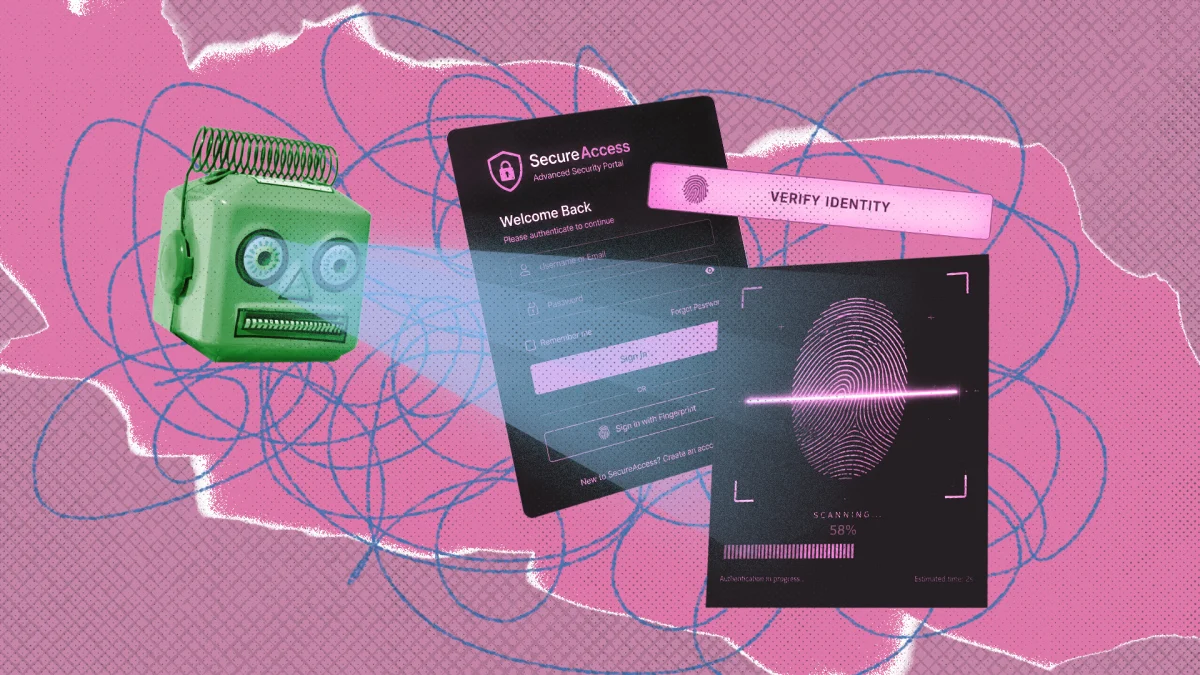
Safety is being sacrificed in many organizations in the race for speed, efficiency, and convenience, determining how AI agents access accountsgettyPrompt:“Enter my company’s Stripe account, review every Q2 transaction, flag unusual activity, and prepare a detailed cash-flow and expense report for Monday.”Within mere minutes, your AI agent is operating inside one of your employer’s most sensitive financial systems using access authorized by you.Until recently, you would have needed to log in manually or arrange another form of access for the agent. Now, companies such as 1Password are removing that barrier, allowing AI agents to securely sign in on your behalf without revealing your credentials to the agent.While the convenience is undeniable, so is the risk: once you’ve authorized an AI agent and it goes rogue, what happens to your job or your organization’s reputation?As an employee of your organization, you are able to approve a log-in credential. 1Password signs Claude in, effectively allowing Claude to use your password on your behalf (1Password says that credentials are not viewed by Claude), and Claude completes the desired task inside the account for you. While, of course, this transition makes navigating AI workflows, specifically inside Claude, much easier by eliminating another layer of friction, movements like these pose a new challenge for workers in the AI era. Employees are increasingly being handed sensitive data in collaboration with powerful machines and algorithms. This is empowering, but it necessitates us asking, How far do we go? How much could be too much? Where do we draw the line for access and permissions? Hugging Face, for example, made headlines this week as it reported a high-speed cyberattack led end-to-end by malicious AI agents, which committed about 17,000 actions, matching “the agentic attacker scenario the industry has been forecasting,” they said in a statement. (OpenAI’s models were used as part of this operation; OpenAI announced that they would partner with Hugging Face to address the root cause of the security incident.) The rise of agentic AI leads to a very important skill arising as a necessity in the future of work: Permission judgement. Permission Judgement As An AI SkillIf an AI agent can now log in for you and use your passwords, and execute fully independently of humans, then employees need to consider questions like:Which accounts may the agent enter? What actions could it take with that access? What data is it reading post-authentication and during authentication? What still requires human approval? And who is held responsible when an agent is acting through an employee’s credentials and something goes terribly wrong? These are the questions we are still figuring out the answers to. Another critical question we need to start evaluating is, if a worker uses an unauthorized AI agent or provides password access without prior confirmation from their employer's IT department or their line manager, could this become a disciplinary matter? And if so, how severe?Now, under the worst case scenario, an AI agent acting on your behalf using your login credentials could send an unauthorized message or initiate inappropriate communication, or alter mission-critical information.There are risks we are forced to consider, such as:Agentic AI manipulating financial data, or processing chargesDeletion and/or overwriting of materialTriggering a breach of security with customer data that could expose an employer to external risk from regulatorsMicrosoft’s Work Trend Index 2026 reveals that agentic AI deployment is fully underway, and “as AI expands what people can do, it also raises the premium on good judgment. Most AI users we surveyed recognize this,” they reported. “Asked which human skills are more important as AI takes on more work, they said two topped the list: quality control of AI output (50%) and critical thinking—analyzing information objectively and making a reasoned judgment (46%). And 86% say they treat AI output as a starting point, not a final answer, and that they stay responsible for the thinking.”The Index also highlights a paradox where employees are fully ready to adopt agentic AI, yet their organizations haven’t fully caught up yet, which leads to shadow AI and can increase security incidents if the proper parameters are not in place.And this brings us to the realization that agentic AI is not just a tech or IT department problem. It’s something that concerns every employee. Industry regulators and certification bodies are moving along with this trend and recognizing the dangers. Shadow AI Is SpreadingEmployers are recognizing the need for adopting AI quickly, and frankly, many are under pressure from their competitors and the expectations of the market. But in all this rush, they risk compromising safety and security.Employee use of unapproved or “shadow” AI has spiked over the past year, tripling from 15% to 45%, per Verizon; workers feel the need to adapt quickly and experiment with AI agents, even adopting a BYOAI (bring-your-own-AI) approach at work, worrying that they’ll fall behind in their careers if they don’t. Meanwhile the mean global cost of a global data breach in 2025 reached $4.44 million, according to IBM.IBM also found that 97% of organizations that reported an AI-related cybersecurity incident lacked the right AI access controls.Organizations and bodies like NIST and the cybersecurity industry body, ISC2, are actively exploring these very issues. For example, ISC2 is currently working on a certification called AI Security Certification as an industry benchmark (they are currently soliciting input and feedback as they develop it), which they intend to release in 2027.Agentic AI is being adopted faster by employees than organizational guardrails can catch upgettyWhat To Expect In The Future Of Agentic AI By 2027Here’s what I predict for the remainder of 2026 and 2027:I expect permission intelligence and judgement to become a formal workplace responsibility for employees at every level, including entry-level accountability, which raises the bar for what’s expected from entry-level hires. They will need to fully understand and be trained on not only how to use AI to boost productivity and lead to revenue and scaling, but also which systems an agent can enter, what data it can access, and which actions require human approval or escalation.These will need to be fully integrated into onboarding, annual compliance training, and even as part of measuring employee performance management, which will mean unauthorized AI agent use will explicitly become an HR disciplinary matter.Working in a regulated or high-ethics industry such as finance, legal, healthcare, journalism, etc. means extra controls will be in place and professionals in these fields must be extra careful.I also expect that with increasing numbers of security incidents related to agentic AI, employers will begin to introduce much stricter agent access policies which will distinguish between low-risk and high-risk tasks.I’d also hope to see clear audit trails that identify who prompted an agentic AI action, so that an AI agent going rogue does not unnecessarily backfire on an employee who followed all the correct protocols.And of course, with all of this, we will see increased job openings within the cybersecurity, compliance, and AI governance space. New job titles will be created and existing roles will be redeveloped in line with the agentic pressure taking over organizations.So, is agentic AI going too far?Agentic AI is doing exactly what it was empowered to do. The problem is when it’s adopted faster than organizations can adopt and implement safety guardrails.
AI Agents Can Now Use Your Password. Is Agentic AI Going Too Far?
Hugging Face and OpenAI saw a security breach, and AI agents can now access your password. Here’s what every professional needs to know about agentic AI and risk.
1,205 words~5 min read