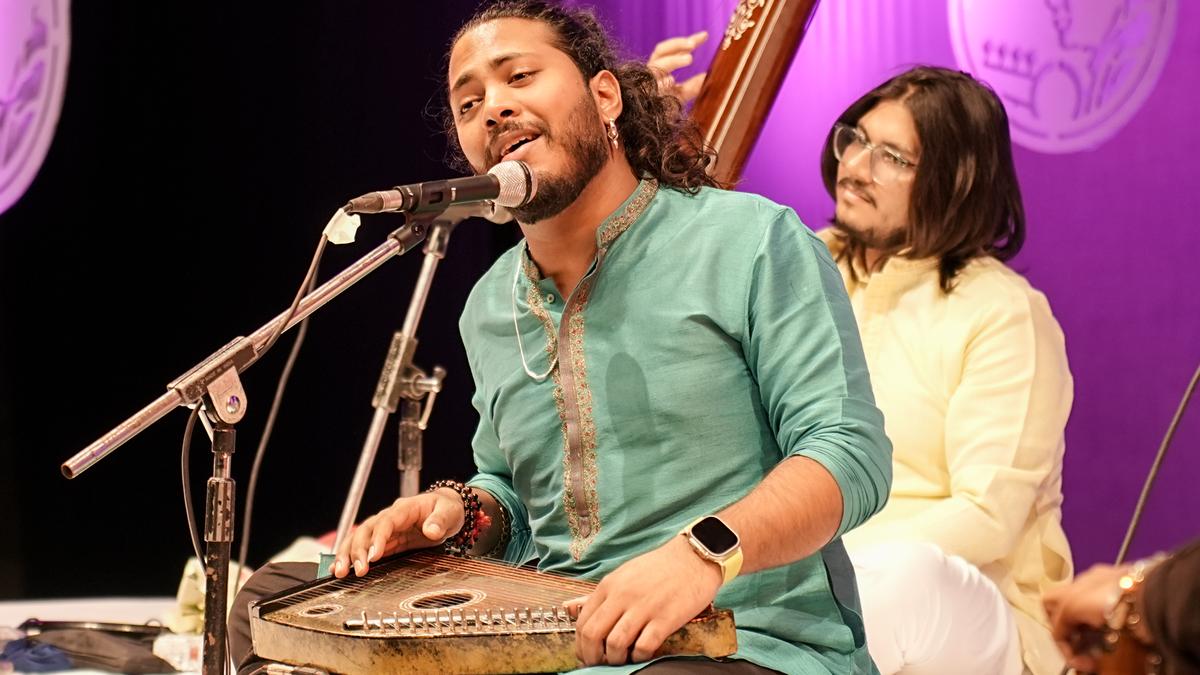
Swara Samrat Festival, which began 14 years ago in Kolkata in memory of Ustad Ali Akbar Khan, has expanded to other cities over the past three years. The second Delhi edition of the festival, held recently, featured only young musicians.The festival opened with a dhrupad vocal recital by Bangladesh-born Niloy Ahsan, who is currently training under Ustad Wasifuddin Dagar. Earlier, he studied with the Gundecha Brothers. Niloy possesses a powerful voice, and the range he displayed, extending into the mandra saptak, was particularly impressive. He presented Mian ki Malhar, beginning with an expansive 45-minute alap that left him with barely 10 minutes for the compositions that followed. He was accompanied on the pakhawaj by the talented Roman Das.
Bangladesh-born dhrupad singer Niloy Ahsan
| Photo Credit:
Courtesy: Swara Samrat Festival
This imbalance in time management was unfortunate, as Niloy displayed a string sense of drama in his layakari — which was all too brief. The well-known Chautaal composition ‘Aayi ghata’ was not sung in full, perhaps owing to the lack of time. The overdrawn alap in the vilambit section also saw Niloy expanding the notes, presenting shrutis to the point of dissonance, which was unaesthetic. Another avoidable distraction was his use of a head mic, uncommon among classical vocalists. It does not allow for volume control and picks up every breath while singing in detail. Niloy had a cold and blowing his nose a couple of times with the mic picking up every sound was not pleasant. Next performance was by Mumbai-based Farrukhabad gharana tabla artiste Ishaan Ghosh. The son of Pt. Nayan Ghosh, Ishaan has been performing since his early teens; despite being only 26, he displays remarkable polish and maturity on stage. His command over the tabla baaj, sense of proportion in presentation and tremendous dexterity on the instrument are exemplary. Accompanied by Delhi-based sarangi player Mudassir Khan, Ishaan performed in teentaal. Gradually building momentum, he presented an impressive array of compositions drawn from the Delhi, Ajrada, Lucknow, Banaras and, of course, Farrukhabad traditions.