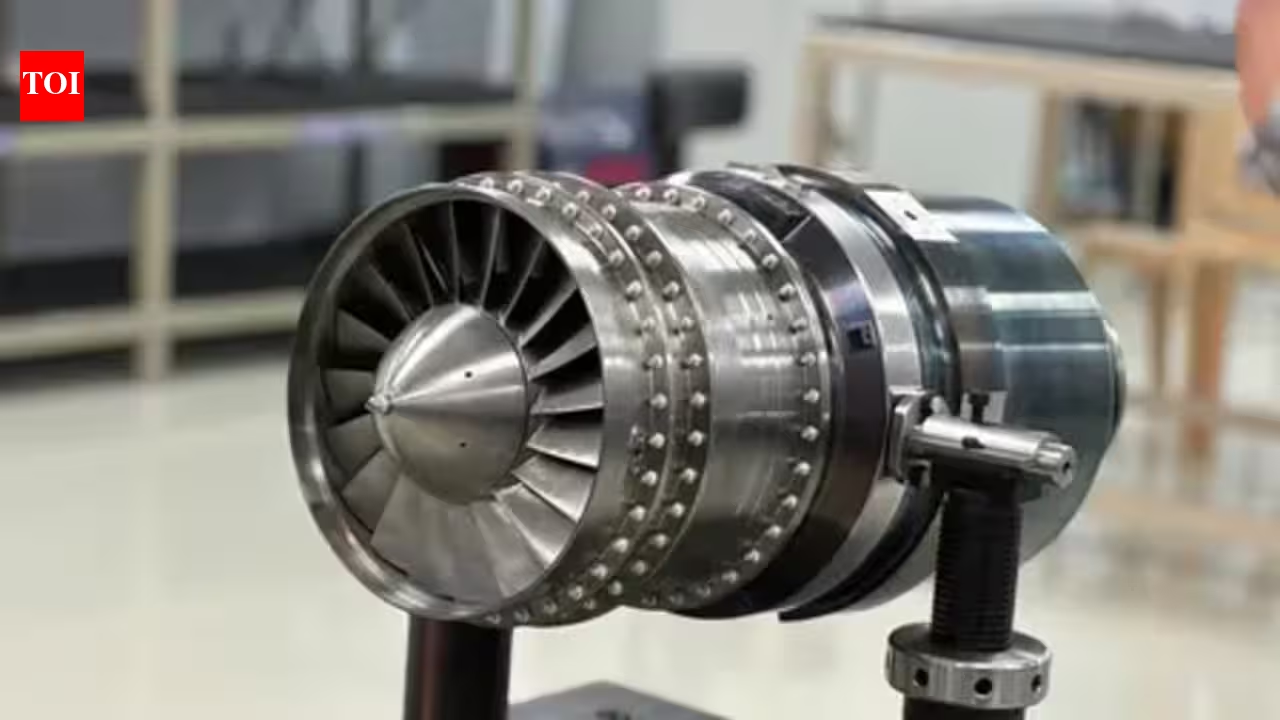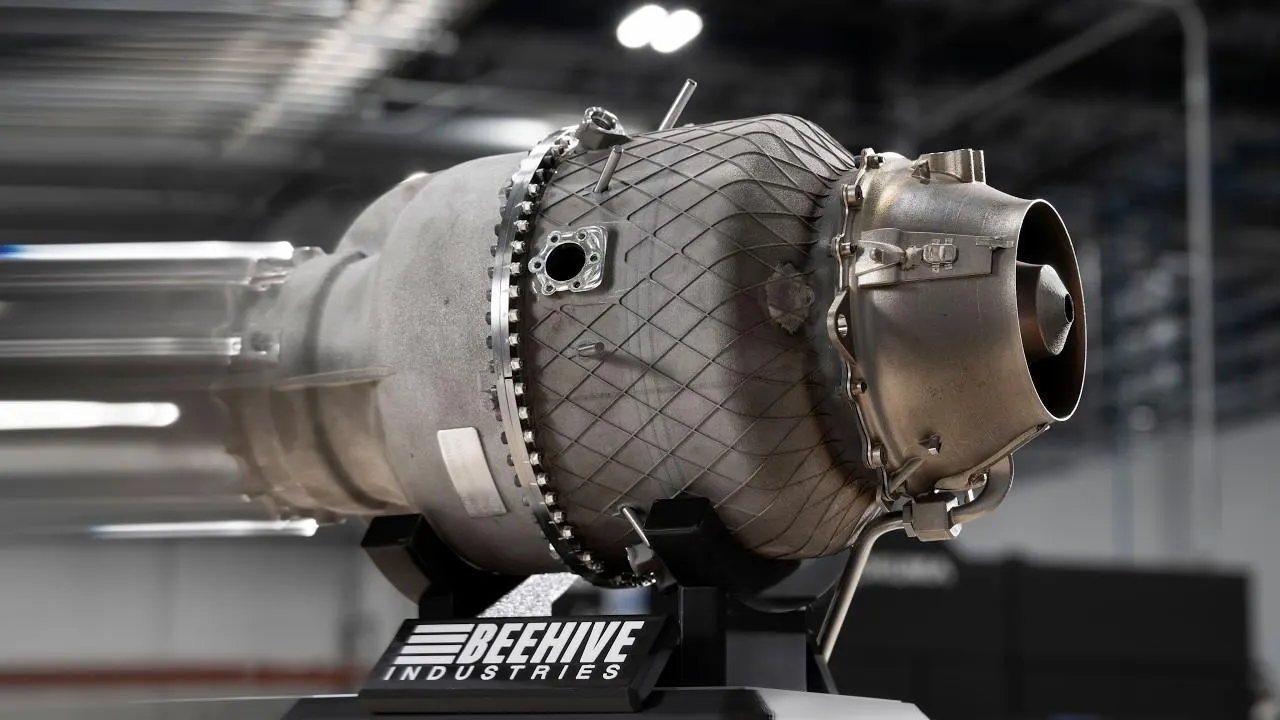
Beehive Industries’ Frenzy 8, a 200-pound-force-thrust jet engine designed for uncrewed defense systems, is at the center of the company’s push to scale additive manufacturing into high-volume engine production.Beehive IndustriesBeehive Industries is moving quickly to turn its additively manufactured jet-engine program into a high-volume production business.Since April, the Denver-based aerospace manufacturer has secured a $29.7 million U.S. Air Force contract, committed more than $50 million to metal additive manufacturing equipment, acquired two Ohio machine shops and announced a $70 million expansion expected to create more than 200 jobs in Southwest Ohio. It has also ordered multiple ultra-large-format metal printers from Nikon SLM Solutions for aerospace, defense, and space production.Together, the moves amount to more than an equipment-buying spree. Beehive is assembling an end-to-end manufacturing system in which additive manufacturing produces complex engine hardware, dedicated machining operations finish the parts, and specialized facilities support serial production. If the company can execute the plan at the scale it projects, the vertically integrated model could offer a trailblazing blueprint for producing small turbine engines faster and in far greater volumes.The immediate focus is Frenzy 8, a 200-pound-force-thrust engine designed for swarm-class drones, expendable aircraft and other uncrewed defense systems. The engine has progressed through ground and high-altitude testing, and Beehive says it is ready for full-rate production.From Flight Readiness to Production ReadinessBeehive Industries developed and tested its Frenzy engine under a $12.46 million U.S. Air Force contract awarded in October 2024 in collaboration with the University of Dayton Research Institute.Beehive IndustriesMORE FOR YOUBeehive completed high-altitude testing of Frenzy 8 in late 2025 at a government facility in Ohio. The company said the campaign validated ignition, acceleration, operability, durability, and performance across the planned flight envelope. Hardware reportedly remained in “like new” condition after mission-life-equivalent runtime.“The milestone confirms Frenzy’s readiness for flight integration,” said David Kimball, Beehive’s chief technology officer.Beehive said it moved from concept to proven high-altitude performance in less than a year, after testing six engines on the ground in four months and sending two prototypes to the Ohio facility.“Frenzy is now flight-ready, and our production system is ready to scale alongside it,” Kimball said.That production claim gained substance in April, when the Air Force awarded Beehive a $29.7 million contract covering vehicle integration, flight testing, and qualification of Frenzy 8. The award also funds initial manufacturing and testing of the smaller, 100-pound-force Frenzy 6 engine.The work supports an Air Force effort to develop affordable turbine engines for uncrewed aerial and standoff systems. The broader objective is often described as “affordable mass”: fielding systems that can be manufactured and deployed in much larger quantities than traditional, high-cost weapons.“This collaboration ensures our warfighters will have the high-volume, mission-ready capabilities they need to maintain a competitive edge in any theater,” said Gordie Follin, Beehive’s chief product officer.More 3D Printers for Engine ProductionThe M4 ONYX metal 3D printer from EOS debuted at the 2025 Formnext trade show for additive manufacturing.Carolyn SchwaarA contract establishes demand, but it does not create capacity. Beehive’s answer is a major expansion of its additive manufacturing fleet.In June, the company announced an agreement valued at more than $50 million for 30 M4 ONYX metal additive manufacturing systems from the German 3D printer manufacturer EOS. The machines are scheduled for delivery to Beehive’s Colorado and Tennessee facilities over 12 months, bringing its installed EOS fleet to 50 systems. EOS described it as the company’s largest publicly announced single order.The M4 ONYX uses six lasers and incorporates automated powder handling, process monitoring, and production-data capabilities. All features that become increasingly important as additive manufacturing moves from development work to repeatable series production.Beehive’s strategy is not simply to print more copies of a conventionally designed engine. Frenzy was developed from the ground up to be 3D printed, allowing the company to consolidate parts and shorten supply chains.The potential advantage is speed. Traditional turbine-engine programs can depend on specialized castings, forgings, tooling, and networks of qualified suppliers. Designing around additive manufacturing may reduce that dependency, though high-rate production still requires machining, inspection, testing, and tightly controlled material processes.Machining Becomes Part of the Additive StrategyTwo weeks after announcing the EOS order, Beehive acquired the assets of Able Tool Corporation and its subsidiary, Planet Products Corporation, both in the Greater Cincinnati area. The purchase price was not disclosed.The businesses bring more than 120 years of combined precision-machining capacity, and their acquisition reflects an often-overlooked reality of metal additive manufacturing: printed aerospace components rarely leave the build chamber ready for installation.Surfaces must be finished; interfaces, holes and sealing features may require precision machining; and components must be separated from build plates, heat treated, inspected and documented. At higher volumes, control over those downstream steps can be as important as access to printers.Beehive is organizing the acquired Cincinnati operations as a Production Machining Center of Excellence. Knoxville, Tennessee, will serve as its Production Additive Manufacturing Center of Excellence, supporting multiple printing and post-processing operations.The company says the combined system is being built to manufacture more than 8,000 engines annually. That remains a target rather than a demonstrated production rate, but it explains the scale of the equipment orders and acquisitions.Large-Format Printing Expands the MarketBeehive also recently acquired large-scale metal 3D printers from Nikon SLM Solutions, which adds another dimension to the strategy. Unlike the EOS systems being purchased primarily for engine production, the NXG 600E machines will give Beehive capacity to print much larger aerospace and space structures for outside customers.Each NXG 600E has a build envelope measuring 600 x 600 x 1,500 millimeters and uses twelve 1-kilowatt lasers. Beehive plans to dedicate one system to aluminum and another to titanium.The size makes it possible to manufacture complete vehicle bodies, satellite substructures and other large components that might otherwise be divided into smaller pieces and joined.The purchase suggests Beehive does not intend to operate solely as an engine supplier. Its equipment base could also support contract production for space and defense customers seeking domestic access to large-format metal additive manufacturing.That diversification may help keep expensive equipment utilized as Beehive ramps its own propulsion programs. It could also create overlap between customers purchasing engines and those needing airframes or structural hardware.Ohio Expansion Adds People and InfrastructureThe latest piece of the buildout is a planned $70 million expansion in Southwest Ohio. Announced at this week’s Farnborough International Airshow, the project is expected to create more than 200 jobs and expand Beehive’s regional manufacturing operations.Beehive’s next challenge is operational: installing and qualifying machines, integrating acquired businesses, hiring skilled employees and producing engines repeatedly at the promised cost and rate.Additive manufacturing can shorten development cycles and simplify assemblies, but printers alone do not guarantee economical serial production. Build consistency, powder management, machine uptime, inspection throughput and post-processing capacity will determine whether Beehive can turn its investments into thousands of qualified engines.Metal printing has spent years proving it can make sophisticated turbine components. Beehive is now betting it can organize those capabilities into a production system built not for dozens of engines, but for thousands.
Beehive Pushes 3D-Printed Drone Jet Engines Into Full Production
Beehive Industries is scaling 3D-printed jet engine production to 8,000 units a year with Air Force funding, 30 new printers, machine shops, and a $70M Ohio expansion.
1,161 words~5 min read