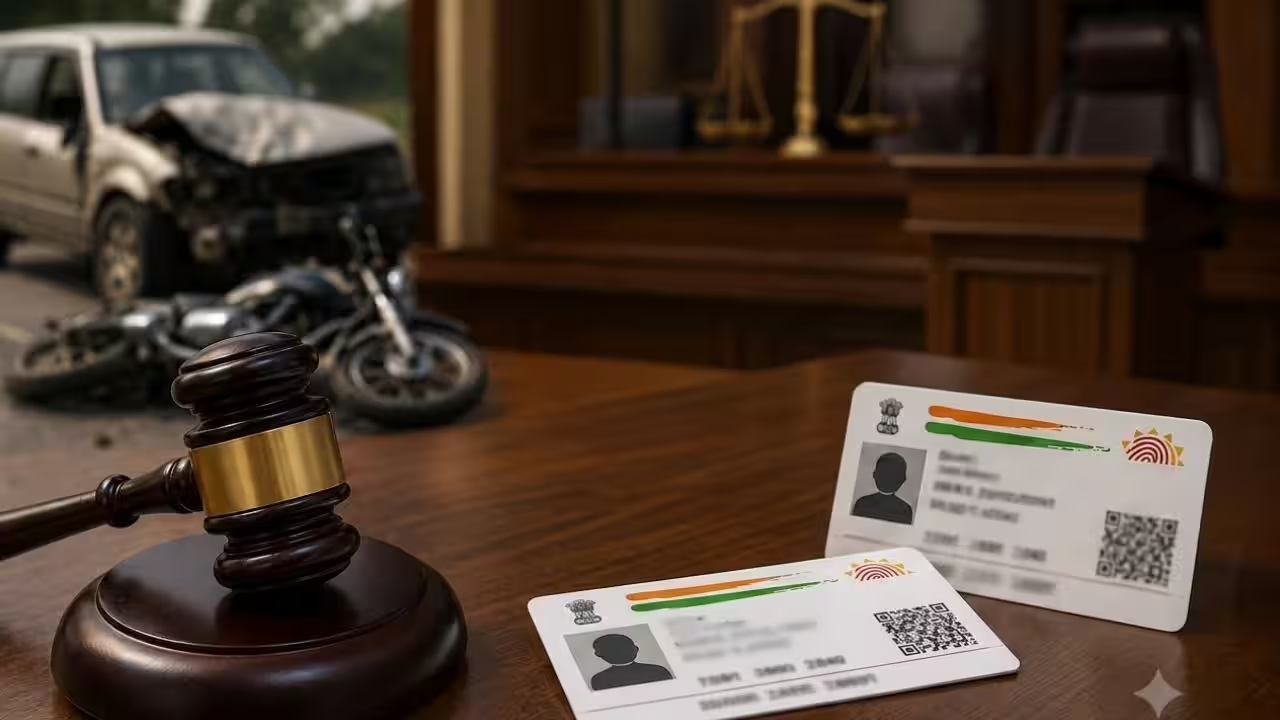
The trial court accepted the plaintiff’s case and held that the insurer had wrongfully rejected the claim.The Delhi High Court has delivered a significant ruling on insurance liability, holding that an insurer cannot repudiate a motor accident claim merely because the driver’s licence was in booklet form and not converted into a smart card.Dismissing an appeal filed by The New India Assurance Company Ltd, Justice Neena Bansal Krishna upheld a decree of Rs 13,77,500/- in favour of the insured, observing that the insurer’s defence was based on a misinterpretation of regulatory requirements and unsupported assumptions rather than cogent proof.Background:The dispute arose from a road accident on 11.07.2014 involving a Tata LPT truck owned by M/s Kapoor Diesels Garage Pvt. Ltd. The vehicle, insured for the period September 2013 to September 2014, was completely damaged in the accident, and the driver, Salmu, died.The insured lodged a claim of Rs.13,77,500/- on the basis of total loss. It was not disputed that the insurance policy was valid, the accident occurred during the policy period, and the claim formalities were duly completed.Despite this, the insurer repudiated the claim nearly eighteen months later, citing violation of policy conditions. The rejection was premised on the allegation that the driver was not holding a valid driving licence at the time of the accident.Insurer’s Defence: Licence Declared “Fake”The insurer’s case hinged entirely on the nature of the driving licence. It argued that the licence issued by the Nagaland Transport Authority was invalid because it was in booklet form rather than a smart card. The insurer, relying on a notification dated 01.08.2014, argued that all booklet licences stood discontinued after 30.10.2009 and were therefore not genuine if issued thereafter.Additional arguments were raised that the driver was underage and not a resident of Nagaland, thereby suggesting further irregularities in the licence. On this basis, the insurer claimed that the policy condition requiring a valid and effective licence had been breached, absolving it of liability.Plaintiff’s Case:The insured, however, contested the repudiation as being unfair and untenable.It was pointed out that the driving licence had been issued on 14.01.2010 and had been renewed for a period covering the date of the accident. More importantly, the insured had obtained a verification report from the transport authority confirming that the licence was genuine. The respondent emphasized that the notification relied upon by the insurer did not invalidate booklet licences immediately but only required their conversion into smart cards within a specified time frame. Since the accident occurred on 11.07.2014, well before the conversion deadline of 1 December 2014, the licence was valid on the date of the accident.Trial Court’s FindingsThe trial court accepted the plaintiff’s case and held that the insurer had wrongfully rejected the claim. It concluded that the insurer had failed to prove that the licence was fake or that any policy condition had been violated. The suit was accordingly decreed for Rs.13,77,500/- with interest at 12% per annum.Aggrieved by the decision of the Trial Court, the insurer challenged the same before the High Court.High Court’s Analysis: The High Court undertook a detailed examination of the notification issued by the Nagaland Transport Authority and found that the insurer’s interpretation was fundamentally flawed.The Court clarified that the notification did not render booklet licences invalid per se, but merely mandated their conversion into smart cards within a prescribed time.In a clear and categorical observation, the Court held:“Merely because the driving licence was in a booklet form and not a smart card, the driving licence cannot be termed as fake.”The Bench further emphasized that the conversion deadline of 01.12.2014 had not expired at the time of the accident.It observed:“The driver had the window till 01.12.2014 to convert his booklet driving licence into the smart card.”Therefore, rejecting the insurer’s interpretation outright, the Court stated:“Such interpretation is absolutely contrary to the Notification dated 01.08.2014.”The Court’s also emphasized on the burden of proof.The Court noted that once the insured produced a verified licence, the onus shifted to the insurer to establish that the licence was fake or invalid.It held:“The onus was on the Insurance Company to rebut the testimony of the Plaintiff about the genuineness of the driving licence.”However, the insurer failed to discharge this burden.The Court pointed out that no official from the transport authority was examined, nor were any records produced to substantiate the allegation of forgery.The Court stated:“No witness was called by the Insurance Company from the Transport Authority… to show that the booklet form of driving licence… was fake.”Instead, the insurer relied only on an internal investigator’s report, which the Court found insufficient to override official verification.The Court also highlighted the evidentiary value of the verification report produced by the insured. It noted that the report from the transport authority confirming the licence’s genuineness carried far greater weight than the insurer’s internal assessment.The Court observed that repudiation of claims cannot be based on internal opinions unsupported by authoritative evidence.The Court made it clear that:“Repudiation cannot be founded on conjectures or technical assumptions without cogent proof.”The Court also rejected the insurer’s additional arguments regarding the driver’s age and residence.On the issue of age, the Court examined the date of birth mentioned in the licence and found that the driver was over 20 years old at the time of the accident.Regarding residence, the Court noted that no evidence had been led to establish that the driver was not a resident of Nagaland.It observed:“The bald assertion… is not enough to discharge the onus.”After analysing all aspects, the Court concluded that the insurer had failed to prove any breach of policy conditions. The Court reiterated that the existence of a valid licence at the time of the accident had been sufficiently established through documentary evidence. It further held that the insurer’s attempt to invalidate the licence based on format alone was legally unsustainable.The Court dismissed the appeal filed by The New India Assurance Company Ltd and upheld the trial court decree directing payment of Rs 13,77,500/- along with interest at 12% per annum to the insured. It ruled that the insurer had wrongly repudiated the claim, as the driver’s licence could not be treated as fake merely for being in booklet form, especially when the statutory window for conversion into a smart card had not expired and the licence stood verified as genuine by the competent authority.RFA 131/2023, CM APPL. 8138/2023 & CM APPL. 8140- 8141/2023THE NEW INDIA ASSURANCE COMPANY LTD vs M/S KAPOOR DIESELS GARAGE PVT LTDReserved on: 19th January, 2026 Pronounced on: 30th March, 2026For Petitioner: Mr. J.P.N. Shahi and Mr. Divyanshu Kumar, AdvocatesFor Respondent: Mr. Daljeet Singh, Advocate(The author of this article, Vatsal Chandra is a Delhi-based Advocate practicing before the courts of Delhi NCR.)
Not a smart card, still valid driving licence: Delhi High Court rebukes insurer for ‘technical’ claim rejection, upholds Rs 13.7 lakh award
The Delhi High Court has delivered a significant ruling on insurance liability, holding that an insurer cannot repudiate a motor accident claim merely because the driver’s licence was in booklet form and not converted into a smart card.
1,110 words~5 min read