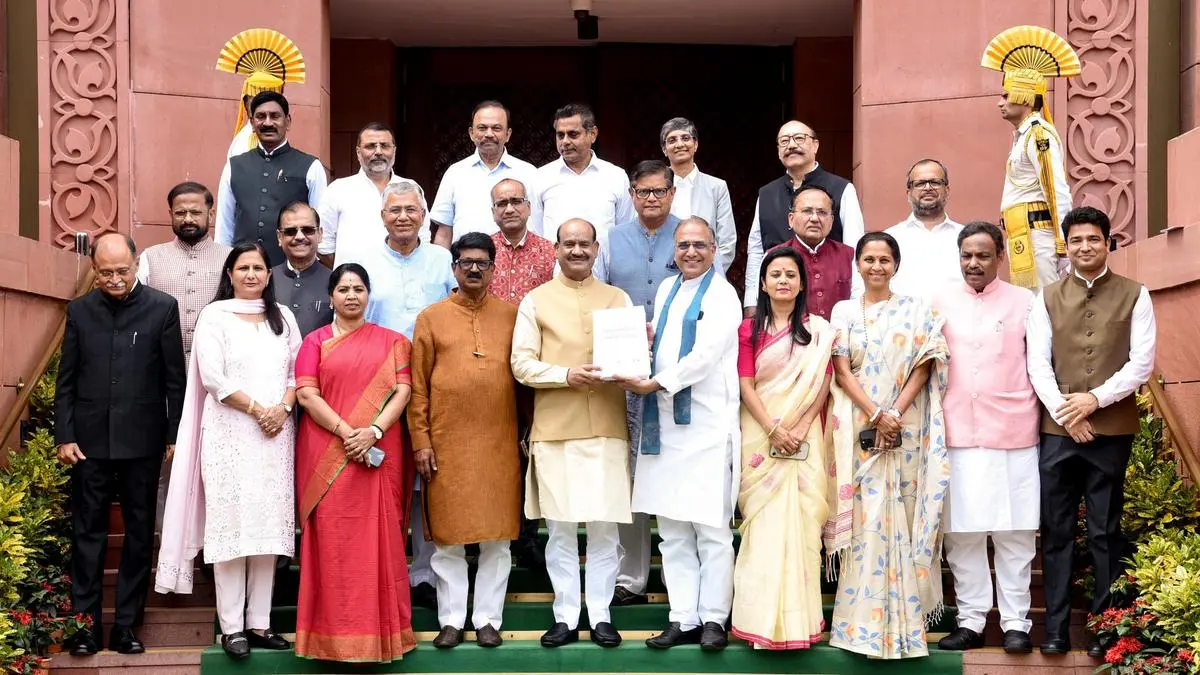
A bill to amend the Companies Act and Limited Liability Partnership Act is now expected be taken up for consideration and passage in the next session as the Parliamentary Panel looking into this bill needs more time to finalise its report on the bill.The Joint Committee on the Corporate Laws (Amendment) Bill, 2026 headed by Sudheer Gupta (MP, Lok Sabha) has sought time till the last day of the Monsoon Session to present the report. Earlier, the committee was asked to submit its report on the last day of the first week of the Monsoon Session. The Committee has so far held 23 meetings, with the last one on July 17.The Corporate Laws (Amendment) Bill prescribes enabling provisions to permit companies and Limited Liability Partnerships in International Financial Services Centres (IFSC) to transact and maintain books in permitted foreign currencies. At the same time, the bill provides a framework for conversion of specified trusts into LLPs.According to the statement and objects of the bill, the amendments provide for decriminalisation of procedural defaults under the Companies Act and the LLP Act, by replacing criminal provisions with civil penalties. Procedures related to mergers and amalgamations are proposed to be simplified through rationalisation of approval thresholds for fast-track mergers and enabling filing of applications before a single bench of the National Company Law Tribunal having jurisdiction over the transferee company.The bill, once enacted, will enable companies to hold Annual General Meetings and Extraordinary General Meetings through video conferencing or other audio-visual means, with the requirement to hold at least one Annual General Meeting in the physical mode within a specified period. There is provision to replace certain affidavits required under the Act with self-declarations. Also, it will enable multi-disciplinary partnerships for cost auditors and secretarial auditors in a similar manner, as provided for financial auditors.One key provision includes simplification of procedures relating to voluntary strike-off of companies to facilitate quicker and simpler closure or voluntary exit for companies. Another one talks about providing small companies further relaxations by providing exemption from mandatory Corporate Social Responsibility (CSR), requirements related to auditor appointment for the prescribed class of small companies, reduction in additional fees, etc.Further provision is about simplification of procedures relating to mergers, amalgamations through rationalisation of approval thresholds for fast-track mergers, enabling filing of applications before a single-bench NCLT having jurisdiction over the transferee company. There is a provision related to rationalisation of capital-related provisions, including changes around buy-back norms, including but not limited to periodicity. Also, there is a provision for introduction of enabling provisions for recognising instruments such as Restricted Stock Units and Stock Appreciation Rights, in addition to ESoP.Experts feel that the enabling provisions allow companies and LLPs in IFSCs to transact and maintain books in permitted foreign currencies are a significant step toward positioning India as a competitive global financial hub. “This is complemented by structural flexibility such as the introduction of a framework for conversion of specified trusts into LLPs, which is expected to benefit investment vehicles and regulated pooling structures by ensuring continuity of assets and contractual arrangements,” said Amit Maheswari, Managing Partner of AKM Global.Published on July 22, 2026
Bill to amend corporate laws is now expected to be taken up in the Winter Session
The Corporate Laws Amendment Bill, 2026 will be discussed in the Winter Session after the Parliamentary Panel requests more time.
523 words~2 min read