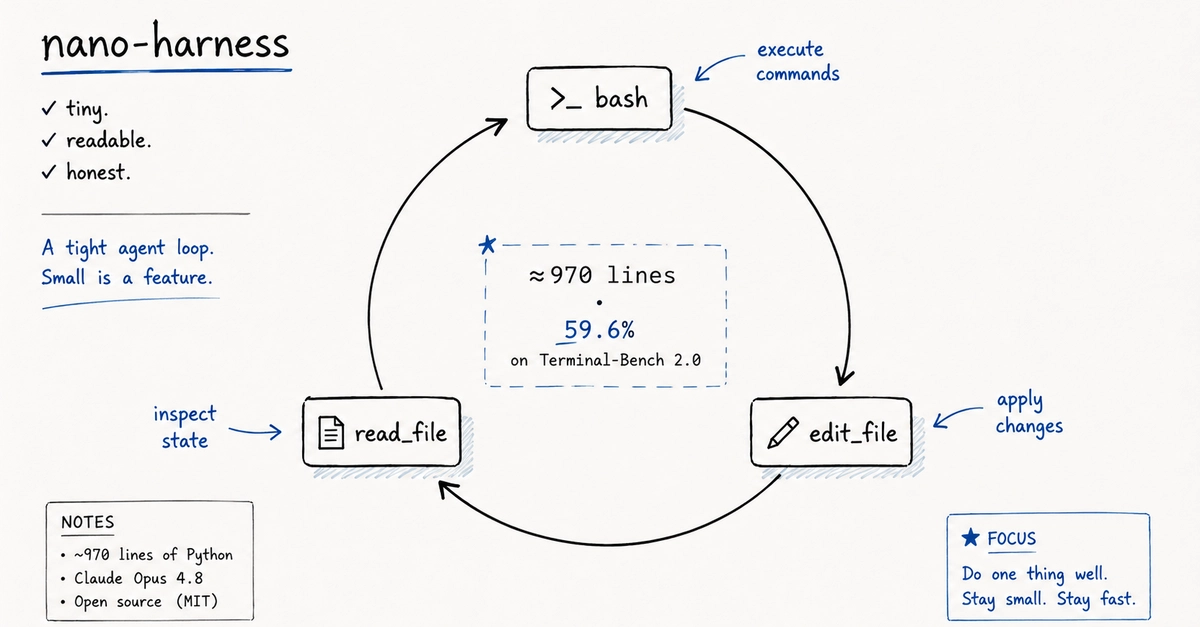
TL;DR: I built nano-harness a coding agent in ~970 non-blank lines of Python (5 files, 3 tools, 2 providers, MIT). It scored 59.6% (53/89) on the full Terminal-Bench 2.0 suite with Claude Opus 4.8. Along the way an independent frontier model (GPT Sol 5.6) reviewed the code and gave it a 4/10, which turned out to be the most useful thing that happened to the project. This is the whole arc the score, the bugs, and the parts that went wrong.
Why I built a harness at all?
Back in February I started reading about harnesses from none other than.... Andrej Karpathy, I think is llm-wiki had just gone viral and I saw this repo. So I read it and started reading more on harnesses and loops. This was before EVERYONE was talking about loops and harnesses and every YT video was about prompts and so on. I wanted to learn something new, and at the time was training my own model using Azure Machine Learning (which costed an arm and a leg to learn), then was using PyTorch to learn patterns within my AI Operating System. Anyways, most agent projects I was following led with features: plugins, orchestration graphs, UI dashboards, memory systems (their obsidian "second brain") all the same thing. I had a harder time finding small, readable harnesses paired with a reproducible full-suite benchmark score (and if you know anything about wanting to benchmark your harness it IS NOT CHEAP!). This really stuck with me and I didnt know why more people were talking about this, to me this was where everything was heading and the harness is the part of an agent you can actually engineer, so it's the part you should be able to code and measure.