Enterprise employees and customer service representatives have long been forced to work between two systems: the contact center, where conversations occur, and the CRM, where those interactions are documented manually. But as generative AI and voice AI mature, that long-standing divide is beginning to disappear.
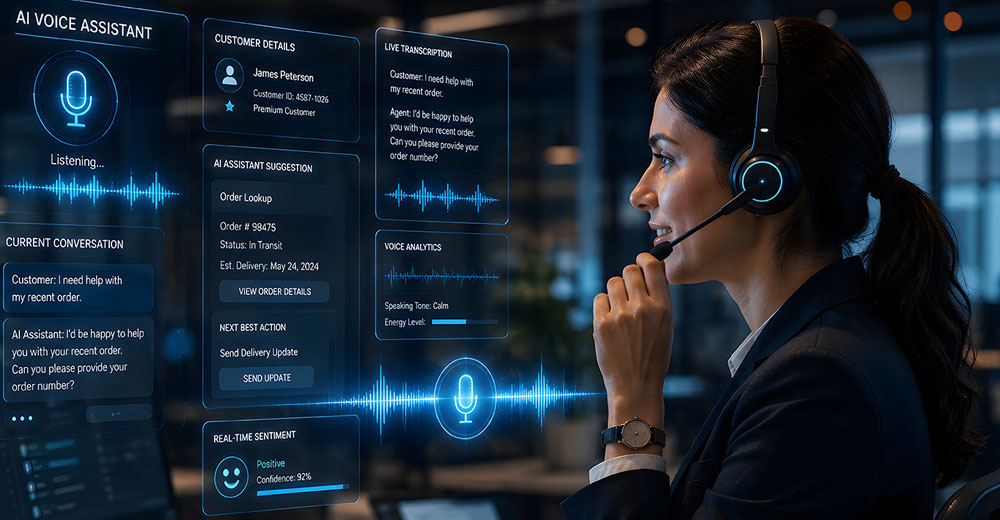
AI-powered voice assistants are changing how employees interact with CRM without forcing organizations to overhaul existing systems. Rather than replacing CRM, they sit on top of existing platforms, capturing customer conversations in real time, transcribing notes, updating records, tagging customer sentiment, and triggering backend actions across connected enterprise resource planning (ERP) and service systems.
Employees no longer have to manually log details across separate contact systems and databases because end-to-end speech-to-speech models and agentic AI enable voice assistants to handle complex, multi-step tasks through natural dialogue, rendering traditional interactive voice response (IVR) menu trees obsolete.
Industry analysts also see AI changing how employees use CRM systems. In an April 2025 analysis of the future of front-office software, Forrester wrote that CRM platforms will become increasingly accessible through AI agents and other business applications, with conversational interfaces becoming the primary user experience.