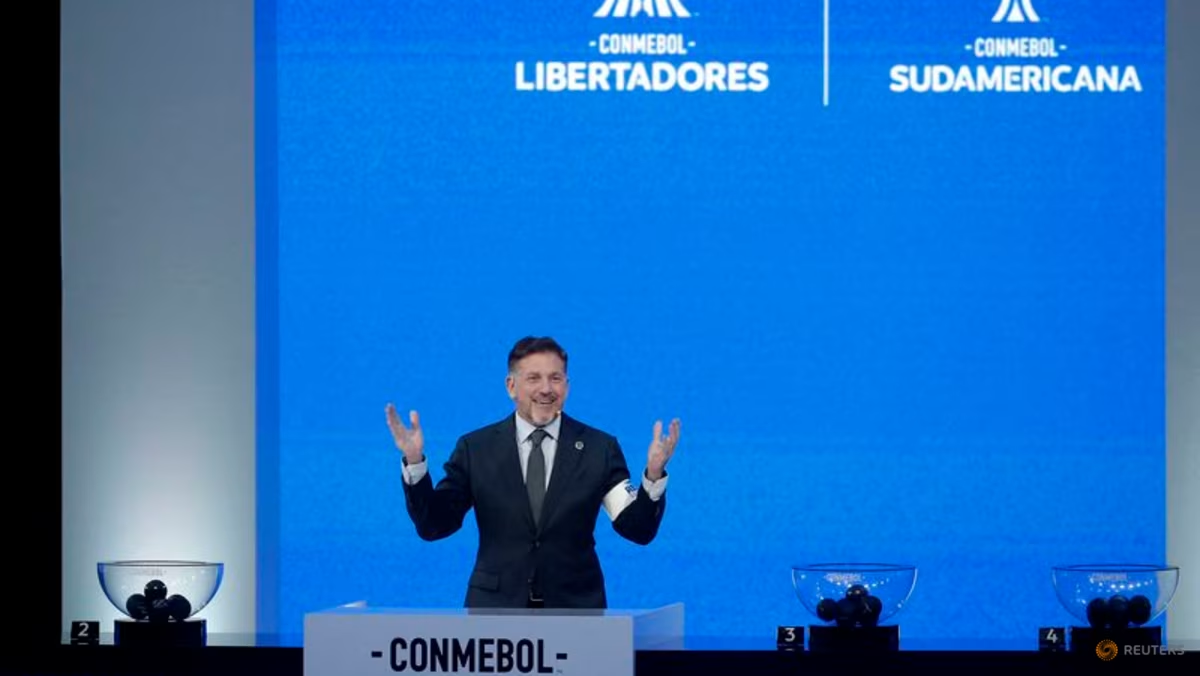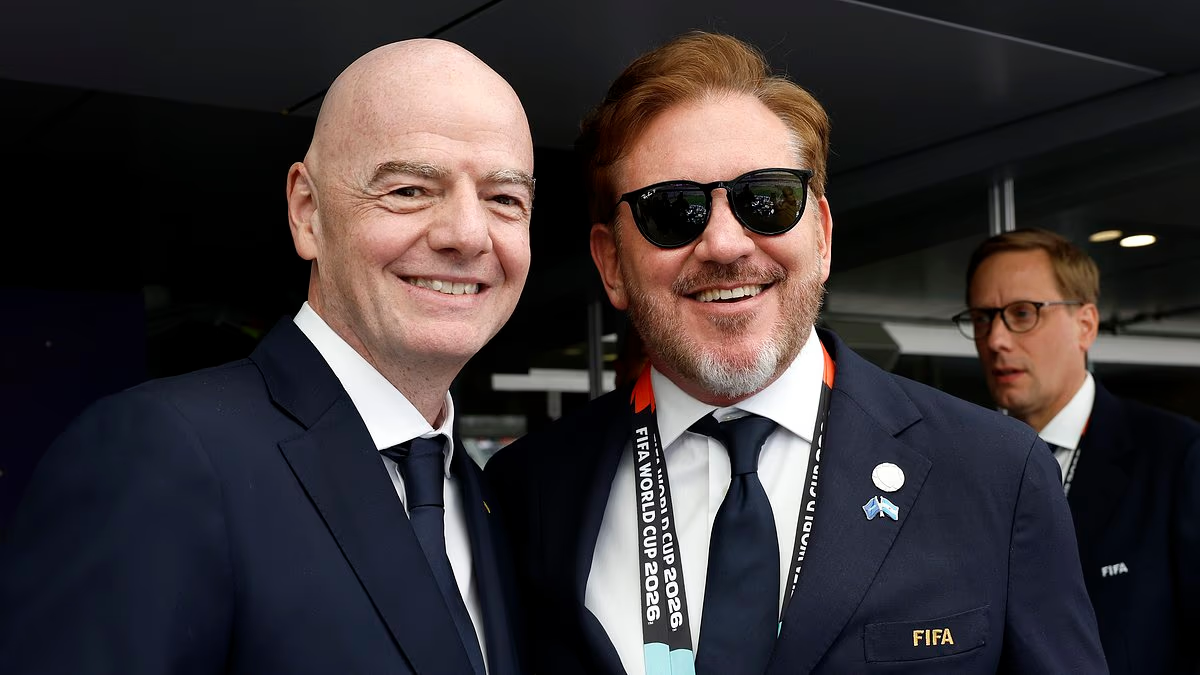
Alejandro Dominguez, the president of South American soccer’s ruling body Conmebol, has doubled down on his desire for the 2030 World Cup to be expanded to 64 teams.In September 2025, FIFA held discussions over expanding the World Cup again for 2030, which will be the 100th anniversary of the tournament, after receiving a formal pitch from a delegation of influential South American soccer leaders including Dominguez.This summer’s tournament in the United States, Canada and Mexico was the first to have 48 teams, with the World Cup previously a 32-team competition for its last seven editions. Last week, FIFA president Gianni Infantino confirmed the proposed increase would be examined.“In 2030, the World Cup comes to Uruguay, Argentina and Paraguay, a great opportunity for football, to celebrate the World Cup Centenary with a 64-team tournament,” Dominguez wrote on social media on Monday.
¡El próximo se juega en casa! En 2030 se viene el Mundial de Uruguay, Argentina y Paraguay, Una gran oportunidad para el fútbol, para celebrar el Centenario de la Copa del Mundo con una competencia con 64 equipos pic.twitter.com/ocIjHYCN5f
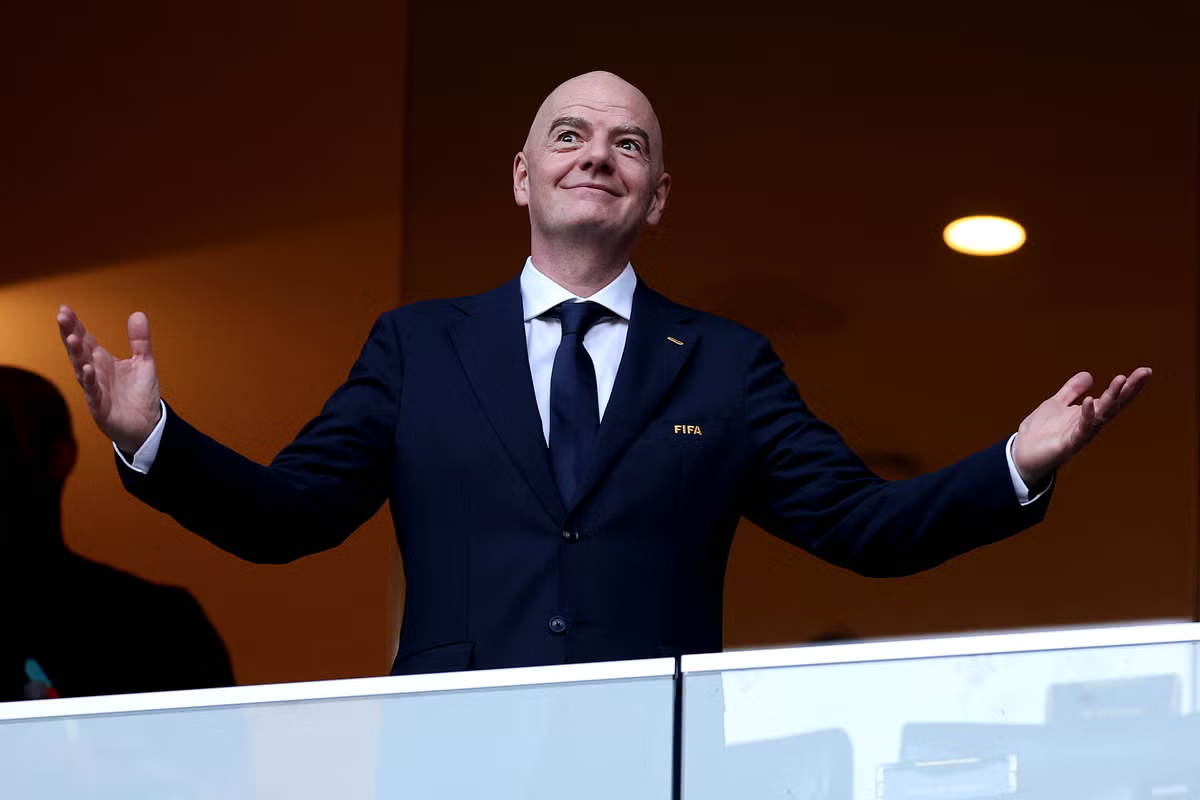
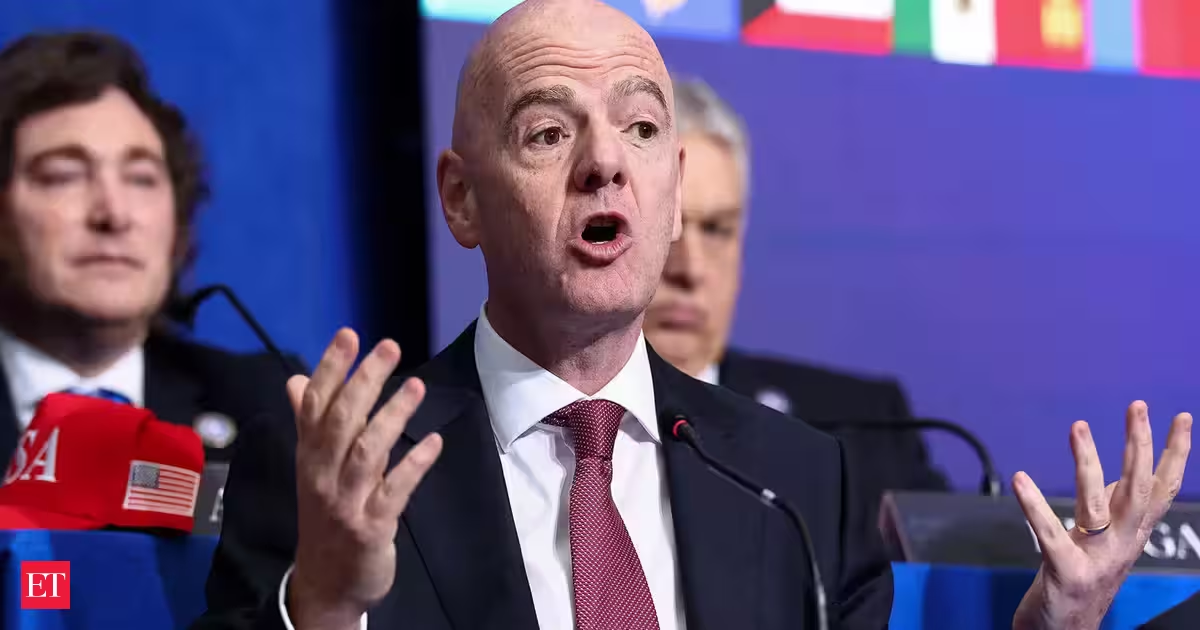
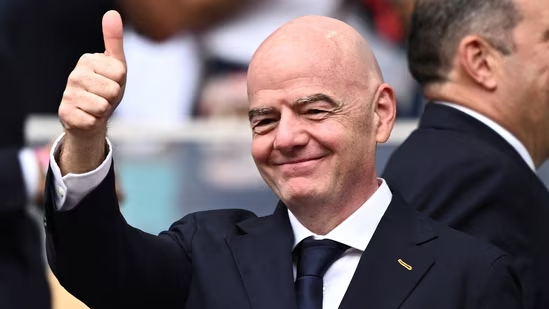
— Alejandro Domínguez (@agdws) July 20, 2026“We are working to ensure that the 2030 World Cup is held with 64 national teams in homage to the World Cup centenary,” Dominguez, who is also a FIFA vice president, added in a separate post.“International football grows when it opens up to the world. The expansion to 48 teams demonstrated that greater participation generates more opportunities, boosts the development of football, and turns the World Cup into a true global celebration.“The centenary offers us a historic opportunity to dream big. The World Cup will be the greatest celebration that football has ever known.”Dominguez, speaking to Sky News on Tuesday, added that the 2030 World Cup being the 100th anniversary means “it has to be a different party” and involve more nations.“We have to give the opportunity to more countries,” he said. “I think that the 48 teams was a totally successful World Cup.“More games for South America? I hope so, for sure.”FIFA has been approached for comment.The 2030 World Cup will be hosted between Spain, Portugal and Morocco but as it is the competition’s centenary edition, one match will be held in each of Uruguay (the hosts and champions from 1930), Paraguay (which houses Conmebol’s offices) and Argentina (the beaten finalists in 1930) at the start of the tournament.Speaking to Swiss media outlet Bluewin last week, Infantino said the expanded 2026 World Cup was “100 percent a success”.Not everyone agreed with this assessment. Ghana head coach Carlos Queiroz said after the group stages that the increase in teams devalued the qualification process and turned the tournament into something “vulgar and ordinary”.Would FIFA agree to an expansion?The World Cup has grown into a beast like no other event in sport. This summer’s tournament has been forecast to generate more than $10billion (£7.4bn) in revenue, touching every corner of the globe with its appeal. Even the Olympic Games has now been left trailing in its wake.FIFA has capitalised on football’s booming international popularity in recent times and has successfully built out a tournament that involved just 16 teams as recently as 1978 and 24 in 1994. Seven World Cups since then kept the number of participants consistent at 32, but an expansion to 48 teams for this year’s event has left FIFA wondering if this thing can go bigger still.Why has the World Cup expanded to 48 teams?Matt Slater and Reuben PinderThe past month might well have emboldened the expansionist view. Infantino has called the first 48-team World Cup a “huge success”, with debutants including Cape Verde holding their own against the established order. Nine out of Africa’s 10 teams advancing to the last 32 has also been highlighted as a metric for progress.“Every nation should be allowed to dream of participating in the World Cup,” Infantino told Bluewin. “If you don’t give the smaller countries a chance to participate in the World Cup, they’ll lack the incentive to keep improving.”Infantino, pictured at a pre-tournament press conference on June 10 (Carl Recine/Getty Images)FIFA will always point to its responsibilities in growing the game around the world and further expansion, widening their own income streams in the process, and it is something they will at least discuss ahead of the next World Cup in 2030. That will be co-hosted by Spain, Morocco and Portugal (with the three opening matches held in Argentina, Uruguay and Paraguay).Philip BuckinghamHow would it work?That is currently unclear, but the logical step would be 16 groups of four teams, with the top two in each advancing to a round of 32. That could be a tidier option than the current format, which saw the eight best third-placed teams advance, but it would take the tournament up to 128 games — double the number of Qatar 2022.(Leonardo Munoz/AFP via Getty Images)The path from 36 teams to 48 teams was not straightforward. It was first discussed in 2016 and then unanimously approved by the FIFA Council — FIFA’s decision-making body made up of the president, eight vice-presidents and 28 elected members — for the 2026 World Cup the following year. The hosts for 2026 had not been confirmed at that point, but FIFA announced that there would be 16 groups of three, with the top two from each advancing to a knockout round of 32.That promised to ensure teams would play no more than seven games during a 32-day tournament, but those plans did not last. By 2023, it was decided the format should be 12 groups of four, increasing the total number of games from 80 to 104. FIFA said scrapping groups of three teams mitigated the “risk of collusion” and also guaranteed three games for each nation. The tournament’s duration, though, had ballooned to 39 days, a decision that has been routinely criticised by players’ unions.The logistics behind hosting a 64-team event would also be challenging. Adequate bases would need to be found for all 64 teams, as well as suitable stadiums to cope with the additional matches.Would further expansion be popular?A 64-team tournament would see more than a quarter of FIFA’s 210 men’s international sides compete and would risk rendering many regional qualification processes meaningless.Six of the 10 Conmebol nations already qualify automatically for a 48-team finals, with an additional play-off qualification spot.In April, UEFA president Aleksander Ceferin dismissed the proposal as a “bad idea”, saying it would damage both the tournament itself and Europe’s qualifying competition. His North American counterpart, CONCACAF president Victor Montagliani, holds a similar view, saying it was “not a great idea.”UEFA president Ceferin spoke against the idea of a 64-team World Cup at his association’s congress in April (Pedrag Milosavljevic/AFP via Getty Images)Asian Football Confederation (AFC) president Sheikh Salman bin Ibrahim Al Khalifa has made his opposition known, questioning last year where the expansion might end.“Someone might come along and demand raising the number to 132 teams,” he said at an AFC conference in April 2025. “Where would we end up then? It would become chaos.”There is also a scarcity value to consider. A 64-team tournament would likely see 96 group games played, saturating the opening two weeks and diluting the spectacle. Maintaining interest levels would then become a challenge not previously faced by the World Cup.