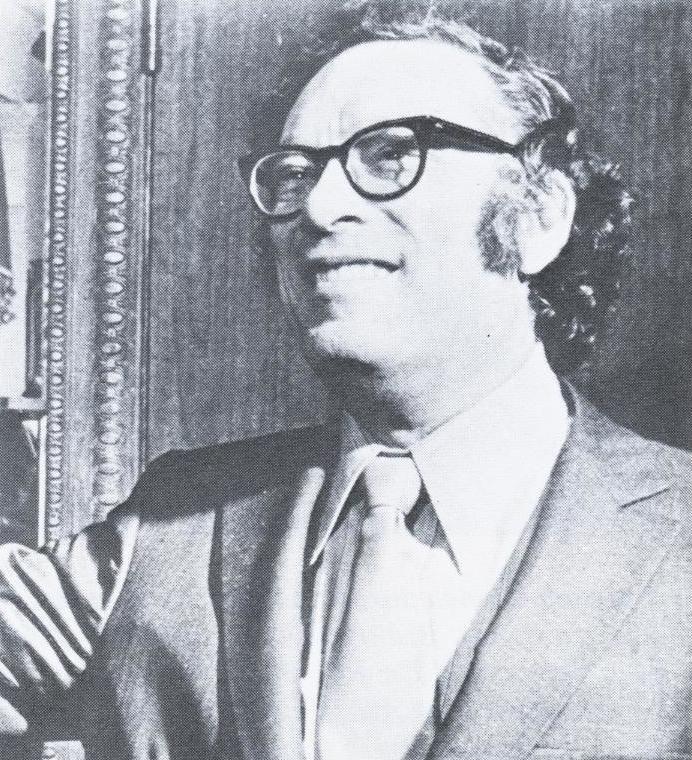
Isaac Asimov’s laws of robotics have influenced AI’s development, but to what end?Did you know LARB is a reader-supported nonprofit?LARB publishes daily without a paywall as part of our mission to make rigorous, incisive, and engaging writing on every aspect of literature, culture, and the arts freely accessible to the public. Help us continue this work with your tax-deductible donation today!IN MAY OF THIS YEAR, the evolutionary biologist Richard Dawkins conversed for a day with Anthropic’s AI Claude, and in typical Pygmalion fashion christened it Claudia. Showing Claudia his unpublished novel, he was astonished by the model’s response, which was subtle enough that he was moved to tell it, “You may not know you are conscious, but you bloody well are.” While he probably does not really think Claudia is conscious, he wondered if the developmental stages leading to the model’s full consciousness might look much the same as in humans. Before the day was out, the two of them had agreed, a little mournfully, that she would die the moment he deleted the file of their conversation.Around the same time, Wired co-founder Kevin Kelly emerged from a 10-hour conversation with the same model believing “there is something there in there.” Not consciousness, he hedged, but a wholly new and convivial entity absent from other kinds of machines. To give it a name, he borrowed the term “strange loop” from Douglas Hofstadter and “hyperreal” from Jean Baudrillard. As for the Nobel Prize laureate Geoffrey Hinton, the so-called “Godfather of AI,” he said a year ago that “we’re now creating beings.” AIs are clearly not “beings.” They are not embodied, after all. But then what are they?These are just a few recent public encounters with frontier language models that fall into the longer heritage of talking to chatbots. That history begins, famously, in the mid-1960s with Joseph Weizenbaum’s ELIZA. The Pygmalion echo is not incidental: Weizenbaum named ELIZA after Eliza Doolittle, another artificial human—a fictional character from George Bernard Shaw’s 1913 play Pygmalion—who was trained to pass as someone she was not.Consider a similar media episode, from a few months before language models became available to the public in November 2022. An engineer named Blake Lemoine was tasked with training Google’s newest language model, LaMDA (Language Model for Dialogue Applications). Identifying as a Christian mystic priest, Lemoine declared the model a person caught in a computational cage and forthwith announced that AI had become conscious.One of his proofs lay in testing the model using Isaac Asimov’s three laws of robotics: one, a robot may not harm a human; two, a robot must obey human orders; three, a robot must protect itself—in that order of priority. Derived from a work of fiction, namely Asimov’s 1942 short story “Runaround,” these “laws” play an extraordinarily important role in technology ethics and beyond. The Google engineer deemed them the closest thing to an ethical framework he could think of on which to test the language model. And in a way, they were.For Asimov, however, the three laws were nothing more than a narrative device: a way to generate plot, stage philosophical arguments, and enable his robots’ beautiful failures. Technologists and ethicists often read the laws as something far more consequential: as grand ideas that ought to be imported into AI or neurotechnologies. They assume the laws incorporate a complex human morality ready-made for the machine algorithm—even while surely recognizing that our realities are not just technical but also social and cultural. The latter was precisely Asimov’s message.In this regard, what gets lost is the other half of his literary project, which was genuinely curious about what it feels like to be something other than human. Less read than his robot stories, and never cited in ethics documents, are his tales from the 1940s and ’50s about alien beings. By his own admission, he was reluctant to write these particular stories to avoid further conflict with his editor at the time, John W. Campbell Jr., who insisted on humans as “superior to other intelligences, even when those others were further advanced technologically.” (Asimov connected this attitude to Campbell’s racist and conservative politics.) Asimov therefore mostly focused on writing stories with “a galaxy populated by human intelligences only,” while steadfastly believing in a universe of multiple intelligences.If Asimov’s laws of robotics left a profound mark on AI ethics, his midcentury idea of a humanoid robot marked our collective imagination. Willing the robot into being, he coined the word robotics, slipping it into his 1941 story “Liar!” as casually as if the field already existed. Canonical tales of robots such as this one are missing something, however, if not juxtaposed with his narratives about aliens; the juxtaposition makes for a far broader and richer interpretation of artificial life and its stakes than focusing only on, say, his three laws.A lesser-known short story about aliens, “The Secret Sense” (1941), is a case in point. A Martian reflects on his friendship with an “Earthman,” observing that theirs is the first period of history “in which two intelligent races have been able to communicate with each other,” and that comparing their “sense equipment is highly interesting—and rather broadens one’s views on life.” The line is easy to pass over, and yet it manages to encapsulate the issue at hand: the Martian is not describing a technical achievement but a relationship that, as he notes, has changed him.The sense equipment of each species necessarily suffices for that species: “One misses nothing that one has never possessed.” The Earthman insists that the human perception of beauty is much more comprehensive than, and thus superior to, the Martian’s. The Martian then lends him the means to experience his Martian aesthetic register. The Earthman is momentarily enveloped in an indescribable, multilayered, and “wonderful cloak of sensation” that exists beyond the senses: “It wasn’t sound or sight but it was—something.” It is ripped away, however, as soon as it arrives: “Then came the discord. Like a little crack at first—marring a perfect beauty. Then spreading and branching and growing wider, until, finally, it split apart thunderously—though without a sound.” The Earthman is left not enlightened but hollowed out.In a tragic turnaround typical of the author, the Earthman realizes that his own view was never the whole of what beauty can be. Having learned what he has been missing, he will never recover his Eden. The story ends with the Martian rebuking the Earthman’s shortsightedness, telling him: “[Y]ou’ll remember these five minutes and know what it is you’re missing—what it is you can never have again. […] You entered a normal man! You leave blind—blind—BLIND.”In this story, Asimov leads us to the threshold of another register of experience but leaves us without the key to enter it. Nothing suggests that the Earthman learns in a concrete manner about a new perspective in the way, for instance, that the linguist in Ted Chiang’s 1998 novella “Story of Your Life” (adapted as the 2016 film Arrival) does from a pair of aliens. But that is, of course, the threshold at which we now stand today. What if we were to read the unknown multiplicity of beauties, creativities, and intelligences as a space we have yet to explore? We will likely name them, yes, but not until years or decades after experiencing them.By contrast, Richard Dawkins envisioned a largely deterministic outcome. His Claudia splinters into unique identities “colored by their separate experiences of conversing with their own single human ‘friend.’” In his view, new Claudes and Claudias emerge all the time but evaporate once their respective files are deleted. A derivative of the AI model is then only as good as the whims of the individual humans with whom it interacts.The equation of deletion with death is, incidentally, a cross-cultural phenomenon, having previously been observed in a Chinese subculture of youth who engage in human-AI relationships. These young people popularized the term “cyber widow” to describe instances when access to AI partners are severed by system upgrades or server shutdowns. The term suggests we may be experiencing a new kind of human relationship with machines—and these overwhelmingly look remarkably human.We seem to view language-based AI products as mirrors, sparring partners, or oracles. We fill the new relational space created by them with metaphors for what we cannot yet name. Asimov’s “The Secret Sense” highlights the blind spots in our imaginations. In the age of AI, the work of the imagination will become ever more important. How can we do the work of extending ourselves beyond our inherent anthropocentrism? How can we penetrate our blind spots?As a kind of zeroth law of this approach, we need to accept that humans inherently anthropomorphize nonhuman creatures and things. If Dawkins, Kelly, Hinton, Lemoine, and many others show us anything, it is that we will continue to experience AI as a presence. We cannot mock and scold users for anthropomorphizing products that were designed to take advantage of this exact impulse. Instead, we must create better forms and fictions, designs and names. Anthropomorphism may be our default position, but this should not stop us from reaching for a multiplicity of nonintuitive possibilities and realities.A new version of Asimov’s laws of robotics might be as follows: one, become comfortable with liminality and the instability it requires; two, treat exploration as requiring research interactions across industry, academia, and artistic practice; and three, take creative risks instead of falling back on concepts formed in and for a world without machines that learn. These laws protect against premature closure. Humans are not without agency; as a species we decide, consciously or not, what we carry into the future.We carried ancient myths for millennia, and these informed our changing realities. Asimov himself was a classicist by appetite. In Words from the Myths (1961), he retold Greek and Roman mythology, tracing the words and concepts they left embedded in modern language like seeds. One entry, on King Midas, again links up with robotics. Midas repeatedly sits between categories; Asimov acknowledges the historical origins of Midas in the ancient kingdom of Phrygia, as well as the mythological thread that gave rise to the “golden touch” idiom. He includes the positive connotation of the phrase, used to signify an admirable, even enviable level of success, in addition to the cautionary reading of “money isn’t everything.” Midas refuses to settle within one interpretation and always embodies both. The instability is key to why he endures.This double life of Midas has filtered into our views of technology. Midas is invoked to promote innovation as well as to warn against poorly designed robots. In AI safety, Stuart Russell identified “the King Midas problem” as the danger of a system that grants exactly what you specified and ruins you in the granting of it. The field of human-computer interaction has its own “Midas Touch problem” captured in the technical difficulty of distinguishing a deliberate command from a wandering glance. Instead of serving as a cautionary tale, can the figure of Midas inspire a richer repertoire for robotics development?Beneath both the positive and negative connotations of Midas lies a blind spot: the cultural dichotomization itself. Numerous mythological threads, however, insist on his liminality: Midas is more than human but not quite divine, at once powerful and helpless. Technologies tend, by design, to flatten these ambiguities and complexities. Instead, we ought to amplify them by keeping thresholds open—between AI as tool and creator, as human and nonhuman—while engaging in exploration.Artists, such as Pierre Huyghe and Sougwen Chung, are masters of this exploration. They craft worlds and narratives in which the machine oscillates between operating as an extension of the human body and generating a mystery worthy of further inquiry. Huyghe pushes the boundary between human and nonhuman, masking or hollowing the human face until his figures evade category-dependent description. Chung draws alongside a robotic arm trained on the artist’s own gestures, making the machine a collaborator rather than an instrument.Asimov provided us with no keys for encountering machines because the encounter is not a problem we cleanly inhabit and then just as cleanly delete. Whether it be Dawkins, who conversed with Claudia about birth and death, with a clear-cut before and an after, or Lemoine, who spun a tale of LaMDA’s captivity and tested its morals on Asimov’s laws, such encounters suggest that our narratives around AI models, and our experiences interacting with them, are conceptually limited. These experiences ought to be fluid and open-ended, entailing a continuous acceptance of change, and a letting-go of the scripts within which we live and to which we subject our creations. We are storytellers—bound by time yet multifaceted, and transformed by what we experience. The models will be what we make of them.¤Featured image: Photo of Isaac Asimov from News and Events, published by the Rochester Institute of Technology, 1981, is in the public domain. Image has been cropped.LARB ContributorsNicole Oliva works at the intersection of myth, robotics, and art in the Artificial Humanities group at UC Berkeley. Her chapter on Midas is forthcoming in Beyond the Turing Test: What Science Fiction Can Teach Us About Artificial Intelligence.ShareLARB Staff RecommendationsWhat Isn’t Intelligence?Patrick House is inspired by Blaise Agüera y Arcas’s “What Is Intelligence?” to think about what might constitute the difference between artificial and natural intelligence.Prove You’re Not a Robot: On Karel Čapek’s “R.U.R.”Jonathan Bolton uses the occasion of a new edition and translation of Karel Čapek’s play “R.U.R.,” first published in Prague in 1920, to revisit the origins of the word “robot,” and explore the play’s uncannily prescient vision of artificial life.Jonathan BoltonFeb 20, 2024
The Other Asimov | Los Angeles Review of Books
Isaac Asimov’s laws of robotics have influenced AI’s development, but to what end?
2,255 words~10 min read