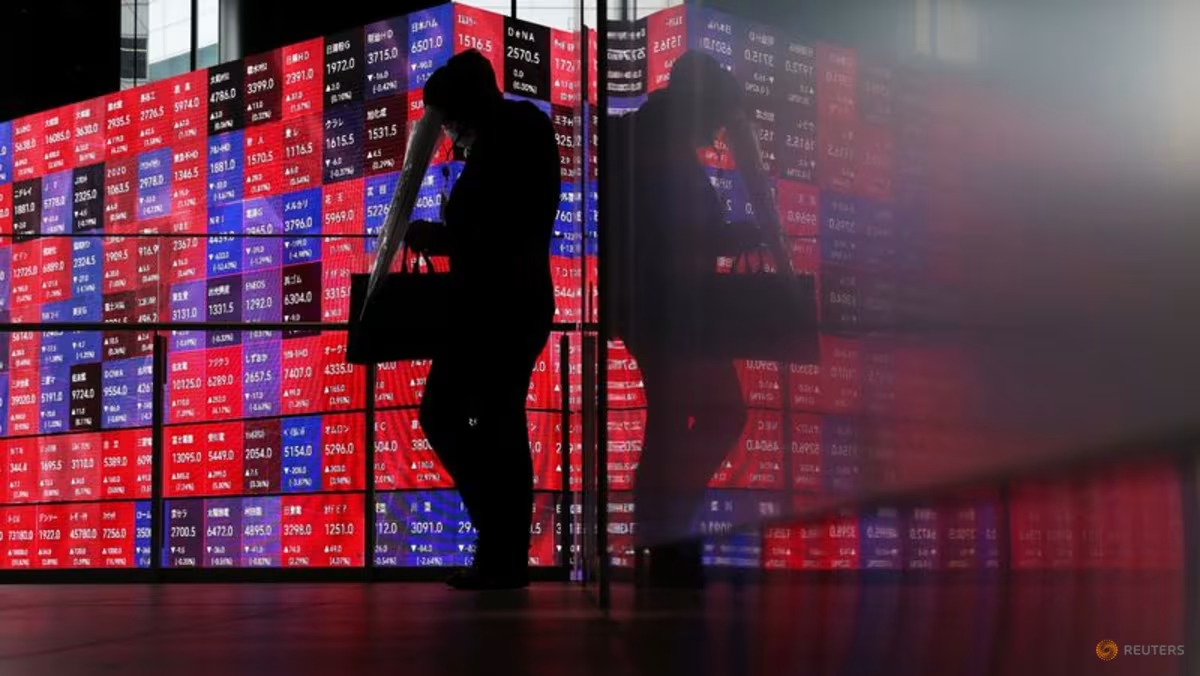
LONDON - Stocks edged up on Monday as investors fine-tuned positioning ahead of a packed week of major tech earnings which will test the artificial intelligence trade, while keeping a nervous eye on developments in the Gulf. The short-term focus again was oil prices, which swung sharply as investors weighed Yemen's Iran-aligned Houthis declaring a naval blockade against Saudi Arabia against Reuters reporting that mediators had passed Iran a proposal to de-escalate the war with the U.S. Benchmark Brent crude was flat on the day at $88.3 a barrel, having earlier climbed above $90 for the first time in more than a month. But that was enough to help equity markets stabilise after last week's chip stock-led pull-back. Europe's broad STOXX 600 nudged higher, led by a 0.8% gain in tech stocks. In the U.S., futures on the tech-heavy Nasdaq 100 rose 0.9%, and broad S&P 500 futures gained 0.4%. U.S. equity markets are in focus this week as the second-quarter earnings season picks up pace, with several major companies, including Alphabet, Tesla, Intel and IBM, reporting earnings. The earnings will reinforce or challenge this year's gains, which have been driven by a surge in AI capital spending lifting semiconductor stocks and other companies that are seen as the beneficiaries of the buildout. Investors are already jittery, and the powerful rally in chip stocks gave way to a sharp reversal last week. The earnings season will also provide more colour on secondary effects of the war. "(The situation in the Gulf) was the dominant story in March, April, May and still very important, but something broader is playing out," said Samy Chaar, chief economist at Lombard Odier. He said that as well as watching the key Strait of Hormuz, investors were also looking at governments' and companies' efforts to diversify and build alternative supply chains in the medium term. "To secure anything, you're going to have to put down the money. That means capital expenditure, demand, profits, and broader economic gains," he said. INFLATION FEARS STILL TOP OF MIND In bond markets, traders are focused on what the renewed rise in energy costs means for inflation, even after U.S. consumer price data surprised on the downside last week. Futures markets are pricing in at least one Federal Reserve rate hike by year-end, and on Monday the benchmark 10-year Treasury yield was at 4.56%, up 2 basis points. Yields on 30-year Treasuries are also back above the psychological 5.0% barrier, a level that tends to attract funds away from equities and toward fixed income while lifting the valuation bar for future corporate earnings. Money markets see more tightening from the European Central Bank, which they see as likely to raise rates again in September. They are also pricing an 80% chance of a further move by year-end. The policy-sensitive German 2-year yield rose to a peak of 2.817% on Monday, its highest in two years. Traders in Europe are also watching gas prices, which hit a four-month high on Monday morning. Currency markets were broadly calm, but the focus was on sterling, as Andy Burnham became Britain's seventh prime minister in a decade. The pound strengthened on the euro, which was down 0.17% at 84.88 pence, but gave back earlier gains on the dollar to trade flat at $1.3451.
Choppy oil keeps investors on edge, stocks brace for big earnings week
The short-term focus again was oil prices, which swung sharply as investors weighed Yemen's Iran-aligned Houthis declaring a naval blockade against Saudi Arabia against Reuters reporting that mediators had passed Iran a proposal to de-escalate the war with the U.S. Benchmark Brent crude was flat on the day at $88.3 a barrel, having earlier climbed above $90 for the first time in more than a month.
548 words~2 min read