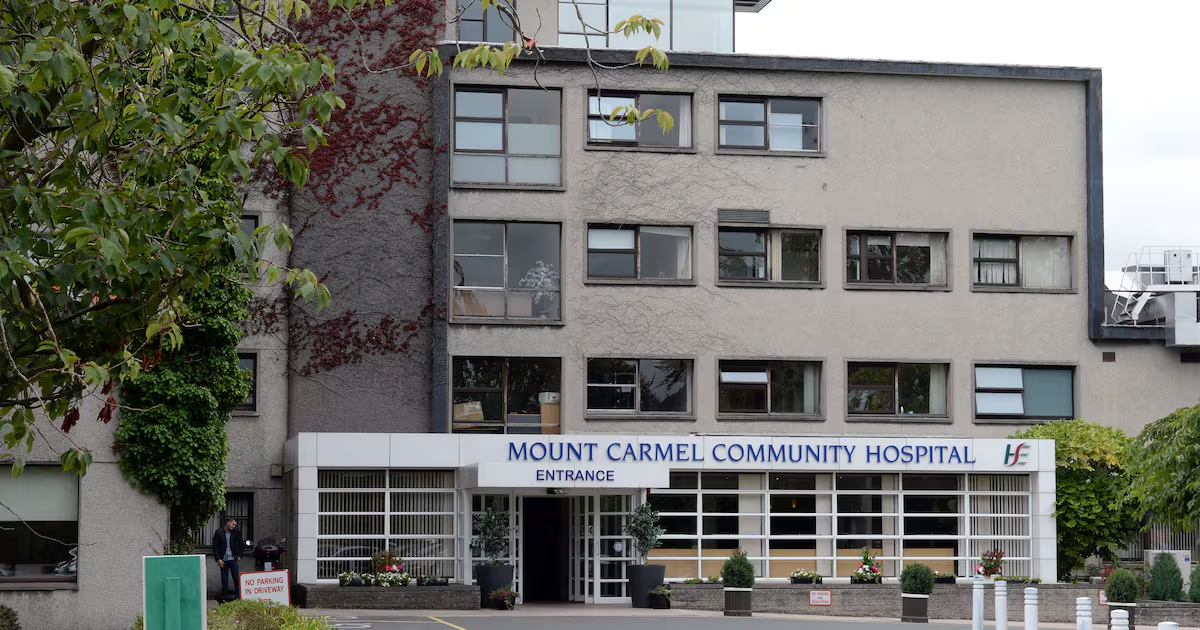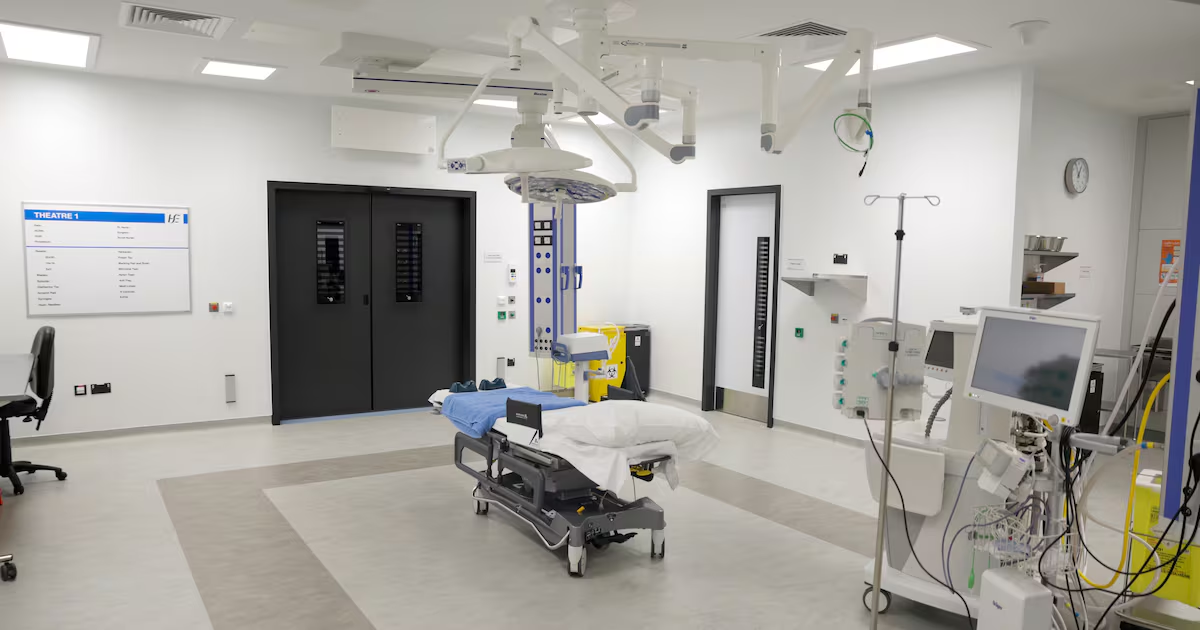
Brand new everything, everywhere you look, makes the HSE Dublin and North East Surgical Hub seem a world apart from crowded, dated hospital facilities that most public patients are accustomed to.It is here, at the back of a tranquil business campus in Swords, Co Dublin, where a road sign warns of ducks crossing, that patients in the region are starting to be referred for minor procedures and day-case surgery. The purpose-built complex, with four theatres and two minor procedures rooms, is providing a much-needed extension of surgical space for five hospitals in the region.This is a physical manifestation of the long-held Sláintecare aim to separate scheduled care from non-scheduled care. Away from the acute hospital settings, the idea is that operating lists here are ring-fenced from the knock-on effects of hectic nights in the emergency department.Inevitably, urgency trumps the routine in healthcare when people are competing side by side for theatre space. However, it’s of no comfort to patients psyched up for say, removal of a skin lesion, or a hernia repair, or cataract surgery, when they get a last-minute cancellation call over a long-awaited appointment.“Low complexity, high volume” is the mantra for cases assigned to the new hub, which is for public patients only in the HSE region that covers Dublin North, Cavan, Monaghan, Louth and Meath. The doors opened to patients on June 22nd and the plan is to be fully operational, 8am to 8pm, Monday to Saturday, by the end of the year.[ Consultants bring legal challenge to ban on private care in new public surgical hubsOpens in new window ]The facility has its own nursing, social care and other support staff, while surgical teams from the acute hospitals go in and out to work on their own cases. Each day is allocated to a different hospital. For example, consultants from Beaumont Hospital have the space at their disposal on Mondays and a half day on Tuesdays. The Mater has an equal amount of time on other days, while the rest of the week is divided between the Rotunda Hospital, Connolly Hospital Blanchardstown and Our Lady of Lourdes Hospital, Drogheda. Saturdays will alternate between Beaumont and the Mater.“This is a huge opportunity to test how the public-only consultant contract is being used or not used, rostered or not rostered,” said the Minister for Health, Jennifer Carroll MacNeill, when speaking in the Dáil in April about the hub before it opened. “This is as much about how people are working as about where they are working… We cannot keep building more physical capacity if people are not going to use it differently.”In this start-up phase, the hub is open four days a week, and two of its theatres are sealed off with opaque drapes while being completed. There are no patients on site the day that The Irish Times is walked through the hub.Any attending patient is picked up by a nurse from the reception area. From there, pathways diverge depending on the nature of the appointment, be it to outpatients, or minor procedures, or across the “red line” of the operating theatre area. Here, only staff in full scrubs, hair coverings, masks and clogs are permitted, as surgery-prepped patients arrive in.A staff base at the new surgical hub in Swords. Photograph: Enda O'Dowd/The Irish Times An operating theatre in the new Swords surgical hub. Photograph: Enda O'Dowd/The Irish Times Integrated healthcare manager for Louth Meath, Paddy Clerkin, outside the new HSE surgical hub in Swords. Photograph: Enda O'Dowd/The Irish Times With considerable investment in surgical specialities, particularly over the last five years, physical infrastructure has been the challenge, according to Paddy Clerkin, HSE integrated healthcare area manager for Louth Meath. While he is not saying some surgeons may have been left twiddling their highly trained, costly thumbs, clearly they need theatre space to do their work.“What surgeons want to be doing is operating,” says Dr Eamon Dolan, regional clinical director for HSE Dublin and North East, as he stands in the hub’s 21-bay day ward, navy blue curtains pinned back around each trolley space for the moment. “This offers that opportunity for them to come in, get their work done, in a nice environment… know that it’s safe, then go back to the other parts of their work where they’re badly needed as well.”As it is not adjacent to an acute hospital, “there’s a certain degree of surgical complexity that can’t happen here”, he explains. Patients are carefully triaged to make sure they are suitable for treatment at the hub. In the very unlikely event of somebody becoming unwell and needing an overnight stay after surgery, they will be transferred to the hospital from which they were referred.This surgical hub is the second to open in a planned network around the country, but the first to be built specifically for this purpose. The first in the network was opened in part of the repurposed, former private maternity hospital, Mount Carmel, in south Dublin in February 2025. Construction of the €35 million-plus Swords hub by Sisk took 18 months, and its commissioning took six months. The hubs are modelled on the successful Reeves Day Surgery Unit in Tallaght, an initiative of Tallaght University Hospital supported by the HSE, which has significantly reduced waiting times there for a variety of elective procedures.[ Number of ‘urgent’ colonoscopy referrals not seen on time almost triplesOpens in new window ]Making inroads into long national waiting lists is not only essential for those needing treatment, but also a political imperative. The shifting sands of improved efficiencies combined with increased numbers of referrals, along with regional and speciality variations, mean that meaningful progress for any given type of patient is hard to gauge for outsiders looking in. The huge amount of data published on the HSE’s website on national waiting lists, even with all the available filters, can be confounding to an individual waiting for their appointment call.A reduction of about 50 per cent, or approximately 141,000 less patients, waiting over 12 months since September 2021, was reported in the National Treatment Purchase Fund’s latest monthly update on the waiting list figures in June. The Government, however, says it is committed to reducing waiting times for all patients to the Sláintecare targets of no more than 10 weeks for an outpatient department case, and 12 weeks for inpatient/day cases and gastrointestinal endoscopy scopes.The smell of newness lingers in the air at every turn in the Swords hub. The uniform fitting out from scratch, in the clinical and public areas, and with all the signage (which includes Braille), contributes to a sense of calm. The spotless white corridors are unadorned with artwork – there was no budget for that apparently.Waiting area at the new surgical hub in Swords. Photograph: Enda O'Dowd/The Irish Times Siobhán Byrne, general manager of the new Swords surgical hub. Photograph: Enda O'Dowd/The Irish Times Throughout the facility, “things are running a bit quicker because everything is new, sharp”, says the hub’s general manager, Siobhán Byrne. “There’s very little [time] wasted.” Just 15 minutes or less is needed to clean a theatre between surgeries.Seating located along one side of the corridor directly outside the minor procedures rooms is unusual, she says, but it is designed for efficient patient flow. If they are working through a “pain list”, she says, “we could have 20 patients rotating in a three-hour period”. A row of blue upholstered chairs merges into orange ones, so nurses who first assess each patient in a room at the top of the corridor use colour coding to direct them to sit outside either room one or two.After treatment, they are wheeled to “second stage recovery” within the day ward, where a central, multidisciplinary staff station supervises them until they are ready to be discharged and walk out.[ Two-thirds of public hospitals have unsafe bed-occupancy levels in first half of 2025Opens in new window ]The first four bays of this ward are used for “day of surgery admissions”- any procedure under general anaesthetic. Here, patients can stow belongings in a locker, give consent for surgery, and are marked up, before being walked by a nurse to the “red line” of theatre, to be picked up by a colleague on the other side. After surgery, patients are wheeled on their trolley to an 11-bay “first stage recovery” room to come around before returning to the day ward for second stage recovery.Byrne also highlights an innovative, multi-door hatch from the theatre area to the outside of the building, which allows specimens for testing at the Connolly Hospital labs to be securely handed over for collection, without the courier having to come into the building or a staff member having to bring them to reception.A recovery room at the new HSE surgical hub in Swords. Photograph: Enda O'Dowd/The Irish Times Dr Eamon Dolan, regional clinical director, HSE Dublin, at the new surgical hub in Swords. Photograph: Enda O'Dowd/The Irish Times A procedure room in the new surgical hub. Photograph: Enda O'Dowd/The Irish Times Some consultants will be able to use a “see and treat” approach at the hub, explains Dolan. After assessing a patient in the outpatients department, they can recommend a procedure is done straight way, within the same visit.A pleasant environment and location away from the city centre are clear attractions for staff as well as patients, with the bonus of free parking. There is a short walk from the nearest bus service. Ongoing recruitment for the hub has not been a problem, says Byrne, although an operator to take over the empty space designated for a coffee shop is yet to be found.With a national digital One Health Record for patients still many years off, the hub’s IT network has to communicate with six different feeder systems. A uniform electronic record will certainly facilitate the operation of a hub such as this, says Dolan, adding: “The ambition is we will be the first region in Ireland to have that rolled out.”The timeline? Three years, he hopes. Then patients will no longer leave this state-of-the art hub with a discharge summary paper in their hand; it will be on the phone in their pockets.Drive to separate scheduled carePreparation room in the surgical hub. Photograph: Enda O'Dowd/The Irish Times A network of surgical hubs for minor procedures and day-case surgeries is part of the drive to separate scheduled care from non-scheduled care for public patients.Here is where they will be located around the country:South Dublin: First floor of Mount Carmel Community Hospital, Churchtown, opened in February 2025.North Dublin: The Campus, Swords, Co Dublin, opened in June 2026.Cork: On the campus of Cork University Hospital, Wilton, due to open in September.Galway: At Merlin Park Hospital, Old Dublin Road, expected to begin treating patients in the last quarter of the year.Waterford: On Maypark Lane, adjacent to University Hospital Waterford, due to open in the last quarter of the year.Limerick: On the former Scoil Carmel site on O’Connell Avenue in Limerick City, due to open in the last quarter of the year. Sligo and Letterkenny: Design teams have been appointed.At least two standalone, elective care public hospitals are also in the pipeline, with the first earmarked for the Connolly Hospital Blanchardstown campus in west Dublin.
A close look at one of the new surgical hubs in Ireland: ‘Low complexity, high volume’
Purpose-built complex with four operating theatres and two minor procedures rooms is a much-needed extension for five hospitals
1,869 words~8 min read