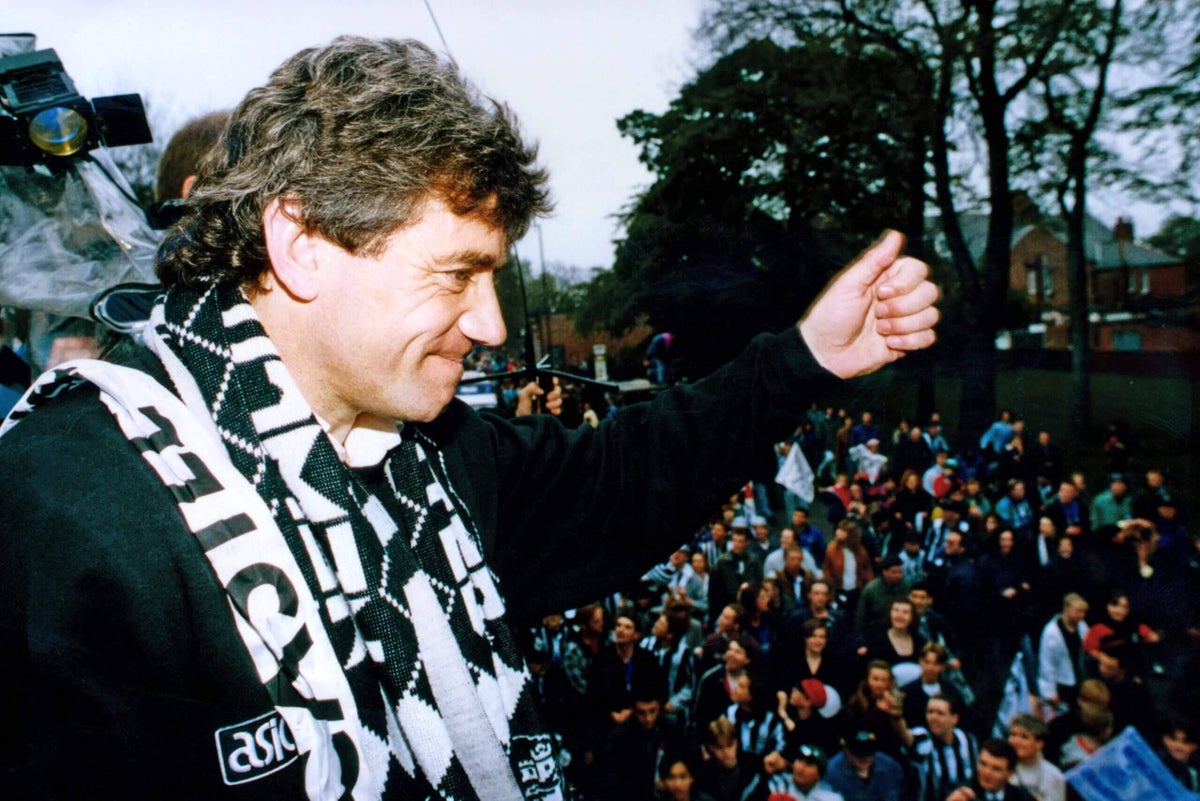
The modern version of Newcastle United would not exist without Kevin Keegan. Perhaps no version would. When he returned to the city as the club’s manager in 1992 — a second shockwave, a second thrill of electricity — they were hovering above relegation to the old third division and paralysed by discord in the boardroom.His first act as manager was both symbolic and necessary: he fumigated the first-team dressing-room.In the eight years since his final game as a player, also for Newcastle, Keegan had watched precisely two matches in person, and, as he wrote in his first autobiography, he “had no interest in club management”. There was one exception, and they came knocking. “The whole ethos of Newcastle triggered something in my mind,” he said. “The sheer energy bubbling below the surface gave St James’ Park more potential than anyone had dared to dream.”Born in Doncaster, South Yorkshire, in 1951, Keegan made his name at nearby Scunthorpe United. He signed for Liverpool under Bill Shankly, a relationship which moulded him. He played for England 63 times, and was twice named European Footballer of the Year while with German side Hamburg. There were then two seasons at Southampton before he stunned football by joining second-tier Newcastle in 1982. Joe, his late father, had been a Geordie. There was a pull. He got them promoted in his second season, and was then whisked away in a helicopter.Daring and dreaming were Keegan specialities.In an interview with UK newspaper The Times many years later, he said: “I want people to dream about their football club. We should all be dreamers at heart. Some people are the opposite and say, ‘We can’t do that’, but when you ask them why, they can’t give a reason. Well, I say, ‘Why not?’”This was in the early days of Mike Ashley’s ownership of Newcastle, when Keegan was back for a third time. It did not last very long.Kevin Keegan upon his return to Newcastle for a second spell as manager in 2008 (Laurence Griffiths/Getty Images)Dreams withered under Ashley, but fun and fantasy were always a very Keegan thing. He described managing Newcastle as “riding the black and white tiger”, and it felt desperately appropriate; wild and euphoric, with an element of peril. He understood the rhythms of the city, how everything built towards the weekend’s release, with the football stadium slap bang in the centre, a magnet on matchdays that hauled supporters towards it.It took some imagination for Newcastle to be considered in those terms 34 years ago. The ground was terraced and crumbling, the team bedraggled. Keegan and Terry McDermott, his loyal assistant and buffer, kept them up — they came 20th out of 24 teams, the lowest finishing position in their history — but were “tested to the limit as promises were broken”. He walked out twice, once saying “it wasn’t like it said in the brochure”, but the pull was now a tie and these ties bind us.What came next was startling.The Premier League was founded in 1992, and Keegan’s Newcastle were bursting to be a part of it. He bought well, supplementing gifted local players and infusing them with confidence. The football was breathtaking, little triangles of neat passing which cut through teams, hunting in packs when the ball was forfeited. The city was transformed. It buzzed, it vibrated and hummed. On Saturdays, fans would queue outside St James’ for hours to get in.The startling did not stop.Newcastle surged to promotion, and Keegan used his programme notes to tell Alex Ferguson and Manchester United he was chasing them down. The following season, they came third in the Premier League and Andy Cole scored 41 goals, a miraculous rise by the standards of most clubs and vertiginous for Newcastle. With Sir John Hall as chairman, this bastion of stale mediocrity was now forward-thinking and ambitious.Keegan completely transformed the mood around Newcastle United (Allsport UK/Allsport)This man of shocks shocked once again; Cole left for Manchester United. Fans wailed outside St James’ and Keegan stood on the steps to placate them, but then Les Ferdinand arrived and another Hollywood-upon-Tyne took shape. In 1995-96, Newcastle tore into the lead at the top of the division and although Manchester United reeled them in, relentless and unforgiving, the drama was human. Keegan railed at Ferguson live on television. The title shimmered just out of reach.“You have never known true romance until you have heard Newcastle supporters gurgle about their former player and manager, this passionate, restless man who rescued the club from oblivion and led it on a headlong dash towards glory, playing football that had been kissed by angels,” Alan Shearer wrote for The Athletic in an interview with Keegan to mark the latter’s 70th birthday in 2021.For those of us who were around then, Keegan’s football made everything that followed it seem pale.It is said that history is written by the victors, but Keegan’s Newcastle offers a different narrative. Everybody remembers them. Thirty years on, Liverpool 4 Newcastle 3 on April 3 1996 remains a defining match of the Premier League era, a hell-for-leather slugfest with no thought of defending, and the image of Keegan slumped over the advertising hoardings at the ground he’d graced as a forward is one of its defining images. It was horrible and it was agony and it was perfect.We will never know how much, if at all, football would have shifted had Newcastle won the league playing that way, yet Keegan was still transformative. Neutrals were transfixed by the swagger and the style of “The Entertainers”, while the team’s ultimate failure — and Manchester United’s dogged brilliance — was pure spectacle. Keegan would change for nobody. It was made for television and is a cornerstone of the league’s identity.In Newcastle terms, transformative is a wholly inadequate way to describe Keegan’s impact. Supporters flocked there, the club went on to sign local hero Shearer for a world-record fee and, suddenly, potential was irrelevant. It ended with sadness — when does it not? — but Newcastle were ensconced as strainers and strivers. They pushed for more, for the impossible dream, until the money and the years ran out.A Newcastle fan reads the news that Kevin Keegan has quit in January 1997 (Allsport/Getty Images)Yet even in the Ashley years, Keegan’s vision of Newcastle endured.It persuaded him to return for that second spell as manager in 2008, a brief spurt of hope quickly submerged by what he would later write about as “an empire of self-harm” — he would subsequently win a case for unfair dismissal. It persuaded Rafa Benitez to have a go and, on a random visit to St James’, this sense of what Newcastle had been and still could be encouraged Amanda Staveley to begin raising funds for a prospective takeover.Staveley finally succeeded in October 2021, bankrolled by Saudi Arabia’s Public Investment Fund (PIF). On the day the takeover was ratified, Staveley said in an interview with The Athletic, “Why is there such little recognition of Kevin Keegan (at St James’)? Why is that?”In November 1995, Eddie Howe turned 18. The following month, he made his first-team debut for Bournemouth, which is a fair way from Tyneside, but Keegan’s influence was felt keenly. “Long before I ever dreamed of becoming a manager, I was captivated by (Keegan’s) ‘Entertainers’ team,” Howe said in a statement on Monday night. “They played with courage, freedom and excitement. They made people fall in love not only with football, but with Newcastle United.”When Newcastle were looking for a manager all those years later, Howe “wanted to do something, to affect people in a city which has that image of ‘The Entertainers’ and to try to recapture it,” he told The Athletic in 2022.Earlier this year, he said to reporters: “We’re always trying to be that team.”Aside from an incognito visit to fulfil a commitment at a private function, Keegan never returned to St James’ while Ashley was there. Representatives of PIF spoke to him in vague terms about an ambassadorial role shortly after the takeover, while Howe called him for advice following his appointment and came to regard him as “a friend, whose guidance and support meant a great deal”.Newcastle fans show their love for Kevin Keegan in January 2026 (Annabel Lee-Ellis/Getty Images)Keegan was not interested in being a figurehead or a legend in the executive boxes, shaking hands and reminiscing about the old days. As he told Shearer, “You’ve got to look forward. Everything you’ve achieved, I’ve achieved, they’re in the past. One of Sir John’s favourite sayings was, ‘If you live in the past you die in the past’. I think it’s a good saying.”Shearer has a statue outside St James’. So do Sir Bobby Robson and Jackie Milburn. Keegan was never bothered about that kind of stuff. “The fans let me know they think I’m part of things,” he said. “They’re great with me. That’s enough. The idea of just sticking up statues… I just think they’ve got the right three there.”Keegan was both right and wrong. On visits to Newcastle for talk-ins or events, he was showered with love. In recent months, with his cancer diagnosis now public, his attitude had softened and the prospect of him coming back to the stadium was dangling. It feels particularly poignant that St James’ never got to serenade their great dreamer one last time and that the man who stirred a city’s emotions so much is now gone.In a message to supporters, David Hopkinson, the club’s chief executive, called Keegan “the beating heart of Newcastle United. He helped to shape what this club means, not only in Newcastle, but around the world. His impact will be felt for generations to come”. He also said, “we will also consider how best to honour his remarkable life and legacy both in the short and long term”.Keegan deserves a statue, a stand named after him or some other kind of permanent memorial, but in another way, it does not matter so much.Dreams are not fashioned out of concrete or steel or bronze, and although he did not lay a brick or a foundation, Keegan and his team built St James’ Park. He is St James’ Park. And the people of Newcastle dream about their football club, because Keegan dared to say, “Why not?”
Kevin Keegan: The man who made Newcastle United dream
Daring and dreaming were Keegan specialities - he completely transformed the club, particularly in his first spell as manager
1,713 words~8 min read