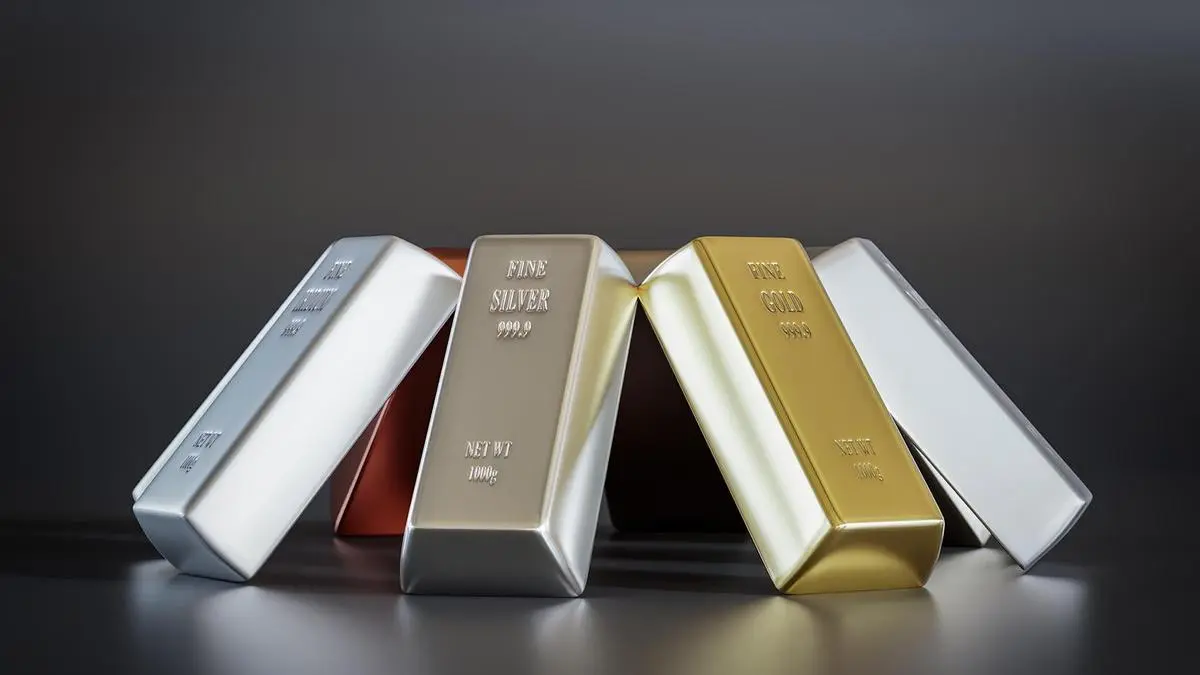
3d rendering of eight common precious metal bars arranged into prism on black background
| Photo Credit:
pryzmat
Nickel has rebounded from six-month lows witnessed recently, but its price direction during the current half of the year will be determined by Indonesia’s policy.“Nickel prices are forecast to ease from current elevated levels to average around $17,500 a tonne in 2026,” said Australia’s Office of the Chief Economist (AOCE) in its Resource and Energy Quarterly. Key downside risks to current prices include any upward revision to Indonesia’s 2026 mining quota (with an announcement expected in July), as well as any improvement in sulphur and sulphuric acid supply shortages,” it said. Stricter policy feared“We have revised up our 2026 nickel price forecast to $17,000/tonne, from $16,600/tonne previously, driven by strong H1 price performance despite our expectation for prices to moderate over H2 2026,” said Research agency BMI, a unit of Fitch Solutions.As of July 7, prices have averaged $17,862/tonne year-to-date, supported by expectations that stricter Indonesian government policy would constrain ore availability and increase procurement costs, alongside risks to domestic high-pressure acid leach (HPAL) output stemming from tighter sulphuric acid availability. Currently, nickel, used in corrosion-resistant alloys, electroplating, stainless steel and electric vehicle batteries, is quoted at $16,950 a tonne, with prices up over 1.5 per cent in the past week, but down 4 per cent in the past month. Indonesia is considering increasing its 2026 RKAB (Indonesia mining work plan and quota system) mining quota to around 360 million tonnes, up from the current 250-260 million tonnes. “While the proposal has not been confirmed by the government, it would represent the first meaningful easing of supply restrictions this year,” said Ewa Manthey, commodities strategist at ING Think, the financial and economic analysis wing of the Dutch multinational services firm ING.May be flexibleBMI expects Indonesia to adopt a more flexible policy stance in the coming months to ease concerns over feedstock availability and support production growth, which should weigh on prices relative to H1 levels. “However, a persistent market surplus should keep nickel prices above 2025 levels of $15,161/tonne, marking a sharp jump of 12.1 per cent,” it said.The AOCE said sustained growth in global refined nickel supply is expected to contain prices at around $17,000 a tonne (in real terms) to 2031. “However, emerging supply risks raise the possibility of a tighter market balance (and higher prices) earlier in the outlook period,” it said. Deficit in 2026?Manthey said if the Indonesian government goes for a higher quota, it would mark another shift in its nickel strategy and further cement the country’s role as the key driver of global nickel market sentiment. Indonesia accounts for 60 per cent of the global refined nickel supply.“The International Nickel Study Group (INSG) forecasts a relatively modest 32,000-tonne primary nickel deficit in 2026. That leaves little room for additional Indonesian supply,” she said.“We expect the nickel market to remain in surplus in 2026, but the excess is now set to narrow to 154,000 tonnes from an estimated 241,000 tonnes in 2025, as supply growth slows more sharply than demand growth,” said BMI.Key swing factorIt forecast refined nickel production to increase by 1.9 per cent over 2025, while pegging the growth of consumption at 4.5 per cent. “Indonesia will remain the key swing factor: additional ore quota approvals could support higher output in H2 2026, but policy uncertainty, higher ore procurement costs and sulphur-related risks to HPAL operations will limit the scope for a stronger supply response,” said the research agency. Manthey said if higher mining quotas result in greater downstream production, the projected deficit in nickel could quickly disappear. “For now, expectations around Indonesian policy remain a bigger driver of the market than physical supply changes,” she said. Published on July 21, 2026