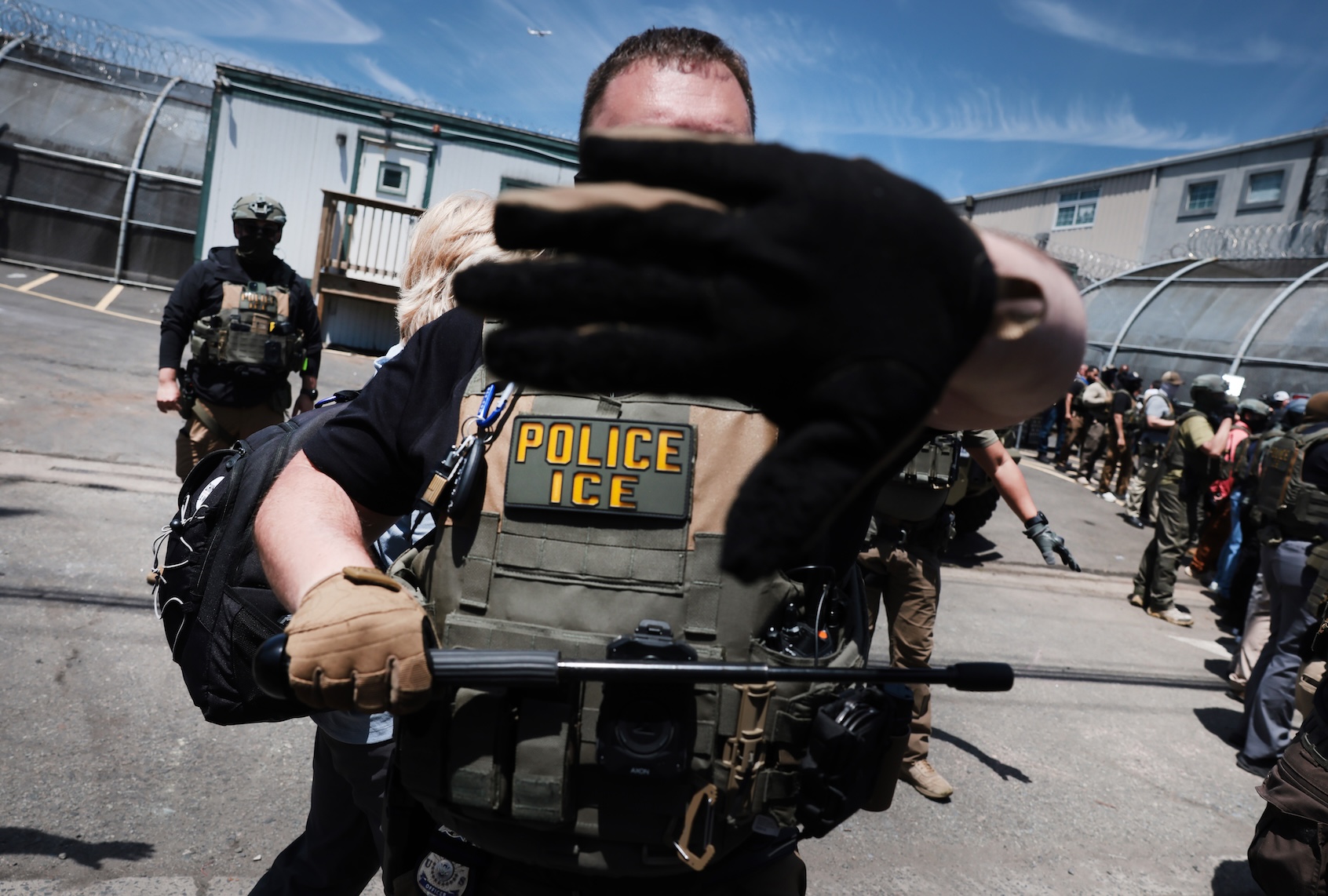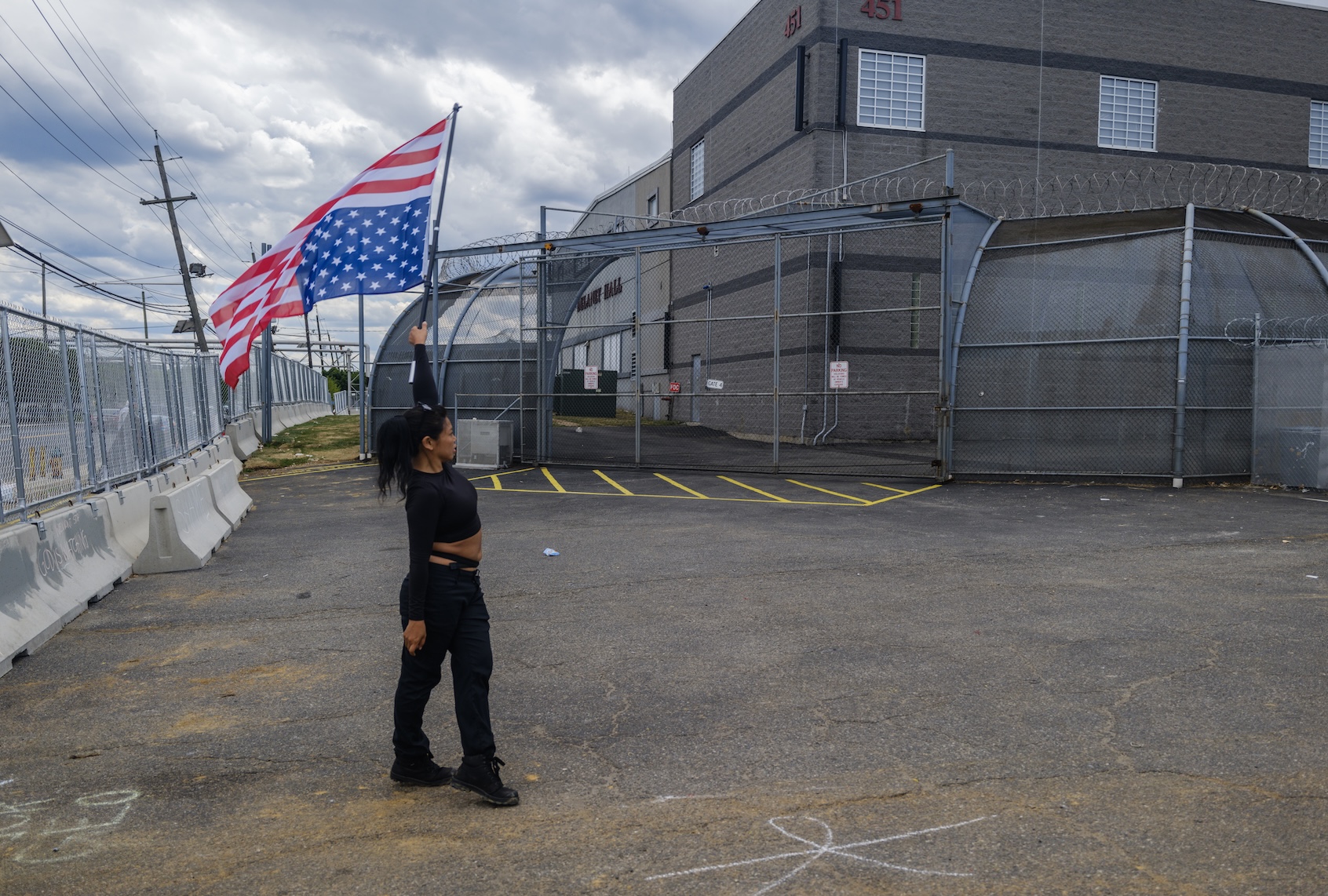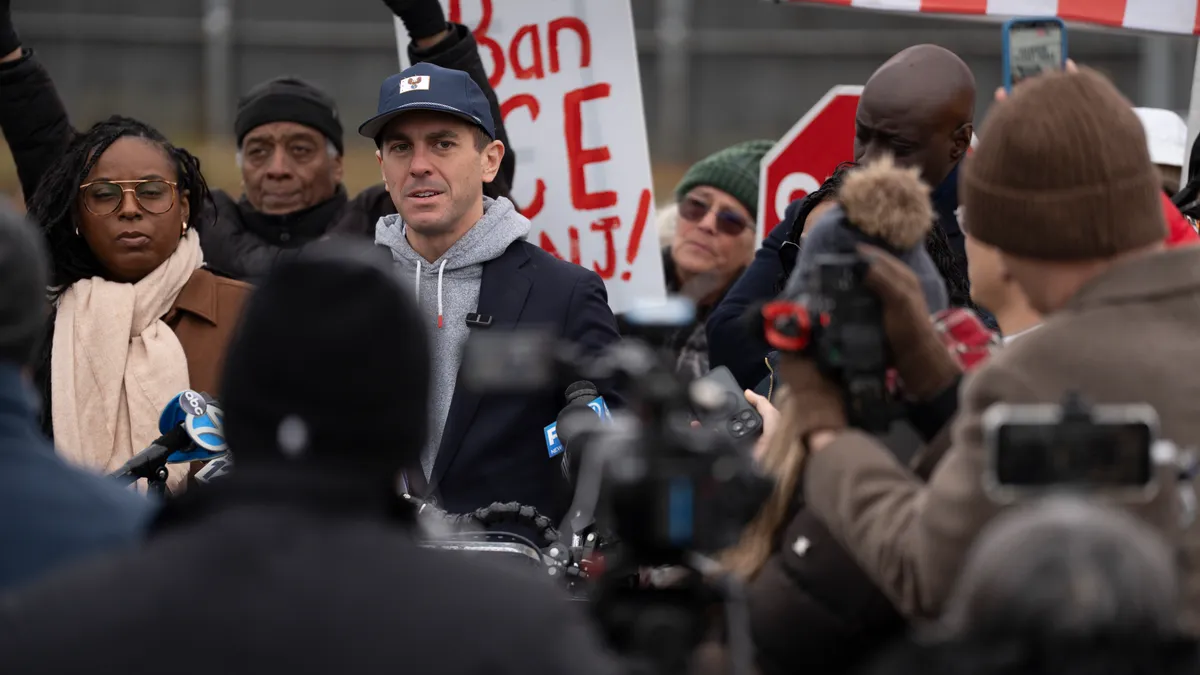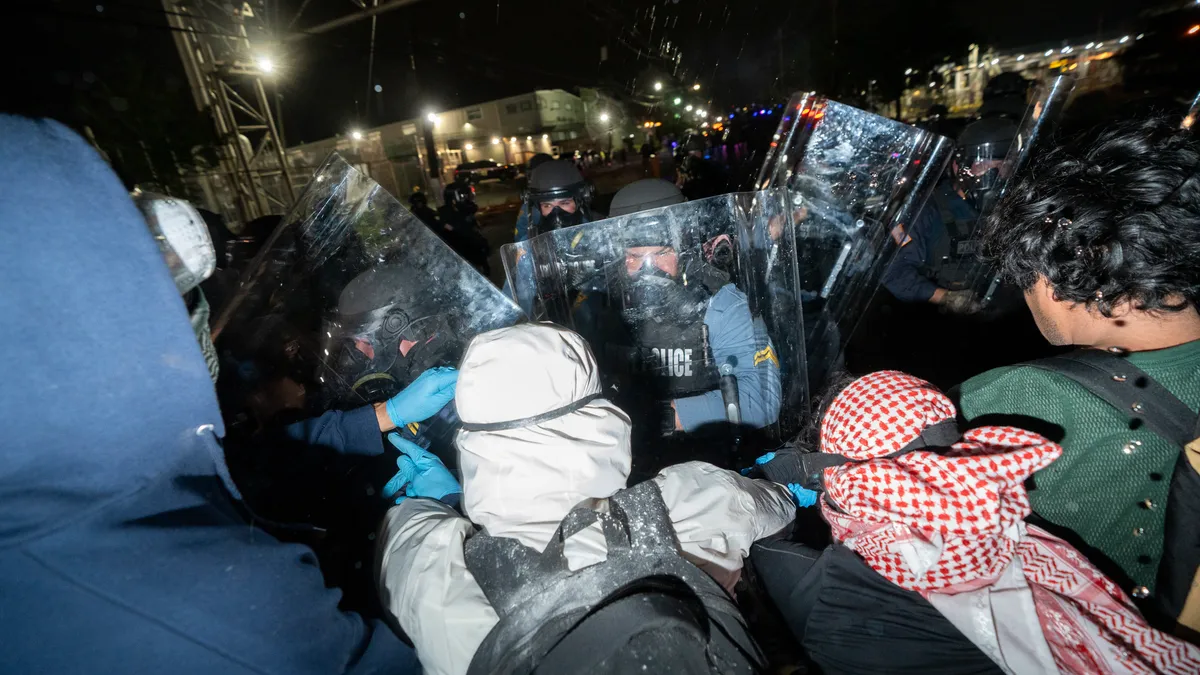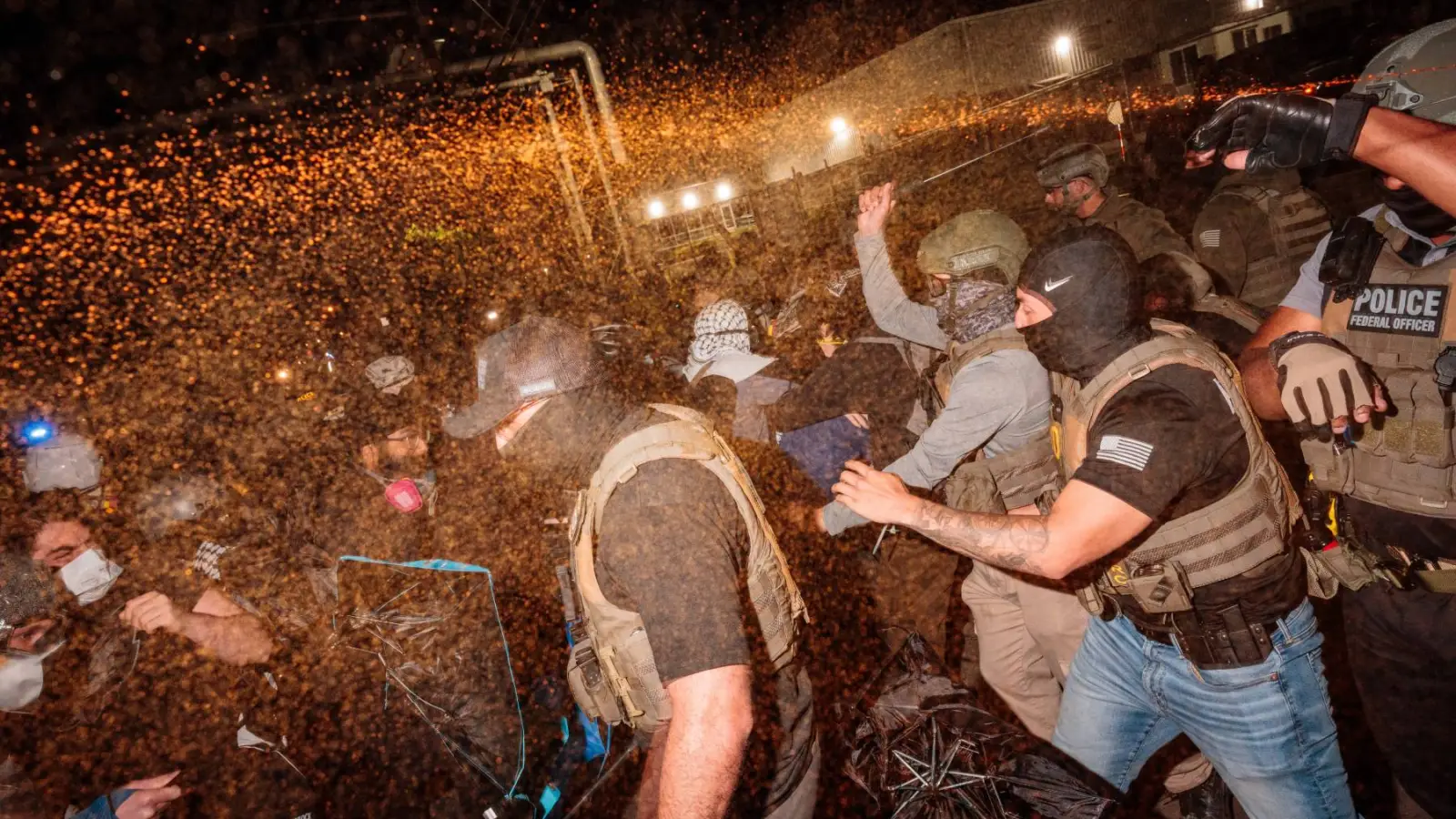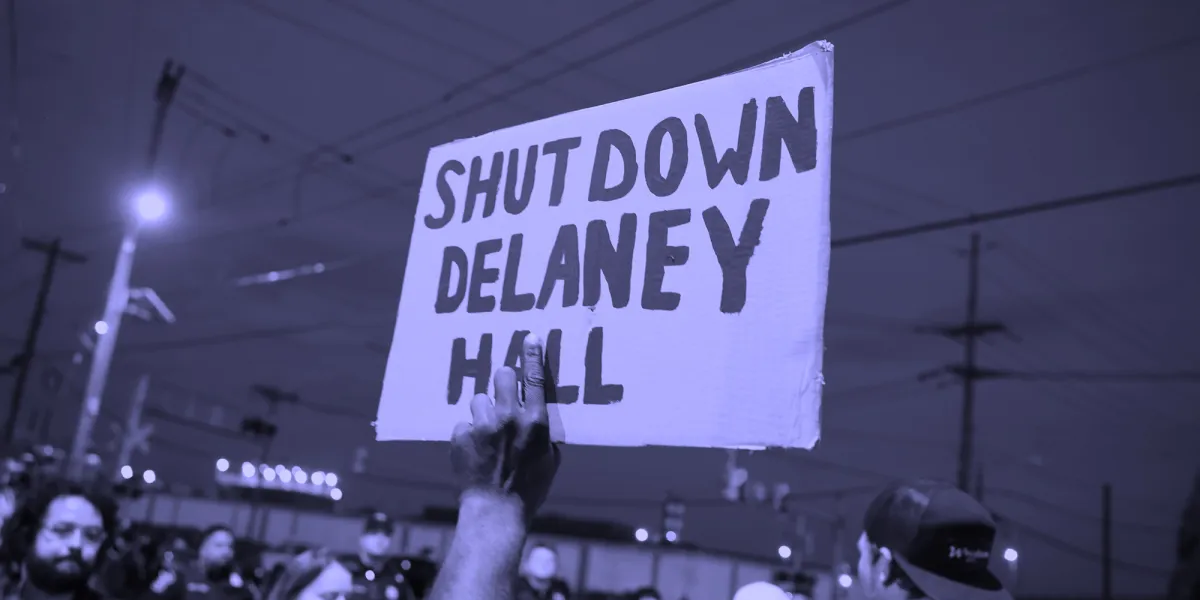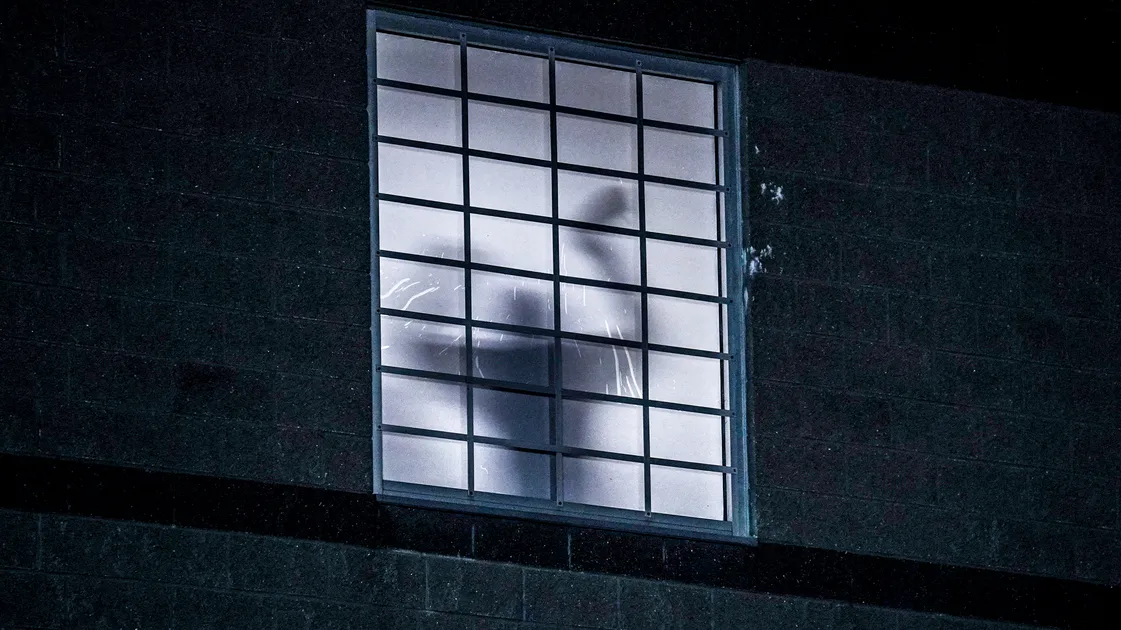
NEWARK, N.J. — Hang around outside the largest immigration jail on the East Coast long enough, and you will hear a volunteer ring a bell. “Seven!” one volunteer yelled recently. “Seven of them!” Guards employed by GEO Group, the corporation that runs Delaney Hall on behalf of Immigration and Customs Enforcement, pushed the chain-link gate aside to reveal seven men who were being released from the facility. The industrial haze of petroleum storage tanks and waste processing plants hung low in the air. Trucks whizzed by. But the men dropped to their knees and kissed the ground, then raised both arms to the sky and wept. Volunteers brought them water bottles and pointed them to a shaded place to rest, grinning next to the released men in video calls to their family members and, eventually, arranging rides away from the jail. Anchored by a mutual aid tent dubbed the “Radical Hospitality Zone,” a motley crew of religious groups, immigrant rights organizations and anti-fascist activists has, for over a year, tended to the families ripped from normal life by America’s immigration enforcement system. They offer food and water near the outdoor waiting area for visitors, toys to keep children entertained, prayer services, guidance on Delaney Hall’s byzantine visitation system, and even clothing that complies with the jail’s strict dress code. Their goal: “Free them all,” and care for everyone they can. But things changed a couple of months ago, when detainees in Delaney Hall took charge, launching a hunger and labor strike to demand freedom and justice, drawing protesters to Newark’s remote industrial corridor. Steps away from the mutual aid effort, crowds have gathered for weeks, heckling the GEO Group staffers and ICE officers behind the facility’s gates, occasionally attempting to block their cars, and clashing with law enforcement operations from three different jurisdictions.The activists’ chances of bringing down Delaney Hall are slim: The Trump administration is working overtime to expand detention capacity nationwide, and the Newark immigration jail is a key junction in the Northeast. The fight for freedom has seen brutality against protesters and retaliation against detainees, including hundreds being transferred to faraway facilities. But the people outside Delaney Hall are not going to abandon their cause. “I’ve been here when people have been released, and then, two days later, they’re back in line, visiting their friend,” said Sister Susan Francois of the Sisters of St. Joseph of Peace, one of several organizations behind the mutual aid effort known as Eyes on ICE New Jersey. “There’s the power of community, which is what made the strike possible at all.”‘Don’t give up!’ As the men who walked out of Delaney Hall acclimated to the outside world — rinsing their faces with bottled water, re-lacing their shoes — I asked them what they’d experienced inside. One man, who did not give his name, said he was held for 11 or 12 days. He spent $400 in commissary during that time, both because detainees were not fed enough and because he suspected some of the meat he was served was pork, even though he had told guards he couldn’t eat that because he is Muslim. The facilities were dirty and smelled bad, he said. Another man, Alexander Paredes, said he spent a month and 20 days in the facility. Treatment of detainees was inhumane, and guards were arrogant and rude, he said in Spanish.The vast majority of people held at Delaney Hall have no criminal record, and even ICE considers most not to present any security threat. Paredes said that many people in the jail were arrested while attending immigration appointments that are required for people who want to stay in the U.S.“I don’t understand it,” he said. “If we are doing things right and showing up for our appointments, why do they arrest us? If we’re doing the right thing, why don’t they go after the actual criminals and bad people instead?” Family members wait for the release of another member as federal immigration officers confront protesters outside Delaney Hall detention center in May.via Associated PressDelaney Hall was first used for immigration detention under Barack Obama, and then became a halfway house in 2017. The Trump administration began using it for immigration detention again in 2025, following a contracting process initiated by the Biden administration.The jail has been a lightning rod since it reopened. Newark Mayor Ras Baraka was arrested by federal agents there last spring — charges were later dropped — and Rep. LaMonica McIver (D-N.J.) still faces years in federal prison for allegedly interfering with federal officers during the same protest. Recently, though, it’s been those imprisoned in Delaney Hall who have been making headlines.Earlier this year, handwritten letters signed by dozens — or in one case, hundreds — of detainees went public. Their allegations were detailed and numerous: decaying food riddled with worms, horrid conditions in bathrooms, medical neglect and sexual abuse. GEO Group did not respond to HuffPost’s request for comment. DHS largely did not respond to the specific details in this story, or responded using statements it has used for months in response to stories about multiple facilities — such as asserting that ICE jails provide “the best healthcare many aliens have received in their entire lives.” “These claims that there are subprime conditions are false,” an unnamed spokesperson said. The department claimed there “are no reported food violations” at Delaney Hall, and asserted that all people in its custody are provided with proper meals — “including religious diets” — in addition to water, clothing, bedding, showers, toiletries, “comprehensive medical care” and opportunities to communicate with family and lawyers. It denied detainees were beaten or abused, and said ICE and GEO Group had “zero tolerance towards all forms of sexual abuse,” though it did not address the report that several female detainees have made sexual assault complaints against a specific Delaney Hall guard.And DHS repeated the claim that “It is categorically false we would pressure someone to self-deport.” That statement is not true, as HuffPost has reported.On May 22, people detained in the facility launched a hunger and labor strike. They demanded freedom — first for the elderly, young and medically vulnerable, but ultimately for everyone — a visit with the governor, an end to the coercion to “self-deport,” and due process in their immigration cases. “We appreciate the support of everyone who is protesting outside the facility,” read one unsigned dispatch from “the detainees at the Delaney Hall Detention Facility” during the strike. “We want you to know that you give us the strength and determination to keep going. Please, DON’T GIVE UP!” “I’ve been here when people have been released, and then, two days later, they’re back in line, visiting their friend.”- Sister Susan Francois, sister of St. Joseph of Peace and a member of the Eyes on ICE New JerseyThe response from the jail’s enforcers was immediate. And heavy.Guards released chemical munitions on detainees who protested an attempt to transfer one detained man who’d served as a translator for others.“Honey, they’re hitting us!” one man told his wife over the phone, she recounted.Guards “swept through multiple units, physically assaulted people, and deployed tear gas,” the American Friends Services Committee, whose lawyers represent clients in Delaney Hall, later reported. “People in those units told AFSC that they struggled to breathe for hours after.” The Department of Homeland Security said at the time that “staff used the minimum amount of force to safely deescalate the situation” in response to “a physical fight involving detainees at Delaney Hall” on May 28.Outside, Sen. Andy Kim (D-N.J.) was among those hit with pepper spray, as ICE officers responded aggressively to a growing protest. New Jersey State Police in riot gear briefly took over external security, at one point kettling and arresting dozens of protesters. Chemical munitions blanketed yards of supplies in the mutual aid tent, rendering it useless. Police checkpoints forced the volunteer effort hundreds of feet away. Amid the chaos, federal agents were spotted rummaging through the mutual aid tent; volunteers returned to find it ransacked.“Our ICE operations continue undeterred — now tent free,” a DHS spokesperson told HuffPost at the time. Violence against protesters has continued, both by ICE personnel — who are liberal with their use of chemical munitions — and GEO Group employees, including one who was charged with assault by auto for allegedly hitting a protester with his car. Still, the letters – which organizers translated and published online – and the response to them showed the strength of the network that had grown to support Delaney Hall detainees and their families.The strike and corresponding protest also secured tangible wins: Certain detainees who were pregnant, medically vulnerable and young have been released. The state of New Jersey filed suit against GEO Group for allegedly impeding its health inspectors, and Gov. Mikie Sherrill (D) more than doubled a state fund to provide legal defense for immigrants facing deportation. Eventually, state and local law enforcement largely withdrew from the area, and the mutual aid effort returned to its spot steps away from Delaney Hall’s entrance.Volunteers with the Eyes on ICE New Jersey coalition tour their mutual aid tent after it was raided by FBI and Homeland Security Investigations agents.Michael M. Santiago via Getty ImagesICE and GEO Group went to work trying to break the strike, observers said, cracking down on visitation and transferring large numbers of people to other facilities — practices that continue today, even though the strike effectively ended in late June. By some counts, hundreds of people have been moved, sometimes states away: In April, ICE figures put the Delaney Hall population at around 850. That number had dropped to 591 by early June, The New York Times reported. (Volunteers say they believe the population subsequently dropped even lower, based on conversations they had with detainees and their family members.) The jail has since been repopulated by new detainees, and Rep. Rob Menendez (D-N.J.) said after a visit on July 9 that the population was about 800. Detainees are also being shuffled between Delaney Hall units “on an almost weekly basis,” Menendez said, adding that he believed it was an effort to prevent further collective action.The out-of-state transfers have laid bare a brutal reality of the ICE detention network: Shutting down one facility will not necessarily make life better for the people detained there, who may end up even further from their families, community and legal help. “We know that ICE’s tactic has always been to transfer and disperse people,” Sally Pillay, a key Eyes on ICE leader, said last month. “Our worst nightmare came true, as we’ve seen — the movement of people, people that we’ve grown to love and care for, for all these months we’ve been present. That’s really hard for us, and so much harder for the families.” Responding to questions about transfers, DHS said “ICE makes custody determinations daily, on a case-by-case basis in accordance with U.S. law.” (The department began saying soon after the strike began in May that “there is no hunger strike at Delaney Hall.”)Visitation rules have also changed. Visitors had previously been able to show up largely unannounced and still get inside, but there are now limited visitation windows for specific units — which has gotten increasingly complicated as detainees are moved within the facility. GEO Group also began requiring detainees to pre-approve their visitors, but multiple people told HuffPost they’d been turned away by guards despite having been told by their loved ones inside that they were on the list.“They’re coming up with these inconsistent, arbitrary rules,” said Kara Morillo of Eyes on ICE. “They’re pretty much giving you a five-day waiting period to visit. What we’ve seen is that they can transfer you in that time.” ‘You just had a death...’People still detained at Delaney Hall spend a lot of their time waiting: for freedom, for news in their case, and for some, the deportation they’ve requested. Haruna Zakaria, a Ghanaian immigrant to the United States, has been jailed in the facility for a year. In December, he began experiencing a period of serious internal bleeding, resulting in paleness in his extremities and exhaustion so bad he could not lift his head, his wife, Tracey Sims, told HuffPost over the phone.At one point, fearing for her husband’s life, Sims, a nurse, said she felt she had to assert herself.“You just had a death the other day,” she recalled saying in a voicemail to the facility — referring to Jean Wilson Brutus, a Haitian man who died at 41 of an unspecified medical emergency after being transferred to Delaney Hall in December. “You want another?!”Zakaria was ultimately hospitalized twice, receiving two blood transfusions and undergoing surgery to remove hemorrhoids, Sims said. After the surgery, he returned to Delaney Hall’s general population, but with a low white blood cell count. He experienced a bad cold, and still deals with severe headaches.“But hey, who are we? He’s just a detainee, right? Just an immigrant?” Sims said. “That’s all he is, so who cares about that?” Sims said she has a recurring dream about visiting her husband in Ghana. But Zakaria has insisted that he won’t self-deport, despite the misery of being separated from his family while in poor health. “They’re trying to break him,” Sims said. “He’s breaking. I can see it in his eyes.” DHS said Zakaria “continues to receive appropriate medical care.” Another woman, Daisy, said her husband has lived in the United States for years, volunteering in the community and holding down the same blue-collar job for decades. In detention, he has described expired milk and moldy bread, she said, as well as guards refusing to respond to detainees’ medical issues. Her husband has been shuffled around different units multiple times, she said, including to several without air conditioning during the sweltering summer.Daisy, who is being identified by a pseudonym because she’s concerned about retaliation, said she has consistently had negative interactions with ICE officers at Delaney Hall. (She has been harassed and intimidated by federal law enforcement for months because of her immigration activism, she said.) “They’re all fucking clowns,” she said. “They’re all nasty. I’ve never met an ICE agent that’s been polite.”With her husband locked up, Daisy is left alone to support her kids, including a son who sleeps with a life support ventilator machine. She said she was drowning in attorneys’ fees, and is facing expensive medical bills — she needs a new liver after her gallbladder exploded last month. But, like the freed detainees crossing Delaney Hall’s gates, the mutual aid volunteers have been a bright spot for her family. The Eyes on ICE network uses the donations it receives to package grocery bags, gift cards, diapers and other essentials for families impacted by detention. “They have pastors that come and pray over people,” Daisy said, adding that the mutual aid space is a gathering point for families to exchange information. “I can’t even describe them,” she said. “They’re just a blessing. They’ve helped so many families.”
Their Chances Of Bringing Down Delaney Hall Are Slim. They're Fighting Like Hell Anyway.
Detainees at the East Coast’s largest ICE jail took a huge risk when they launched a strike. But allies on the outside were ready to join their fight.
2,501 words~11 min read