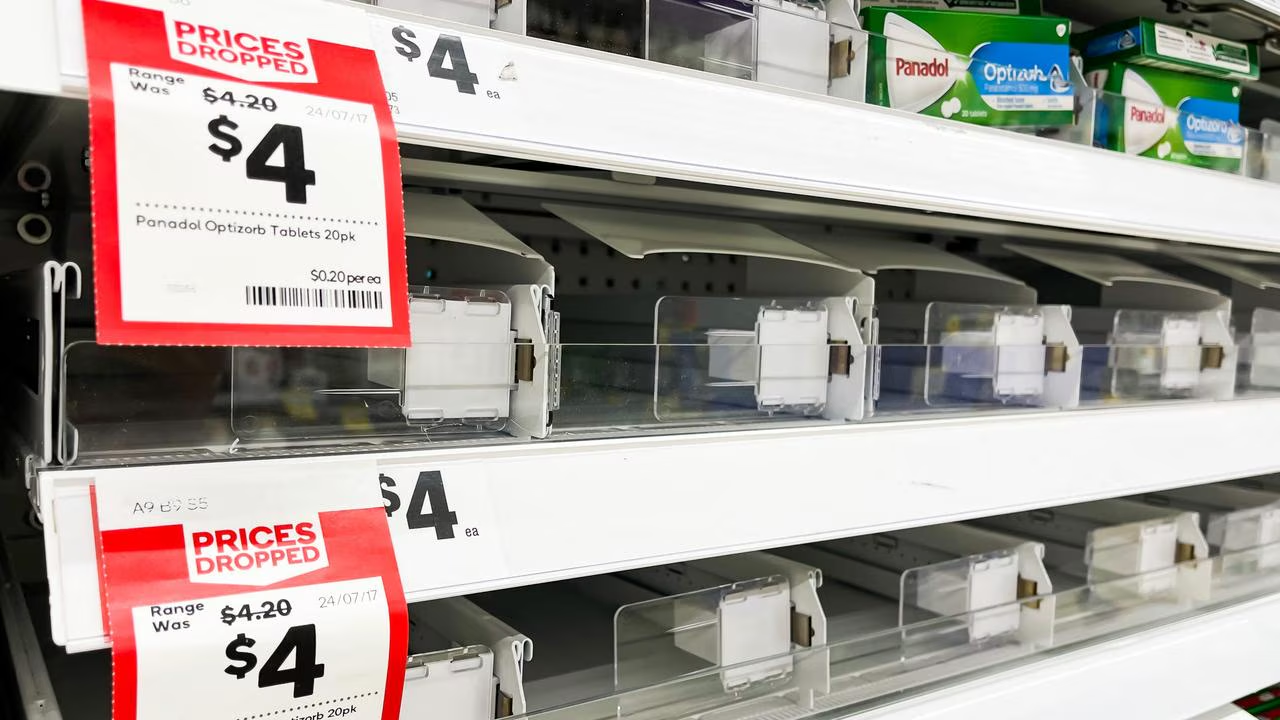
Labor’s new anti-price gouging laws targeting Woolworths and Coles could soon see shoppers paying more at the checkout as the supermarket giants drastically rethink their discounting strategies.The new regulations under Australia’s Food and Grocery Code of Conduct came into force on July 1, making it illegal for very large supermarkets — those with annual revenue of more than $30 billion, meaning only Coles and Woolworths — to charge prices that are excessive compared to the cost of supply plus a “reasonable” margin.MORE: ‘F****d’: Woolies quietly rolls out new trolleysLast month, the Australian Competition and Consumer Commission (ACCC) released its 26-page guidelines on the new laws, highlighting the complexity of trying to determine whether a price is “excessive”.As the supermarkets digest the impact of the new regulations, which are expected to add millions of dollars in annual compliance costs, the regulator says it is quietly collecting information from the public, suppliers and retailers themselves as it weighs up its first targets.The ACCC will publish its initial focus products in October.MORE: Shock reason Costco, Aldi reject big Aus city“We haven’t yet selected those products, but it will be groups of products that the focus products will represent, rather than individual products … so full-cream milk, for example, rather than a particular product,” ACCC deputy chair Catriona Lowe told news.com.au.“The key part of this obviously will be comparison across different types of products, hence we’ll use groups to do that.”Ms Lowe said the watchdog had been receiving “elevated reports” from the public about supermarkets and “pricing in general, but we are encouraging consumers and indeed suppliers to come forward to us and report specifically in relation to this law”.“Deterrence will be part of how the law will operate and we certainly want that deterrent effect,” she added.“Supermarkets are inherently complex businesses, they’ve got tens of thousands of different products, so there is a piece of work in thinking about how best to go about enforcing compliance with this law. In terms of particular product types, we will think about the nature of the product, whether it’s new or established, changes in prices, margins or costs over time, and comparable margins.”Ms Lowe revealed the ACCC may turn to AI to assist with the complex analysis.“There is potentially scope to do that,” she said. “We obviously need to be careful in how we use those tools, but we are as an organisation looking for opportunities to harness that technology to make our work more efficient.”In their submissions to the draft legislation, both Woolworths and Coles took issue with the idea of defining “excessive” pricing and “reasonable” margins.Both argued they could not be accused of price gouging, given their slim profit margins — Coles’ overall net profit last financial year was 2.4 per cent, while Woolworths came in at 2 per cent.The ACCC’s supermarkets inquiry last February did not make any findings of price gouging or excessive pricing, but noted the high concentration of market share between the two retailers and said if there were greater competition, it would expect margins to be lower.Queensland University of Technology (QUT) marketing expert Professor Gary Mortimer said the new laws had left many experts “at a loss”.“What I find incredibly strange is we’ve had multiple inquiries, including government inquiries, into price gouging, and no inquiry found any evidence of price gouging — so then we put in legislation to make price gouging illegal,” he said.“So it’s like we’re making something that doesn’t exist illegal. In my view this is politicking at its best. The narrative is the big supermarkets are ripping you off, the government responds by doing an inquiry, we can’t find any evidence but to satisfy the masses we’ll make it illegal.”Prof Mortimer said one “unintended consequence” of the new laws — and the ACCC’s recent court win against Coles — would be all retailers, not just supermarkets, would now be “very sensitive to timelines”.In May, the federal court found Coles had misled consumers with its “Down, Down” promotion, as the product had not been sold at the previous higher price stated on the ticket for a “reasonable period”.Prof Mortimer predicted retailers, after passing on price increases from suppliers, would lean towards keeping prices higher for longer before discounting.“I think that’s where we will see all retailers that use high-and-low promotional strategies be more selective in thinking, when do we push it down and call it a was-and-now price?” he said.Competition law expert Ray Steinwall, Adjunct Professor at UNSW Sydney, warned the new laws were “incredibly complex” and proving excessive pricing was “not straightforward at all”, even if the ACCC relied on precedents from the UK and Europe.“The challenge for the supermarkets is they’re going to have to look at how all of their products are costed so as not to run foul of this law,” he said.“They may have to look at, for example, how long they have a discount in place before putting prices up — because the ACCC might say, ‘If you are able to sell it at this price [and still make a profit], why is it now higher?’”One of the ACCC’s guiding overseas cases involved Aspen in the UK, which was accused of using its dominant power to hike the price of a vital cancer drug in European markets. Aspen ultimately settled with regulators and paid millions in fines.“If I was a supermarket, I’m thinking are you a little bit more cautious about having lower prices for sustained periods, because that might be seen as the benchmark price against which you’ll be judged, or do you keep it higher for longer and not discount so that’s regarded as the benchmark price?” Prof Steinwall said.Per the new guidelines, a very large retailer only “engages in excessive pricing” of grocery products if, in all the circumstances, the pricing is “significantly excessive” when compared to the costs to the supermarket to supply the product plus a reasonable margin.The cost to supply can include a range of factors including the cost of buying or producing the product, transportation, staff wages or store rent, research and development or investment in new equipment or technologies.Woolworths, in its submission, said it was “simply not possible” to comply with the law in relation to each of the roughly 28,000 product lines it sells.Coles argued that “at a minimum” the new rules would add $1-2 million in compliance costs in the first year alone.Ms Lowe, however, stressed that “reasonable is a word that is well known at law, and it’s important to say that it’s an objective test, not a subjective one”.“It comes back to looking at the facts and circumstances and applying it in relation to a particular kind of product — those sorts of questions that look at changes in price or margin over time, is it a well established product with a consistent demand, what are the comparable margins for similar products, what are the broader economic circumstances?” she said.Ms Lowe said the watchdog’s focus for the first 12 months would be on “monitoring compliance” and publishing information, but did not rule out legal action.“If we do find conduct of serious concern we do have our suite of enforcement tools available to us, including substantial penalties,” she said.“The maximum penalties for breaches under the Food and Grocery Code are $10 million per breach.”But Prof Steinwall said he would be surprised if the supermarkets did not vigorously challenge any potential court action — and if it came to that, he did not like the ACCC’s chances.“The commission has the onus of proof, it’s a tall burden to establish [excessive pricing],” he said.“In that environment it doesn’t bode well for how it would end up in federal court.”The Law Council of Australia had “strongly cautioned against” the introduction of the new laws, saying pricing regulation “in any form reflects a major intrusion into market dynamics and ought not to be introduced unless there is a clear and demonstrable need for it”.The body’s Competition and Consumer Law Committee, in its submission, warned of “ambiguity around what constitutes an ‘excessive’ price, an inherently subjective concept, creating compliance uncertainty and significant enforcement costs”.Chris Rodwell, chief executive of the Australian Retail Council, said Australian retailers were “already heavily regulated under consumer and competition law” and “adding another layer of red tape will not lower prices but rather increase compliance cost and complexity”.“We have seen eight taxpayer funded reports fail to find evidence of price gouging,” Mr Rodwell said in October. “The most recent ACCC report on this subject confirmed Australian grocery inflation is lower than in many OECD countries. In recent times, the net profit margin of Coles and Woolworths remained stable at less than three cents in the dollar.”The Business Council of Australia (BCA) also warned in its submission that the laws could lead to significant direct and indirect compliance costs, distort competition and ultimately risk higher prices.“The ACCC did not find that supermarkets are driving inflation, and it also found grocery prices being pushed up by the rising costs of getting goods onto shelves — including energy, transport and insurance costs,” BCA chief executive Bran Black said in December.Dr Andrew Leigh, Assistant Minister for Productivity, Competition, Charities and Treasury, said in a press release last month that the laws would “protect Australian families from artificially inflated prices on their groceries”.“Our competition reforms empower Australians to make informed choices at the grocery store and feel protected from unfair actions,” he said.But the Coalition has called the new laws a Band-Aid solution to rising inflation.“The reason Australians are paying higher prices in their red basket or trolley is because the government keeps stoking inflation and making it harder for Australians to get ahead,” Shadow Treasurer Tim Wilson said last month.A Woolworths spokesman told news.com.au, “Our focus remains on delivering dependable low prices to our customers in a highly competitive grocery retail sector”. “This includes our ongoing commitment to thousands of products on Lower Shelf Price and Everyday Low Price, and the value Woolworths provides through weekly specials and Everyday Rewards,” the spokesman continued.“The regulations apply to two Australian-owned and operated supermarkets groups, while exempting global retailers, which have far greater scale globally, and have a significant and growing market share in Australia.“We note that no other country globally has adopted this approach. The guidelines also do not clearly define what an excessive price is to enable practical and efficient business compliance.“As always, we are committed to complying with the regulations that govern our sector.”A Coles spokesman said, “At Coles, we know that cost of living remains front-of-mind for Australians, particularly with the challenges of higher interest rates and the price at the bowser. “Multiple inquiries, including the ACCC’s 12-month Supermarkets Inquiry found no evidence of price gouging and confirmed that higher grocery prices are being driven by rising costs such as energy, fuel, insurance, production, freight and distribution.“For every $100 customers spend at Coles, we make around $2.43 in profit – less than 3 cents in the dollar.“We urge the government to tackle the real drivers of higher grocery prices for Australian families. Increasing regulation is likely to put upward, not downward, pressure on prices. At a time when the focus should be on easing cost-of-living pressures, these regulations risk doing the opposite. “Australia’s grocery sector is highly competitive, and carving out large multinationals and other major players from this legislation does not reflect how Australians shop and risks weakening competition. “At a time when many Australians feel under pressure, we’ve remained focused on providing customers with value when they shop at Coles.”frank.chung@news.com.auRead related topics:Woolworths
Why you’ll see fewer supermarket discounts
Labor’s new anti-price gouging laws targeting Woolworths and Coles could soon see shoppers paying more at the checkout as the supermarket giants drastically rethink their discounting strategies.
1,921 words~9 min read