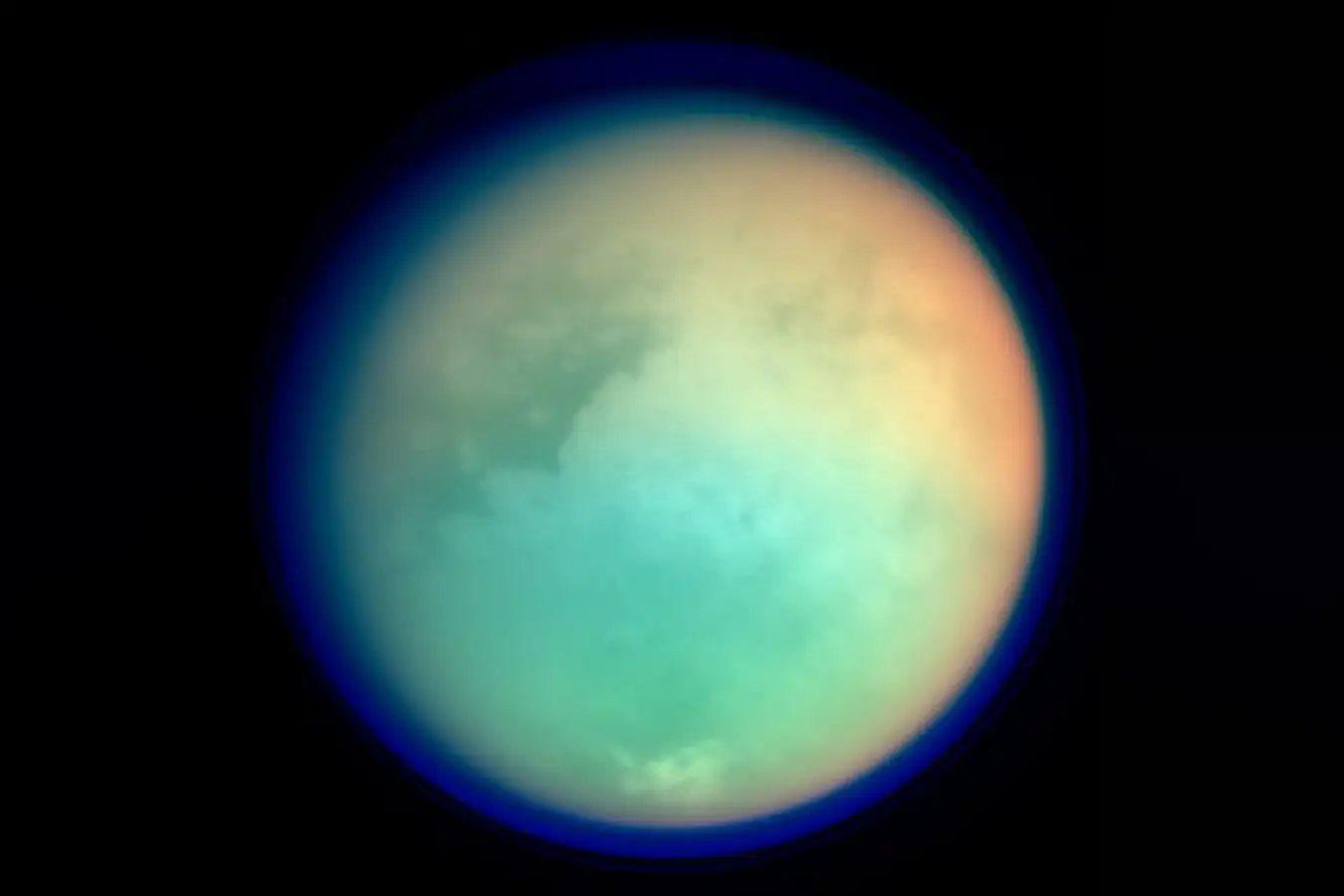
NASA's Cassini spacecraft took this image looking down on the north pole of Saturn's moon Titan.
(Image credit: NASA/JPL/Space Science Institute)
Separated by billions of miles and shaped by very different environments, Saturn's smoggy moon Titan and the dwarf planet Pluto have, on paper, little in common.Titan is a geologically active world cloaked in an atmosphere denser than Earth's, its landscape shaped by seas of liquid methane and vast dunes built from organic particles that rain out of its skies. Pluto, by contrast, is a frigid outpost with a tenuous atmosphere hovering above an icy, frozen surface.Yet, observations from the James Webb Space Telescope (JWST) have revealed these two disparate worlds share an identical, unexplained infrared signature on their surfaces — a sign that similar chemistry may be unfolding on both worlds despite their stark differences, scientists say.Detailed in a new study, the feature appears at precisely the same infrared wavelength on both Titan and Pluto, indicating that it absorbs light identically on both worlds. The signal points to the presence of an unknown compound, or a family of related compounds, that scientists have yet to identify."It's rather mysterious," Bruno Bézard, a planetary scientist at the Paris Observatory who led the discovery, told Space.com. "We cannot say what it is."Chasing the signalBézard first spotted the unexplained feature while analyzing Titan observations from November 2022, when JWST gathered infrared light leaking through the haze in very specific, narrow wavelength bands, allowing scientists to peer directly through the otherwise opaque atmosphere.To make sense of this light, researchers rely on spectroscopy, a technique used to identify compounds by the specific wavelengths of light they absorb. Because every molecule leaves behind a unique spectral fingerprint that telescopes can detect, astronomers can routinely identify substances across the solar system and beyond, ranging from simple water ice to complex molecules.But the newly detected feature neither matches any of the standard library spectra cataloged so far, nor does it appear to be a fluke of the hardware, the study notes. The exact same absorption feature was detected by two different JWST instruments — the Near-Infrared Spectrograph (NIRSpec) and the Mid-Infrared Instrument (MIRI) — ruling out the possibility of an instrumental artifact.After failing to find a match with the cataloged spectral fingerprints of the simplest and most common planetary ices, Bézard wondered whether another world with similar atmospheric chemistry might hold a clue. He turned to his colleague Emmanuel Lellouch of the Paris Observatory, who had led a JWST program that had observed Pluto in May 2023."I asked him, 'Do you also have a signature [on Pluto] at this exact wavelength?'" Bézard recalled in the interview with Space.com. "So we looked, and we found that it is present there."The ground truthThere is no evidence that the mystery molecule is a biosignature, Bézard said. Instead, it likely reflects the kind of prebiotic chemistry that has been operating in Titan's oxygen-free environment for more than 4 billion years.One compelling possibility is that it belongs to a family of hydrocarbons known as allenes, which the study notes are essentially the only organic compounds known to exhibit strong absorption bands within the same 5-micron infrared range as the mystery signal.But the allene family contains many complex variations for which complete spectra do not yet exist, Bézard said. Alternatively, the signature could belong to a known molecule whose spectral fingerprint has shifted, potentially because it is mixed with other planetary ices that have not yet been fully cataloged."We only have spectra for the simplest of them," Bézard said. "But it is possible that within this family you could find one or several compounds which are present together and make such an absorption feature."Whatever the compound ultimately proves to be, he and his team believe it forms in the atmosphere through photochemical reactions before eventually "snowing" down onto the surface.Despite their stark differences, both Titan and Pluto possess atmospheres dominated by nitrogen and methane. Scientists know from spacecraft observations and lab simulations that in the upper reaches of the planets' atmospheres, ultraviolet sunlight breaks these molecules apart, triggering a cascade of highly reactive chemical fragments. These fragments then reassemble into complex organic compounds, some of which condense and snow back down onto the surface below, which is where the JWST detected them.A couple of different lines of evidence support this atmosphere-to-surface pipeline. First, the team analyzed how the signal behaved across Titan's disk. As the JWST scanned Titan from the center of its circular face toward its outer edge, or limb, the mysterious signal steadily weakened, the study notes."This is what you expect if it comes from the surface," said Bézard.Because of the three-dimensional geometry of looking at a sphere, a signal coming from a flat surface will appear strongest at the center and grow fainter near the edge, where the angle of view through the atmosphere becomes longer and more obscured. This specific dimming trait was not shared by atmospheric carbon monoxide the team checked, which remained essentially unchanged from center to limb, Bézard said, which helped the team infer that this mystery molecule likely resides on the ground.