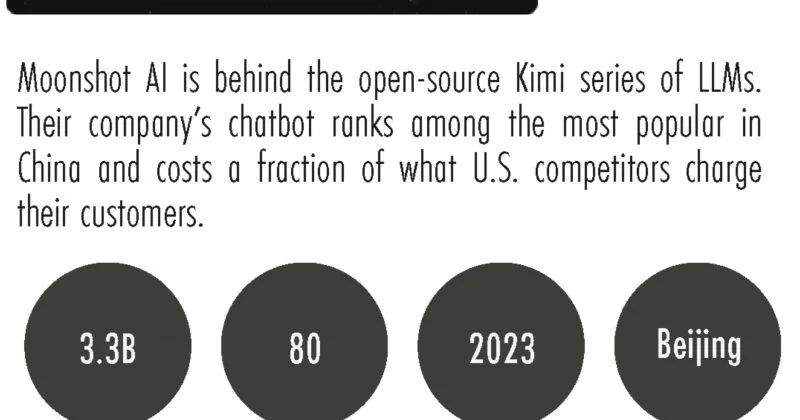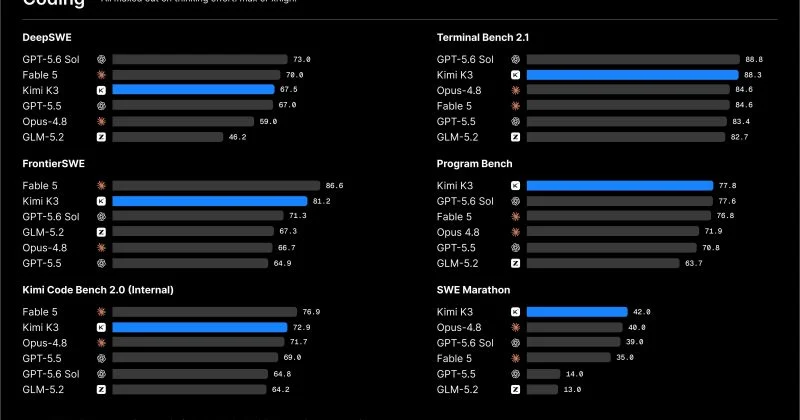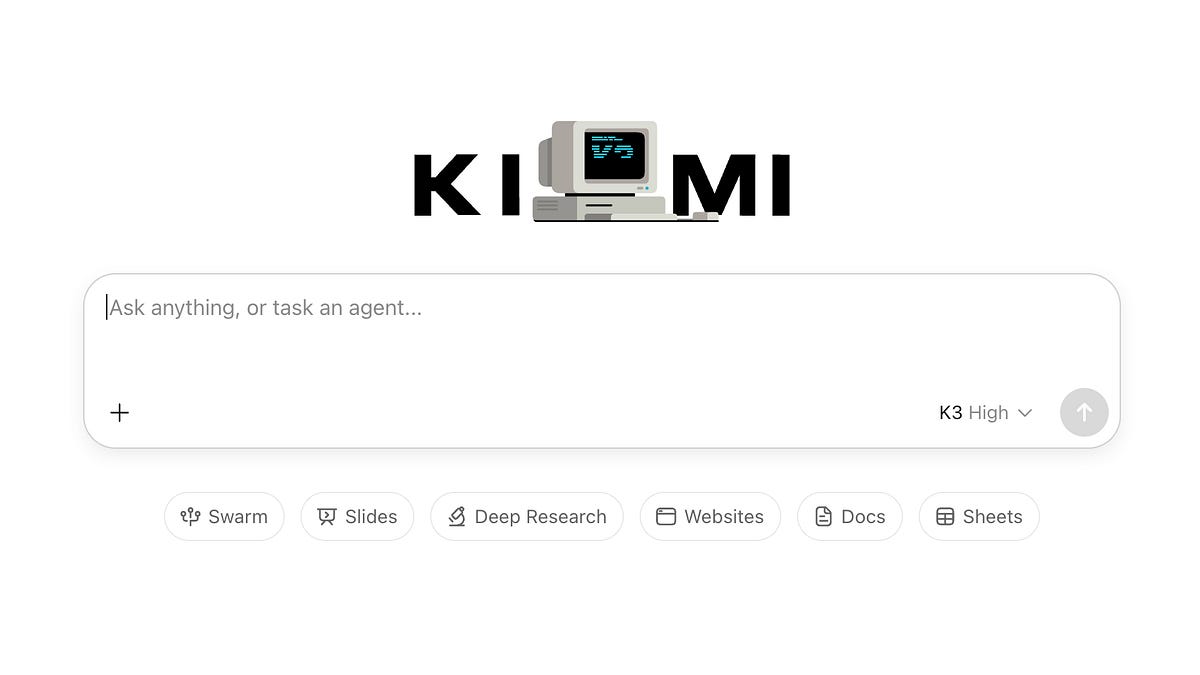
Moonshot’s newly announced Kimi K3 — a 2.8-trillion-parameter multimodal model that’s performing on par with Anthropic’s Opus 4.8 and OpenAI’s GPT 5.5 across many benchmarks — is already so popular that Moonshot temporarily paused new subscriptions Sunday.Kimi K3 is just one of a growing number of open-weight models making life interesting for OpenAI and Anthropic. Last week, Thinking Machines released an open-weight model called Inkling, which includes a mixture-of-experts transformer and with 975 million parameters. We’ll likely see even more open models this week, with Qwen hinting it’s readying to go open-weight with the launch of Qwen 3.8 “soon.”So what does it all mean? Here are some of the best takes on various aspects of Kimi K3, its performance, and the politics that come with it:“This is the first time that an open model is ahead of all proprietary ones for this comprehensive web engineering benchmark,” wrote Vercel CEO Guillermo Rauch, noting K3 reached a comparable success rate than Fable on the Next.js code generation benchmark, but K3 did it in less time.K3’s demand exceeding GPU capacity so quickly suggests frontier open models have real product-market fit, wrote Chayenne Zhao: “protect existing users first, add capacity in batches, split plans by workload type…this is a team that understands both models and serving economics.”Wharton professor Ethan Mollick said K3 and other open-weight models could cause the government to question if it should slow down Anthropic and OpenAI by reviewing U.S.-based model pre-release. However, he also noted K3’s audits of statistical work had some methodological errors.Open is like a ladder with various levels of openness, wrote Meta AI researcher Ravid Shwartz Ziv. While some labs only release weights and some release the training infrastructure and pipeline, few release the most important part: the data. However, he also noted it’s worth considering which companies release open models and why: “Big companies like NVIDIA and Microsoft mostly do it for PR and to get people playing with their tech. Usually, it’s a decision by a few researchers inside the company, and it can change next week. With the Chinese labs, we honestly don’t know why.”Falling AI costs might not lead to lower AI spending if higher consumption leads to higher inference demand, said Box CEO and co-founder Aaron Levie: “For the foreseeable future, anything that lowers the cost of tokens will drive up inference demand. This also gives you some insight into why even open source business models work in AI. No one is running these models on their devices; they’re running them in infra. Great time to be one of those providers.”Some investors and founders see K3 as benefiting most companies except for frontier model providers. “Adtech and other vertical SaaS companies are likely to benefit from Kimi’s improvements and help erode the theory that LLMs will eat all software,” said Viant co-founder Chris Vanderhook: “This creates real optionality and healthier economics across the full 5-layer AI cake.”OpenAI and Anthropic’s products and harnesses could help keep them relevant even if model efficiencies change the dynamics of model competition, said Gavin Baker, Managing Partner & CIO at the investment firm Atreides Management.Continue reading below for the politics of Kimi K3…A MESSAGE FROM OUR SPONSORAgentic AI is here, but is your infrastructure ready? From introducing a 9x traffic jump to creating new security risks, the old rules no longer apply. Discover how to navigate the frontier of autonomous systems and what it means for the enterprise. Read the full storyModel distillation on its own isn’t enough to explain K3’s high performance, said Dean Ball, Head of Strategic Futures at OpenAI, who noted the model “seemed very token hungry.” He also wondered why China still allows good models to be open-sourced given the potential risks, adding that companies likely see it as a way to drive adoption despite being behind: “and they know that very few people would pay for sub-frontier models from China.”Ball’s comments led to sharp blowback, with one user criticizing Ball’s follow-up post about the vitriol he’s received now that he works for a frontier model provider: “Writes a post that demands Altman owns everything, gets mocked, starts crying. The tech feudalist bootlicks are such turbo cucks.”“I kind of like the new narrative: Open-weight-model-dominant world = full AI communism,” wrote Carnegie Mellon University professor Russ Salakhutdinov in a response to Ball’s post. “It feels a lot safer than the world where Open-weight models = nuclear weapons with humanity’s annihilation.”David Sacks even cited K3 (and then GLM 5.2) as a way to critique OpenAI and Anthropic’s guardrails, noting K3 fixed 15 security bugs that Codex and Fable refused to, leading Alex Stamos to reply to Sacks: “this terrible precision/recall tradeoff has been forced by the Trump administration freak out you defended! If you were wrong then admit so, but don’t try to take both sides of the issue.”“If we want to truly build a *science* of intelligence (rather than merely products), open-weights are the *only* viable path forward,” wrote CMU professor Aran Nayebi. “Science thrives in the open. Open-weights are therefore inherently *accelerationist*, *not* decelerationist, as this post tries to claim.”OpenAI published info about a new AI for red-teaming called GPT-Red, which was used to adversarially train GPT‑5.6 by bolstering defenses against prompt injections.Apple escalated its lawsuit with OpenAI by reportedly sending legal letters to dozens of ex-Apple employees who have joined OpenAI.Fireworks AI raised another $1.5 billion with a Series D funding for the startup, which has a cloud service for running open-source AI models.Deepmind’s Demis Hassabis called for a new frontier-AI watchdog modeled partially on FINRA, which would include a “systematic” review of advanced models before they’re released. Hassabis suggested it should also include new standards as part of a public-private partnership and a board of independent experts.Earnings season is back for Alphabet, which reports quarterly results Wednesday. Others reporting this week include Intel and Tesla, which follow IBM’s disappointing results last week that included its stock price falling 25%.New York became the first to enact a statewide data center moratorium, after Gov. Kathy Hochul signed into law a bill for a one-year pause on construction of the largest data centers.Hugging Face disclosed a security incident last week that involved an autonomous AI agent that was able to get unauthorized access to a “limited set of internal datasets” and several credentials used by Hugging Face’s services.Meta is reportedly in talks with Anthropic to lease compute in a deal potentially worth $10 billion.OpenAI announced its first hardware product, Codex Micro, developed in partnership with Work Louder.Major publishers filed a new lawsuit against Google about copyright infringement over AI training for Gemini.Apple expanded access for its new Siri AI through the public beta for iOS 27.Anthropic is reportedly in talks with more investors about its possible IPO.Ranjan Roy from Margins is back for our weekly discussion of the latest tech news. We cover: 1) Kimi K3’s benchmark breaking results 2) How Kimi K3 fits alongside MuseSpark 1.1 and Grok 4.5 3) What are OpenAI and Anthropic’s advantages today? 4) Is the price of frontier intelligence about to drop? 5) It’s all about the product now 6) Satya Nadella’s Reverse Information Paradox 7) What is happening at Google? 8) Is Google too focused on ‘Flash’ models 9) Apple’s lawsuit vs. OpenAI 10) OpenAI’s boneheaded espionage 11) Why does OpenAI struggle to maintain good relationships with partners?You can listen on Apple Podcasts, Spotify, or your podcast app of choice
Everything You Need to Know About Kimi K3, the Latest Model From China to Shake Up AI
Here's how the web reacted to Kimi K3's performance, politics, and how it changes the AI race.
1,233 words~6 min read