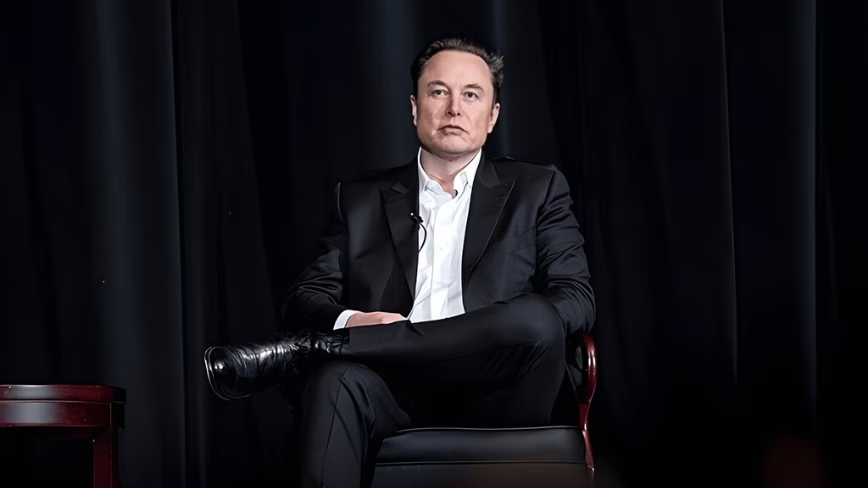
Skip to Content News Archives Economy Energy Oil & Gas Renewables Electric Vehicles Mining Commodities Agriculture Real Estate Mortgages Mortgage Rates Finance Banking Insurance Fintech Cryptocurrency Work Wealth Smart Money Wealth Management Investor Personal Finance Family Finance Retirement Taxes High Net Worth FP Comment Executive Women Puzzmo Newsletters Financial Times Business Essentials More Innovation Information Technology FP500 Podcasts Small Business Lives Told Tails Told Shopping Financial Post Store Obituaries Place a Notice Advertising Advertising With Us Advertising Solutions Postmedia Ad Manager Sponsorship Requests Classifieds Place a Classifieds ad Working Profile Settings My Subscriptions Saved Articles My Offers Newsletters Customer Service FAQ News Economy Energy Mining Real Estate Finance Work Wealth Investor FP Comment Executive Women Puzzmo Newsletters Financial Times Business Essentials HomePersonal FinanceYoung MoneyWorkGarry Marr: SpaceX employee millionaires bet big and won but what about the losers?Stock compensation is on the rise, don't forget it doesn't always pay out You can save this article by registering for free here. Or sign-in if you have an account.Elon Musk, founder and CEO of SpaceX, speaks via video before the ringing of opening bell at the Nasdaq Marketsite at the launch of the company's initial public offering on June 12, 2026, in New York City. Four hundred SpaceX employees found themselves worth US$100 million overnight from stock options. Photo by Spencer Platt /Getty ImagesWe independently select everything we recommend. Buying through us may earn us a commission, which supports our work.Space Exploration Technologies Corp.’s initial public offering last month created 4,400 instant millionaires; it was the bet of a lifetime for some employees of the American spaceflight, telecommunications and artificial intelligence company, which soared to a US$2.64-trillion market cap.Subscribe now to read the latest news in your city and across Canada.Exclusive articles from Barbara Shecter, Joe O'Connor, Gabriel Friedman, and others.Daily content from Financial Times, the world's leading global business publication.Unlimited online access to read articles from Financial Post, National Post and 15 news sites across Canada with one account.National Post ePaper, an electronic replica of the print edition to view on any device, share and comment on.Daily puzzles, including the New York Times Crossword.Subscribe now to read the latest news in your city and across Canada.Exclusive articles from Barbara Shecter, Joe O'Connor, Gabriel Friedman and others.Daily content from Financial Times, the world's leading global business publication.Unlimited online access to read articles from Financial Post, National Post and 15 news sites across Canada with one account.National Post ePaper, an electronic replica of the print edition to view on any device, share and comment on.Daily puzzles, including the New York Times Crossword.Create an account or sign in to continue with your reading experience.Access articles from across Canada with one account.Share your thoughts and join the conversation in the comments.Enjoy additional articles per month.Get email updates from your favourite authors.Create an account or sign in to continue with your reading experience.Access articles from across Canada with one accountShare your thoughts and join the conversation in the commentsEnjoy additional articles per monthGet email updates from your favourite authorsSign In or Create an AccountorStories abound about not just the largest shareholder, Elon Musk, who became the world’s first trillionaire overnight, but about everyone from welders to technicians whose paper wealth soared after receiving company stock in addition to their salary. There were 400 employees who found themselves worth US$100 million overnight.We always remember the winning bets because people love to talk about them, but they never brag about their losses. Do they?FP Work touches on HR strategy, labour economics, office culture, technology and more.By signing up you consent to receive the above newsletter from Postmedia Network Inc.A welcome email is on its way. If you don't see it, please check your junk folder.The next issue of Work will soon be in your inbox.We encountered an issue signing you up. Please try again“We see headline news about the big successes, but it’s like looking at the salaries of pro athletes and saying this is my benchmark,” said Patrice Gélinas, a partner in executive compensation at Mercer Canada, a business of Marsh & McLennan Cos. Inc. “Overall, there are many companies where those plans just don’t work out because the companies don’t work out and the gain for the participants is zero.”He said equity-based incentives depend on the company’s size and whether it is a startup, but, overall, they have become prevalent in privately owned companies and are almost universally available in publicly traded companies.“Not every employee gets access to those programs, but many employers use them,” he said, adding the tech sector has heavily relied on incentives as part of the total compensation to attract talent.The median size of initial equity grants issued in the second half of 2025 to individual contributors rose nearly 11 per cent over the past two years, while the median salary was up 6.4 per cent, according to a report by San Francisco-based Carta Inc.Tech employees are driving the trend. Among artificial intelligence and machine learning engineers, the median initial equity grant jumped 31 per cent between January 2024 and February 2026, nearly tripling the growth rate of the grant size across the broader employee population. Over that same period, the median salary for such engineers rose by 9.1 per cent.“The closer you are to a startup, the more likely you are to get equity because at that stage, equity is the only currency they have,” Gélinas said. “You participate like an owner and you are very well aligned like the other owners, and everyone wants to be successful, but it’s riskier than having the same value or expectation in cash or bonus or salary.”As with most things, a riskier plan offers a better opportunity to quickly generate wealth than a longer route with incremental salary growth.“You can get rich and (be a) millionaire working your whole life for the government because your pension value, which is secure, is going to reach millions of dollars,” Gélinas said. “But that’s going to take a while.”Mercer said young people are drawn to this form of stock-based compensation, but it can also be attractive for older employees who have already accumulated sufficient wealth to take a risk.“They can say I want something new, I want to build something fresh and take a risk, and if it doesn’t work, it doesn’t work,” Gélinas said, adding young people have different parameters. “They are willing to take that risk if it means living with my parents a few more years.”Employers also embrace stock options because they don’t immediately vest and tie you to a company, making it a powerful retention device if things go well at the company.Everyday employees don’t always have access to stock awards, but most publicly traded companies offer employees the opportunity to purchase shares, sometimes at a discount to the market price. Gélinas said the greater the employer contribution, the more likely there is a pickup in the plan.He also said the safer the company, the more likely you are to participate in a share purchase plan. But, generally, employees see them as a simpler benefit compared to stock awards.Of course, none of these compensation awards are going to come without paying taxes on them since even a discount on buying your own company’s shares is taxable, Yannick Lemay, a tax training specialist at H&R Block Canada, said.The advantage of participating in a startup is that if you make, say, a $250,000 contribution for a one-quarter share of a $1-million company, that’s a future tax consequence when that equity is cashed out. If you get one quarter of the company instead of pay, that is compensation and is taxed.“When it’s a public corporation, it is easier to know the value of the compensation you are receiving,” Lemay said, adding private companies can be harder to value.There are different ways to structure share awards, some of which could be more appealing to employees based on tax consequences.Ted Rechtshaffen, chief executive of TriDelta Private Wealth, said he has clients who have gone to startups because they were attracted by the chance to accumulate wealth fast.“It’s kind of like a private/equity investment or investing in an individual company. One of the things you have to say is you could lose all your money on this,” he said. “You have to say, ‘Invest to a level where you will be OK if you get nothing.’”Ultimately, he said your salary is probably “watered down” by stock option compensation.“It’s a smaller segment here, but it exists,” he said.Even buying your company’s shares carries some risk. If you are a Canadian bank employee loaded up on your company’s shares, you can point to a 65 per cent return in the past year on the shares you likely got at a discount.But imagine if you worked for BCE Inc., once described as the most widely held company in Canada. Those shares are worth about half what they were four years ago.Rechtshaffen said the bottom line is that you don’t want all your money in one stock, even if it is your own company.“It’s an emotional and financial thing,” he said about having equity in your company. “Sometimes you think there will be a huge payout. Sometimes it happens, and sometimes it doesn’t happen.”Those SpaceX employees looked like lottery winners when the stock IPOed at US$135, and it’s since fallen below that level. Musk is no longer a trillionaire, and some of those millionaires are probably not seven-figure winners anymore.Obviously, every early employee of SpaceX is still a big winner, but getting paid in stock means you can be a loser, too. Nobody talks about those stories. Join the Conversation This website uses cookies to personalize your content (including ads), and allows us to analyze our traffic. Read more about cookies here. By continuing to use our site, you agree to our Terms of Use and Privacy Policy.
Garry Marr: SpaceX employee millionaires bet big and won but what about the losers?
Elon Musk's SpaceX IPO turned employees into multimillionaires. Stock compensation is on the rise, but it doesn't always pay out. Read on.
1,634 words~7 min read