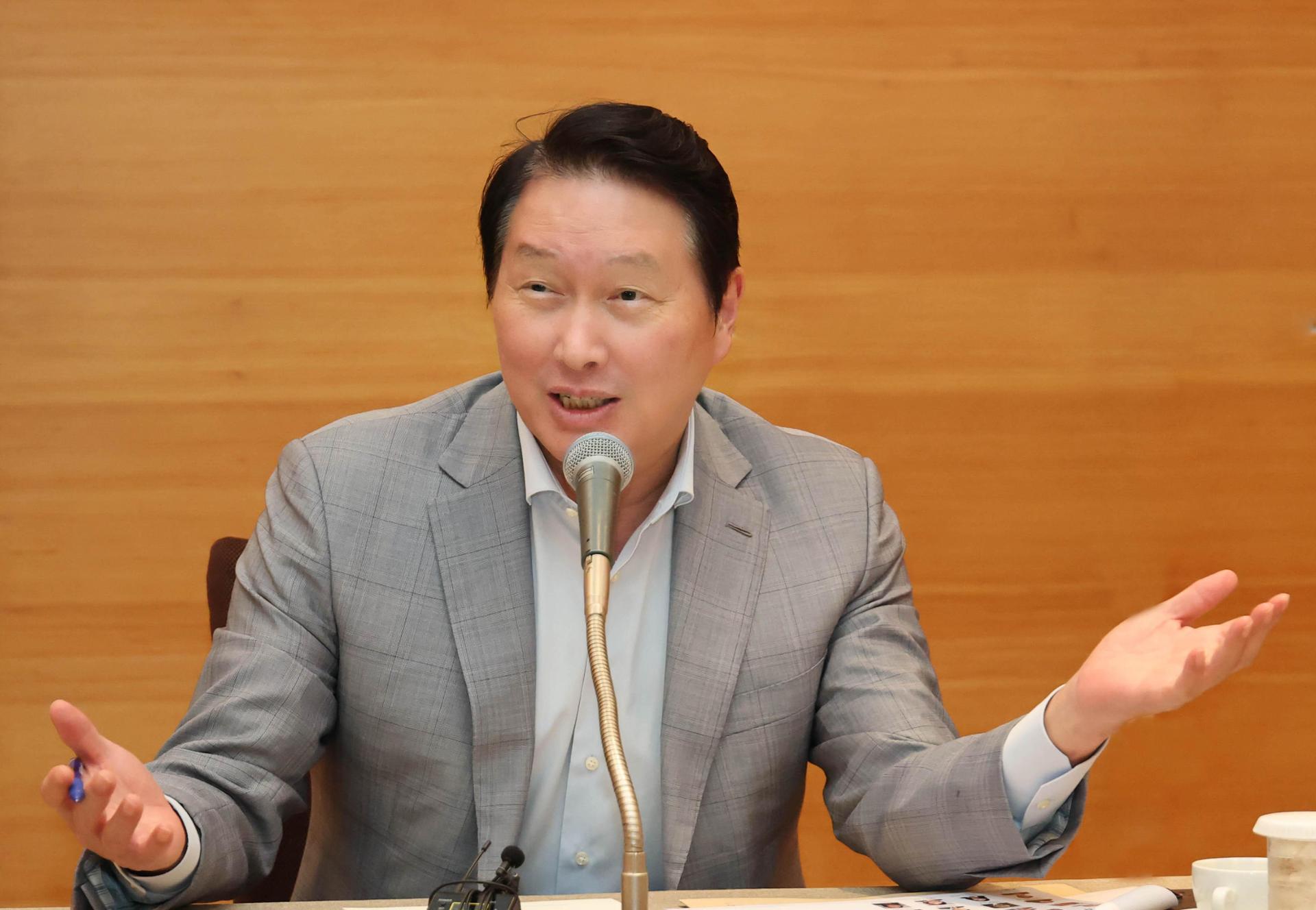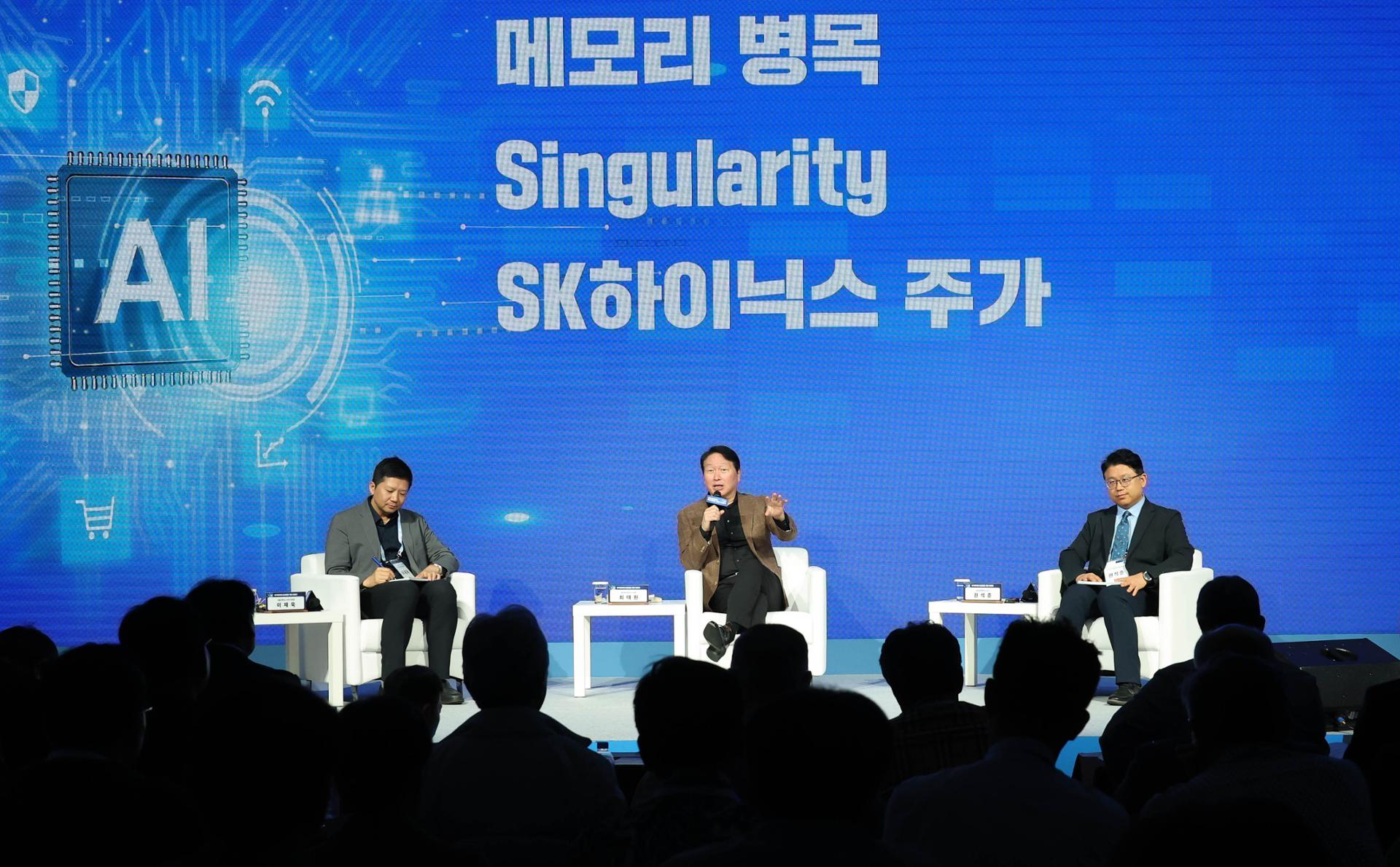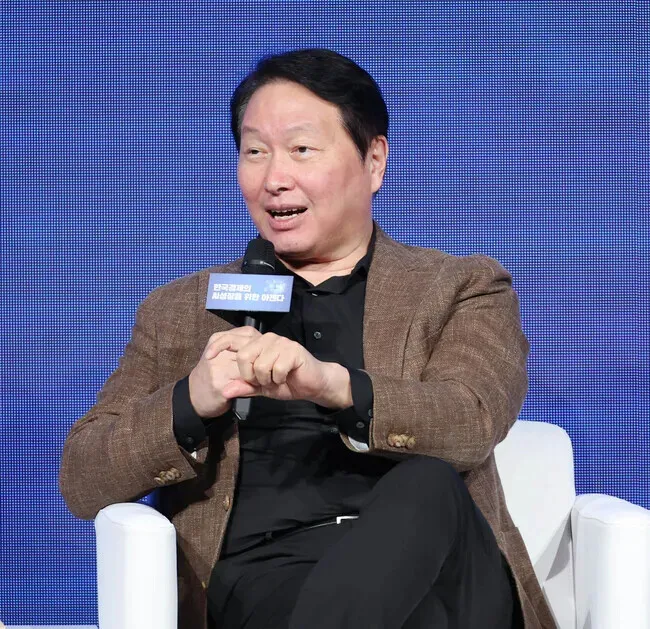
SK Group Chairman Chey Tae-won, who serves as the head of the Korea Chamber of Commerce and Industry, speaks at the KCCI Jeju Forum at The Shilla Jeju on July 17, 2026. (courtesy KCCI)
Amid fears over slowing semiconductor demand, SK Group Chairman Chey Tae-won signaled plans to increase investment, saying semiconductor demand is increasing “exponentially.”Using the expression “utter chaos” to describe the memory supply shortage, Chey hinted at the possibility of expanding his conglomerate’s chip investments not only in Korea, but also in the US.Chey made the comments at a press conference Wednesday for the Korea Chamber of Commerce and Industry’s Jeju Forum at the hotel Jeju Shilla in Seogwipo, Jeju Island. Chey serves as the chairman of the KCCI. “We’re receiving requests [from our clients] saying they plan to increase their use of AI memory chips 60%-100% next year from this year,” Chey told reporters. “Since AI chips make up nearly half of total chip demand, overall demand is forecast to jump at least 50%-60%.”“But no [chipmaking] company is in a position to raise supply next year,” he added. “The supply-demand gap will definitely widen a lot further from this year to next year, and I’m also facing tremendous lobbying and pressure.”“Current memory prices are abnormal and need to come down,” he said. “They’ve already skyrocketed, and if they surge further and ‘chipflation’ intensifies, we’ll definitely take a major hit.”On the 1986 semiconductor agreement between the US and Japan that supposedly led to the collapse of Japan’s chip industry, he warned that the shortage could escalate into geopolitical conflict in the form of pressure from the US and China to expand supply.“Prioritizing the world’s best, fastest and largest sites to quickly build plants is the lifeline of the Korean semiconductor industry,” Chey said. “Even if margins drop, we must boost supply to protect the market and grow it together for the sustainability and advancement of Korea’s semiconductor industry.”If memory supply does not rise in a timely fashion, the fear is that Korean companies could lose market share to latecomers like China’s Changxin Memory Technologies, aka CXMT.“We intend to build semiconductor plants wherever possible,” Chey said.“If feasible, I believe that we should also build them in the US,” he said, signaling his intent to consider expanding chip investment in the US in consideration of trade pressure and infrastructure needs.On the cluster planned for southwestern Korea, Chey confirmed his commitment to investing in the region. “We haven’t found another place in Korea that perfectly meets the infrastructure requirements,” he said. In addition, the chairman called massive government investment in the three “megaprojects” for infrastructure of semiconductors, AI data centers and physical AI “the first step toward an electrified society,” while noting that Korea faces a power shortage despite requiring “enormous amounts of electricity.”Stressing the need for government expansion of power generation and transmission infrastructure, he named energy, electrical equipment and related materials as key bottlenecks for the development of AI, following memory chips.Turning to SK Hynix’s performance bonuses for staff, Chey said, “Employees should not pursue their own happiness at the expense of our stakeholders’ happiness,” referring to workers, shareholders, suppliers and local communities. “For sustainable happiness, we must take on and change such issues.”“It’ll take time to determine if this is truly the case,” he said. “I’m sure that SK Hynix’s labor, management and employees will all put their heads together to resolve this issue in their own way,” though declining to give specific details.On the debate over profit distribution at chipmakers, he said relevant discussions were still in the early stages, adding, “I’m not sure if this is the right direction for making stakeholders happy.”“Excluding semiconductors, the country lacks a single revenue source to cover its rising budget and costs,” Chey said in his capacity as the head of a major business lobby. “Only by changing our systems to align with growth can Korea achieve sustainable growth and resolve related issues.”By Park Jong-o, staff reporterPlease direct questions or comments to [english@hani.co.kr]