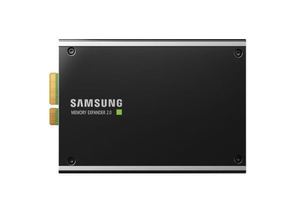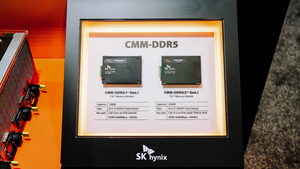
CXL memory promises to expand AI capacity without adding costly processors SK hynix displayed its first- and second-generation CMM-DDR5 memory modules at HPE Discover in Las Vegas in June, with the second-generation part doubling capacity to 256 GB on the CXL 3.2 standard. (SK hynix) Samsung Electronics and SK hynix are moving to commercialize a new class of memory that adds an extra layer to artificial intelligence systems as the industry hits the limits of simply stacking more high-bandwidth memory next to the chips that need it.Both companies are developing products based on the newest generation of Compute Express Link, or CXL, a standard that connects processors and memory over the common PCIe interface. It slots in between conventional DRAM and solid-state storage, offering far more capacity than the memory attached directly to a chip while staying fast enough to be useful during live computation.SK hynix showed how far its work has come at HPE's Discover conference in Las Vegas in June. It displayed a second-generation 256-gigabyte CMM-DDR5 sample based on CXL 3.2, double the capacity of its first-generation part, running in a pooled-memory server from AI infrastructure firm Liqid. A production timeline has not been set.Samsung, meanwhile, is reportedly aiming for year-end production of its own next-generation CMM-D module, though separate reporting in early July said the timeline could slip into 2027 as the supporting server platforms, chiefly Intel and AMD processors, run late. The company has said that "despite some changes to parts of the plan," it is preparing to begin production on schedule. Samsung Electronics' CMM-D, a DRAM memory module based on the CXL standard, is shown from both sides. (Samsung Electronics) The push reflects a shift in AI memory, from a contest over raw speed to one over how the memory system is put together. The core issue is capacity.In current AI servers, HBM sits next to the graphics processor and standard DRAM next to the central processor, but neither can be expanded on its own because each is tied to the chip it serves. Adding memory often means adding the expensive processors too. CXL breaks that dependency, letting a system reach a large pool of memory without buying more compute to hold it. The appeal has grown as AI operators strain against the cost and supply of GPUs.The pressure has sharpened as AI shifts from training models to running them at scale. Serving a large language model builds up a growing store of session data, the key-value cache, and once that outgrows the available memory, systems slow down or redo work already done. SK hynix presented its CMM-DDR5 CXL memory modules at HPE Discover in Las Vegas in June, showing the second-generation part alongside a Liqid pooled-memory server and benchmark data in the booth display. (SK hynix) Both makers have moved to show the payoff. In a test on July 9, Samsung said a 1-terabyte CXL memory pool reached about 92 percent of DRAM-level inference performance across eight GPUs while holding far larger caches than a conventional setup. SK hynix researchers, in work published in June, reported up to a 35.7 percent throughput gain from using CXL as a shared terabyte-scale tier for inference. Both figures came from the companies' own testing under specific conditions.CXL will not replace HBM, which remains essential for feeding AI chips as the bandwidth heavy computation demands. It extends capacity alongside HBM, freeing the costlier memory for the work that needs the speed.The benefit is not automatic, though. CXL memory is slower than local DRAM, and much of its value depends on software deciding which data sits on which tier. That has made controllers, firmware and memory-management tools part of the competition alongside the chips.For now the technology is still early, its market waiting on server platforms and software to catch up."As AI expands, so will the market's appetite for CXL, and that really takes off from 2026," said Yim So-jung, an analyst at Eugene Investment & Securities. "By 2028, CXL-capable server platforms should be the mainstream."
Samsung, SK hynix push new memory layer as AI outgrows HBM alone
Samsung Electronics and SK hynix are moving to commercialize a new class of memory that adds an extra layer to artificial intelligence systems as the industry h
668 words~3 min read