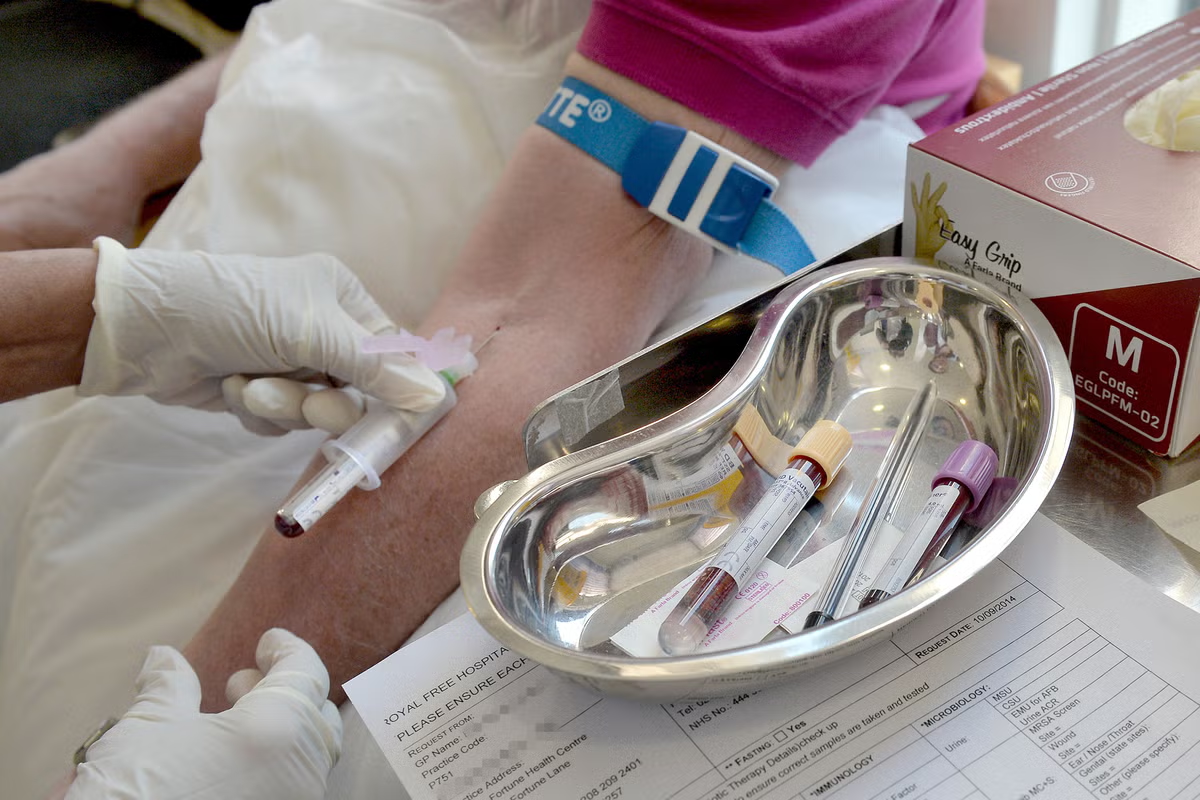
Patients report ‘litany of poor experiences’ with servicesChronic fatigue syndrome, is a complex, long-term biological illness that causes extreme, unrelenting fatigue, severe pain, unrefreshing sleep and profound cognitive impairment or brain fog. Photograph: Dominic Lipinski/PA Mon Jul 20 2026 - 06:00 • 4 MIN READThe health and social care services for people with chronic fatigue syndrome are “not sufficient and do not fully meet the needs” of those with a severe diagnosis, the Health Service Executive has said.Myalgic encephalomyelitis (ME), or chronic fatigue syndrome, is a complex, long-term biological illness that causes extreme, unrelenting fatigue, severe pain, unrefreshing sleep and profound cognitive impairment or brain fog.The symptoms typically don’t improve with bed rest and can worsen significantly with physical or mental exertion.Anne Horgan, general manager for clinical design and innovation at the HSE, which seeks to design better health systems, said the organisation is currently developing a national clinical guideline to help address gaps in services for people with ME.“Current health and social care services for people living with ME in Ireland are not sufficient and do not fully meet the needs of those with severe and very severe ME,” she said.“The guideline will provide an evidence-based framework to improve consistency in care, strengthen clinical understanding and support the development of appropriate services and care pathways for people living with ME in Ireland across all ages and the full spectrum of disease severity.”Horgan said this work is being led by a steering group comprised of patients and service users as well as clinicians, HSE managers, academic and Department of Health officials. It is being facilitated by the Health Information and Quality Authority.“The steering group and core project team are jointly co-led by a patient and service user lead and a HSE lead and people with ME contribute their insights and experiences through dedicated lived experience groups, ensuring that the needs of those with severe and very severe ME are fully reflected in the guideline.”The statement was contained in a letter to Social Democrats TD Aidan Farrelly, in response to a parliamentary question.[ ME/CFS: Is there a comprehensive explanation for this long-misunderstood illness?Opens in new window ]Tom Kindlon, spokesman for the Irish ME/CFS Association, said many people with ME report “a litany of poor experiences from HSE services”.“One area that is particularly disappointing is the explicit exclusion of ME as a qualifying disability by disability services in some HSE areas. There is a wide spectrum in terms of the severity of ME but that it is true for many other disabling conditions too,” he said.“Numerous research studies that have found that the average quality of life in ME is worse than many other conditions and illnesses, including one Irish study commissioned by the HSE itself.”Paul Burton (71) was diagnosed with ME in 1989 when he was 34. Originally from England, he worked as a social worker for 20 years before his symptoms became so severe that he was no longer able to work.“The big issues are I’m in bed 20 to 22 hours a day. I would have two good days a week, two lousy days a week and three somewhere in the middle,” he said.“5pm is the end of my day. I haven’t been out for an evening in 20 years. I can dress myself and get in and out of my electric wheelchair. I have a special mattress to prevent bedsores. But that’s it.”Paul Burton (71) was diagnosed with ME in 1989 when he was 34. Originally from England, he worked as a social worker for 20 years before his symptoms became severe and he was no longer able to work Living in east Mayo after he moved there in the late 1990s, he said he faced many battles to get vital services.“I had to go to war for two years to get an electric wheelchair from my bed with only a phone. I went to the equality authority [now the Irish Human Rights and Equality Commission] to make complaints because the HSE had offered me eight hours a week home help,” he said.“Now I get four hours a day personal assistance service and six hours a week home help. I would have starved to death years ago [if I didn’t have that].”Carmel, who does not want to give her surname, has two children with ME. Her daughter Chloe, who is now 30 years old, has a very severe diagnosis and Carmel has been her full-time carer since 2009.According to her mother, Chloe was in a wheelchair by the time she was 18 due to “total exhaustion”. But things have deteriorated significantly since December 2021.“She’s in bed 24 hours a day in a dark room. She cannot read, she cannot listen to music, she cannot look at a tablet. I have to do all her skincare, washing her, dressing her, I take care of all of her needs from the bed,” Carmel said.“She was technically blind for three years because the vertigo was so bad, her vision went. She wasn’t able to eat normal foods, because chewing was too exhausting.”The lack of support means Carmel feels she cannot see friends or go out for a run or walk as they cannot leave Chloe in the house by herself. She describes herself as completely exhausted and growing increasingly worried about the future due to her own personal health issues.But there is some hope on the horizon, with indications that some of Chloe’s symptoms are beginning to improve.“Her sight has returned but she can’t look at anything digital. She listens to us reading. She is seeing so much better this year that she could see the flowers people got, Now she is able to crochet a little bit, which is really great,” she said.“And she is able to eat normal foods in the last year. She can take protein powder if she’s really exhausted to chew. It’s just so slow to climb out of that hole.”IN THIS SECTION
Chronic fatigue syndrome care services are ‘not sufficient’ to meet needs, HSE admits
Patients report ‘litany of poor experiences’ with services
987 words~4 min read