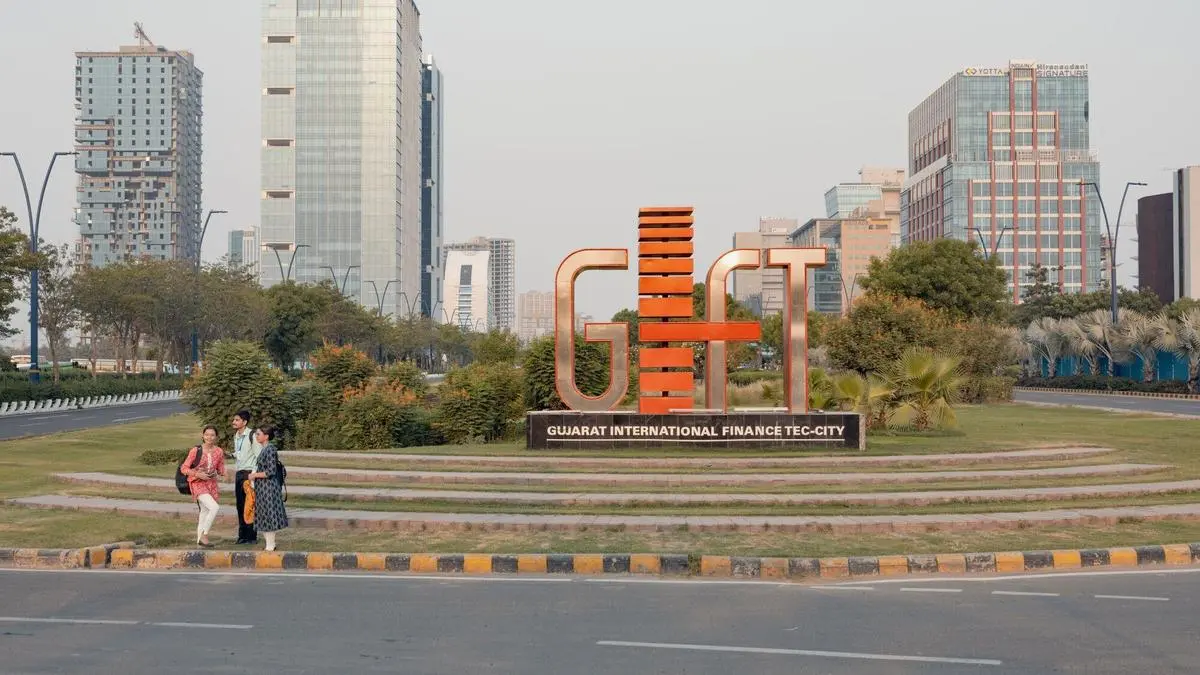
Gujarat International Finance Tec-City (GIFT City) is fast emerging as a centre for global investing and offshore funds. However, an insurance ecosystem is also evolving parallelly at the International Financial Services Centre (IFSC) here.Data from the International Financial Services Centres Authority (IFSCA) shows that as of March 2026, 36 insurance firms and 34 intermediaries have set up operations at the hub. IFSCA—the unified regulator for GIFT City—regulates insurance products in this zone, not the Insurance Regulatory and Development Authority of India.The latest IFSCA bulletin shows that in the January-March quarter of financial year 2025-26, direct insurance (non-reinsurance) gross written premium by IFSC insurance offices (IIOs) rose to $15.38 million, from $9.25 million in the previous quarter.While the IIOs focus on corporate and business insurance solutions, including marine, directors and officers’ liability, property insurance covers and so on, some have also begun offering retail products. These include US dollar-denominated life (unit-linked insurance plans, or ULIPs), international health and travel insurance policies. However, the share of retail plans continues to be minuscule: for example, in 2024- 25, the gross written premium in the life insurance segment stood at $0.02 million, underscoring the market’s nascency.Global aspirers in focusMany companies—including HDFC Life International, ICICI Prudential Life, ICICI Lombard, Star Union Dai-ichi Life, IndiaFirst Life and Tata-AIG General—now offer life and health insurance products. Their primary target groups are non-resident Indians (NRIs), persons of Indian origin (PIOs) and Overseas Citizens of India (OCI) who earn in foreign currencies.ALSO READ | GIFT City investment edge for NRIs: Tax benefits and global investment access with new insurance opportunityHowever, resident Indians too can buy these products under the Liberalised Remittance Scheme (LRS) route, which allows overseas remittances of up to $2,50,000 per financial year. They may be professionals intending to work or live abroad in future, parents with future expenses—such as child’s higher education—in dollars, and investors seeking global exposure for their portfolios.“When we studied the global Indian customer, the sharpest unmet need was a credible, regulated way to build wealth in the currency in which their goals are denominated. Many of our customers’ biggest life goals today is children’s education abroad, retirement flexibility, cross-border legacy, their dollar goals, and we wanted to give them a ‘dollar’ solution,” says Abhay Tewari, MD and CEO, Star Union Dai-ichi Life Insurance.Insurers see it as a niche segment today, but expect demand to rise steadily as overseas education, international investing and global careers become more common among aspirational families. Varun Gupta, Chief Distribution Officer–Bancassurance, IndiaFirst Life, says, “As Indian households grow wealthier and more globally connected, demand for dollar-denominated financial planning will only deepen, and GIFT City is where that demand meets Indian regulation. Individuals with international financial goals don’t have to look outside the Indian regulatory ecosystem to fulfil them.”Insurers are tailoring ULIPs (having exposure to overseas funds) with NRIs, PIOs and global Indians in mind: essentially, customers seeking foreign-currency-denominated protection and investment solutions.“That said, eligible resident Indians can also participate, subject to applicable regulations,” adds Gupta. Much like GIFT City-based mutual funds and broking firms, the ‘global Indian’—and not just NRIs—is emerging as the target group for insurers offering their products through this route.“NRIs are the natural constituency: they earn in foreign currency, their families’ futures are often planned in dollars. But we are equally seeing interest from resident Indians who may remit premiums in foreign currency, within the applicable regulatory framework,” says Tewari. “This is because they want a portion of their longterm savings to sit in the world’s reserve currency rather than depend entirely on the rupee.”What’s on offerAt the moment, life insurance is the dominant product category in the retail space, while health insurance products are relatively scarce.ALSO READ | Should NRIs move wealth to India or keep it abroad amid global uncertainty?“At present, we offer group travel and marine insurance through GIFT City, and we are working on expanding the portfolio to include products such as group health and property insurance,” says Gaurav Sharma, Principal Officer, GIFT City, Tata-AIG General Insurance.Insurance offerings are currently skewed in favour ULIPs, with pure protection term plans yet to be rolled out on a larger scale.HDFC Life International, for instance, offers a global education ULIP as well as retirement ULIP. ICICI Prudential Life has also positioned its ULIP as a US dollar-denominated market-linked plan that allows policyholders to invest globally and can be used for financial goals like children education, wealth creation or retirement.On the health insurance side, HDFC offers international health insurance plans made for students pursuing education overseas and NRIs as well as resident Indians seeking treatment options abroad. On the domestic side, regular health policies do not cover treatment abroad, except some high-end plans that specifically offer global coverage.Domestic vs GIFT City policiesBut why should affluent Indians with global outlook and NRIs look at GIFT City insurance offerings? They can, after all, also buy regular ULIPs, term policies and health plans sold domestically.“For NRIs, the key advantage is that these are dollar-denominated products—they can pay premiums and receive maturity or claim proceeds in US dollars. For one, this eliminates rupee depreciation risk,” says Lakshit Mahajan, Head, NRI Investments, Policybazaar.com, which distributes ULIPs of seven insurance companies with GIFT City branches currently.Mitigation of rupee depreciation risk remains the key USP. “Ten years ago, the rupee was around 67 to the dollar; today it is around 95-96. If your child’s US education is fifteen years away, a rupee corpus has to outrun that depreciation (assuming it continues in future too) just to stay on track. A GIFT City policy eliminates that treadmill— you save in dollars for a goal that is priced in dollars,” according to Tewari.NRIs earn and save in foreign currency, and a GIFT City policy lets them keep their protection and long-term savings in the same currency. “Premiums are paid in US dollars and all benefits are received in USD, with no conversion to rupees at any stage, subject to applicable FEMA (Foreign Exchange Management Act) and other regulatory requirements,” he adds.So, the proposition is that the currency fluctuation risk is eliminated at all levels – premium payment, choice of sum assured and claim settlement. “GIFT city policies can be issued and claims settled in any of the 13 specified foreign currencies permitted by the IFSCA, such as the US dollar, euro and pound sterling. This helps customers with overseas income or liabilities avoid currency conversion and exchange rate risks,” says Sharma.Diversification across geographies and asset classes, a growing requirement of affluent Indians, is another need such products are targeted at. “A policyholder can access S&P 500, US Treasuries, global equities, emerging-market debt and commodities — including oil, an asset class no Indian retail product offers. Domestic mutual funds offer gold and silver ETFs, but no oil ETF is listed in India. So for many customers, this is their first regulated access to oil as an investment,” Tewari explains.Thus, GIFT City ULIPs can offer exposure to global equities, overseas funds and ETFs, including commodity ETFs such as gold and silver. “By contrast, ULIPs sold in the domestic market operate under IRDAI’s investment framework, which does not currently permit exposure to overseas investments or commodity ETFs,” adds Mahajan.Note:“When we studied the global Indian customer, the sharpest unmet need was a credible, regulated way to build wealth in the currency in which their goals are denominated.”ABHAY TEWARIMD & CEO, Star Union Dai-ichi Life InsuranceGIFT City vs Regular ULIPs
NRI insurance: Benefits, risks, and features of GIFT City’s dollar-denominated insurance plans - The Economic Times
Many companies—including HDFC Life International, ICICI Prudential Life, ICICI Lombard, Star Union Dai-ichi Life, IndiaFirst Life and Tata-AIG General—now offer life and health insurance products. Their primary target groups are non-resident Indians (NRIs), persons of Indian origin (PIOs) and Overseas Citizens of India (OCI) who earn in foreign currencies.
1,757 words~8 min read