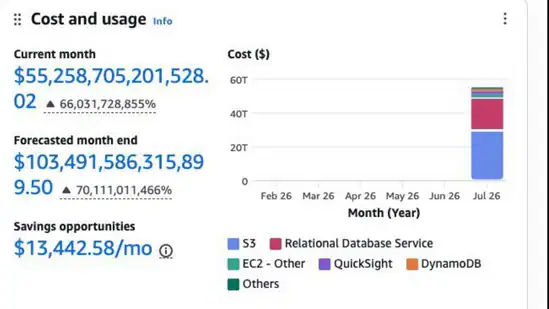
An AWS billing glitch showed customers worldwide bogus invoices exceeding $7 trillion; Israeli developer Hanan Cohen received a bill for nearly $500 million; 'It was extremely stressful, this is Amazon — it should not happen'Strange technical glitches are nothing new on major cloud platforms, but the extremes reached by Amazon Web Services in recent days managed to shock even a tech industry accustomed to bugs and all manner of unusual malfunctions.A bug in the U.S. cloud giant’s account management system generated fictitious bills for staggering sums, in some cases exceeding $1.5 trillion for a single account.GalleryAmazon Web Services (Photo: Shutterstock)Private customers and small-business owners around the world, accustomed to paying a few dollars or several hundred dollars a month for website hosting and data backups, opened their dashboards to find payment demands larger than the gross domestic product of developed countries.Reports of the panic began appearing on social media toward the end of last week. One user in India said his bill had jumped to $1.5 trillion and wrote that his soul had nearly left his body.At the same time, a marketing manager at a British organization discovered that his monthly charge had risen from 43 cents to an incomprehensible $7.8 billion.Another Reddit user posted a bill of more than $7 trillion, an amount greater than the combined GDP of Britain and Canada.Similar errors also appeared in Israel. Hanan Cohen, an Israeli developer, was among those who “received” such a charge. Fortunately for him, the bill came to “only” about half a billion dollars — small change compared with the trillions reported by some users.Hanan Cohen Speaking to ynet, Cohen described the experience as “extremely stressful.”“This is Amazon. They are not supposed to make mistakes like this,” he said.Cohen said he first tried to reconstruct what he might have left “open.” He then asked ChatGPT what the email meant and was told that, judging by its appearance, it seemed to be a genuine incident.“I skipped a few heartbeats because of it,” he said. “Only this morning did I see that they had fixed the problem.”Amazon’s official response on X attempted to ease the anxiety with unnecessary corporate humor, describing the incident as “a very minor calculation error on our part.”The company said users did not need to take any action and that the correction would be applied automatically, although it could take some time.The email Cohen received from Amazon (Screenshot: Hanan Cohen)The notice about Cohen's 'debt' on Amazon's website (Screenshot: Hanan Cohen)Technically, the problem did not stem from a security breach or damage to customer data. It resulted from an internal failure in the company’s cost and usage management system, which is responsible for displaying real-time information on customer dashboards.Modern cloud platforms function like highly sensitive electricity meters, calculating every second how much bandwidth, storage space and processing power customers use. When one part of that data pipeline malfunctions, distorted information can be fed into the system and translated directly into the price shown on the screen.For Amazon, which holds the world’s largest share of the cloud infrastructure market and powers a significant portion of the global internet, the incident represents an especially embarrassing reputational blow.Its main rivals, led by Microsoft’s Azure platform and Google Cloud, are locked in fierce competition with Amazon for every customer, though they are not immune to similar failures.The history of cloud computing is filled with catastrophic cost-estimation failures and incorrect charges. Previous cases have involved Google Cloud or Microsoft algorithms blocking startup accounts after sudden but fictitious billing spikes, as well as coding errors by developers that triggered endless processing loops and exhausted customers’ credit limits within hours.The main difference in the latest incident is its global scale and the absurdity of the figures, which left little doubt that the cause was a software failure by the provider rather than human error by users.The malfunction comes at a sensitive time, as technology giants are engaged in an intense arms race to develop and integrate artificial intelligence — an effort that requires enormous cloud resources and highly skilled personnel.The head of Amazon’s cloud division recently said the company planned to hire about 10,000 additional developers during the year to meet growing demand and strengthen the security of its systems.
'I skipped a few heartbeats': Israeli developer gets $500 million Amazon bill
An AWS billing glitch showed customers worldwide bogus invoices exceeding $7 trillion; Israeli developer Hanan Cohen received a bill for nearly $500 million; 'It was extremely stressful, this is Amazon — it should not happen'
704 words~3 min read