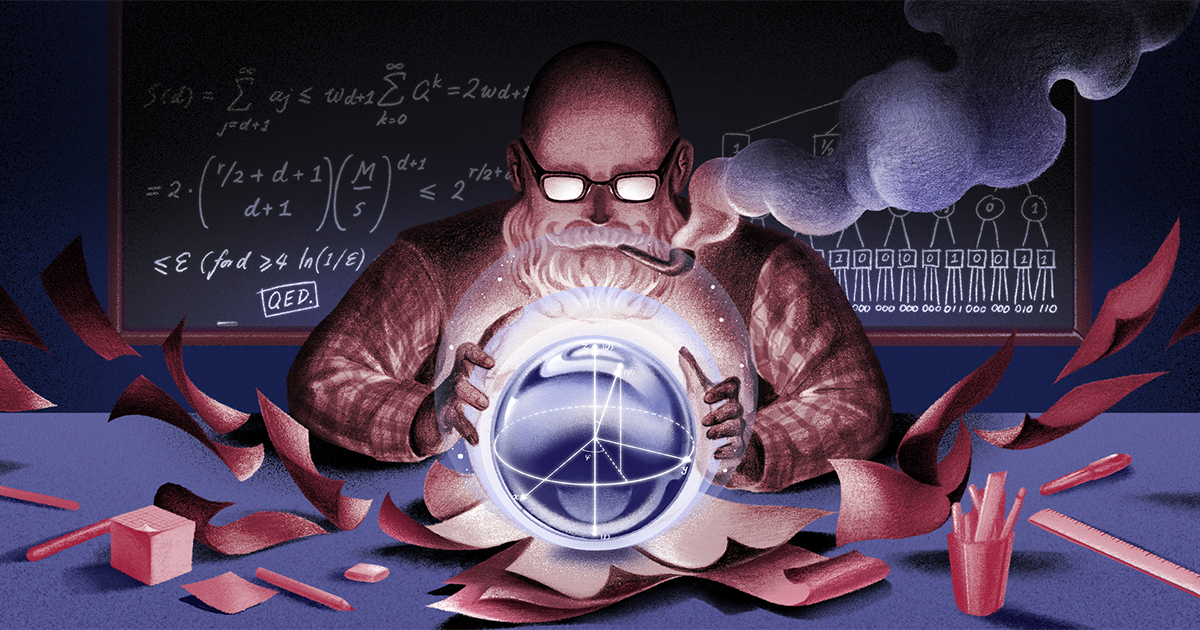
Solving real-world optimization problems requires finding the best combination among countless possibilities. Credit: Matthew Modoono/Northeastern University
Don't underestimate the power of a yes-or-no question. Some of the toughest computing problems boil down to thousands of tiny yes-or-no decisions. Finding the best combination of answers could be the key to anything from nailing a new drug to keeping a city of commuters on the move. For example, take this scenario:
It's World Cup season, and hundreds of fans flocking to the stadium log into a ride-sharing app to get there by kickoff. At the same time, others are rushing to the airport, hitting the gym or going on a grocery run. About 10,000 active drivers are scattered across the city, with around half free to jump on the requests. There are traffic jams and flaky riders who show up late or ghost the driver altogether. How do you match everyone up so drivers cash in on the rush while riders reach their destinations without breaking the bank?
This is an example of a problem known as quadratic unconstrained binary optimization (QUBO), a mathematical equation that aims to find the best possible combination of yes-or-no choices to minimize cost or energy expenditure. By translating the situation into mathematical terms, the method makes it possible to solve for the optimal outcome in a straightforward way that yields a single answer.