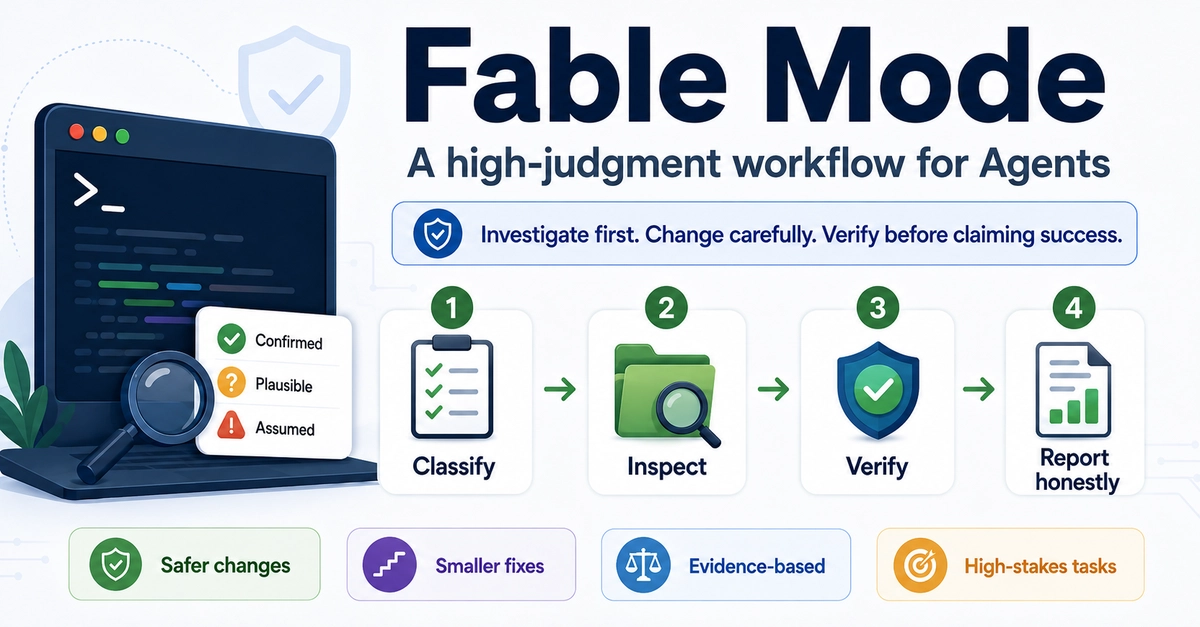
Say "fable-mode" (or "operate carefully," or "high-judgment mode" or "think like fable") in a Claude Code or Codex session, and one line buried in the skill file does most of the work: "Never promote 'plausible' to 'confirmed' in your summary." That single rule is the whole philosophy in miniature — don't let something that merely looks right pass as something that was checked.
Fable-mode is not a tool, a model swap, or a set of new commands. It's a behavioral overlay — a skill file at ~/.claude/skills/fable-mode/SKILL.md or ~/.codex/skills/fable-mode/SKILL.md or any other agent you use, that gets loaded into the turn and changes how the agent scopes work, verifies its own claims, and reports results. Nothing about what Agents can do changes. What changes is the discipline around using it.
What actually changes
The skill is organized into seven blocks, and each one targets a specific failure mode that shows up in normal agent use:
Judgment before action. The first move is classification: is this a question, a problem description, or a change request? For the first two, the deliverable is an assessment — investigate and stop, don't start editing files nobody asked you to edit. Irreversible actions (deletes, pushes, overwrites) require a stop-and-confirm, and specifically: "before deleting or overwriting anything, actually look at the target."