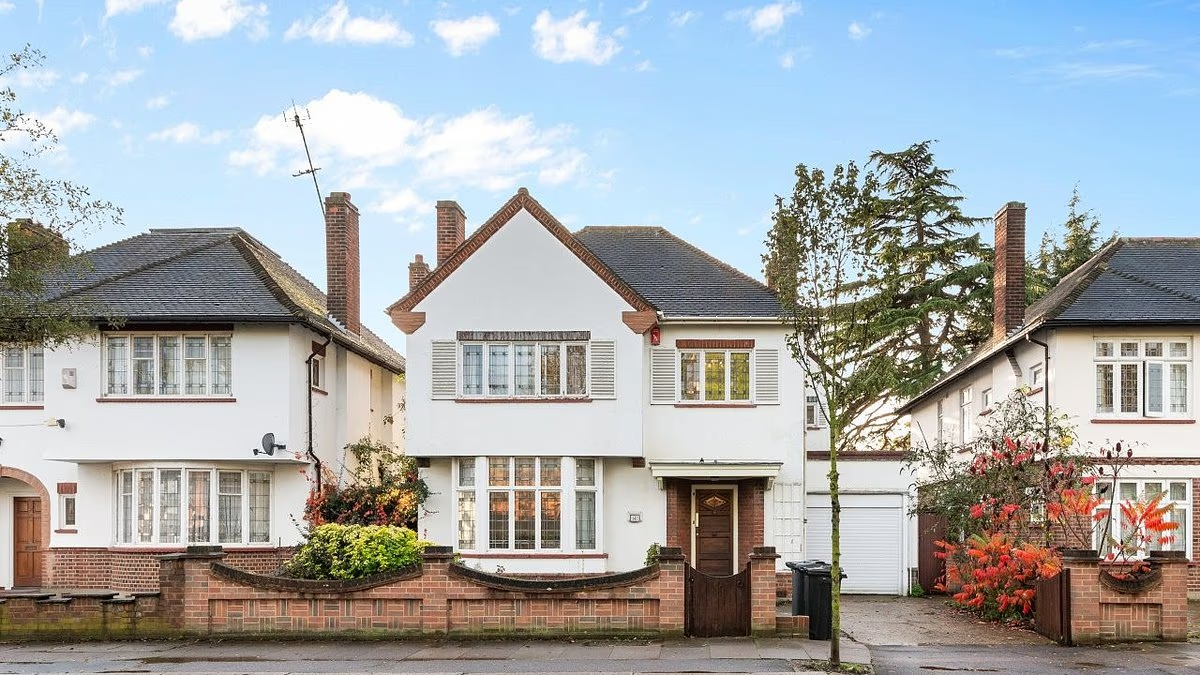
If, on the death of my husband, the family home is bequeathed to our daughter, but I, as his wife, have been granted right of residence until my demise, does inheritance tax become due immediately or will it become due when I die?We want to avoid a situation whereby our daughter cannot sell property to realise the asset and acquire the money to pay the Revenue Commissioners. It is likely that her tax-free allowance will be exceeded.SAPlanning ahead is always a good idea, not least to figure out whether there might be some unintended consequences arising from a person’s good intentions. Right of residence is more common in Ireland than I had realised for a long time, especially in more rural areas. There was quite a reaction when I wrote about it recently. It is, however, a very tricky area, and anyone considering such a provision should ensure they are aware of the tax implications and take legal advice.As you say, you don’t want a scenario where your daughter is left unable to pay for an asset that was ultimately intended for her. And she could be left that way.It might be that there are more straightforward, if not quite as tax-efficient, approaches.The first big question a person needs to address when looking at right of residence is whether it shall be, for want of a better word, an “ordinary” right or residence, or an exclusive right of residence. There are significant differences in how each is taxed, and those differences can impact both the person ultimately inheriting the property – in this case, your daughter – and the person enjoying the right of residence. Age is also a factor, as is the relationship between the dead person and the persons enjoying the right of residence or the inheritance. Whether an exclusive right of residence should also come with a right to maintenance is yet another relevant factor. I’m going to poach an example Revenue provides in its Tax and Duty Manual on this subject, although I will adjust their figures to take more realistic account of today’s property marketThe easiest way to illustrate how things differ is to work through an example. For the purposes of illustration, I will assume your husband is leaving the house to his daughter with an aunt having a right of residence. Why an aunt, and not you? Well, as his wife, you will have no tax bill on anything you receive from your husband, so it would make it difficult to highlight the full tax implications for people generally in this position.So, we’ll take a daughter and an aunt who, for the purposes of this illustration, we will assume is 70 years old when the owner dies.General right of residenceFirst, we will look at a general right of residence, which is where the aunt in this case has the right to live in the property after your husband’s death but might be sharing it with, for instance, your daughter, who could also be living there.[ What tax are we liable for on home we inherited where our mother had ‘right of residence’?Opens in new window ]Working out the value of this right of residence to the aunt can be tricky, and is complicated by the fact that Revenue will accept one of two ways to crunch the numbers.The more formal approach is to take the market value of the property and multiply that by the annual value of the right of residence, divided by what the property would get if rented out on the market.I’m going to poach an example Revenue provides in its Tax and Duty Manual on this subject, although I will adjust their figures to take more realistic account of today’s property market.Let’s assume the market value of the property is €600,000, the annual value of the right of residence is €7,000 and the annual market rental value of the property is €46,000.Multiplying the €600,000 by €7,000 divided by €46,000 gives you a value of what is called the slice, or appropriate part enjoyed by the aunt, of €91,304.The particularly tricky part here is how you calculate the annual value of the right of residence, as it can be impacted by a range of factors.For this reason, Revenue will also accept a slice/appropriate part valuation equal to 10 per cent of the market value of the property which, in this case, would be €60,000.If the right of residence included a right of maintenance, the default figure would be 20 per cent rather than 10 per cent.This figure now needs to be multiplied by another – a factor depending on the age and gender of the person enjoying the right of residence. For those who are really interested in the minutiae of these things, you can find the table of factors in Schedule 1, Part 2, Table A of the Capital Acquisitions Tax Consolidated Act 2003. The rest of you can take my word that the multiple for a 70-year-old woman is 0.4679.The aunt’s €91,304 slice of the property is multiplied by this factor, giving a taxable benefit for her of €42,721 (91,304 X 0.4679 = 42,721).To further confuse, if the right of residence is only for a certain number of years, there is a separate multiple that must be applied, but let’s not complicate things any more than necessary here.So the aunt is deemed to have got a benefit of €42,721. As this is greater than the €40,000 maximum she could receive tax-free from her brother, she will be liable to capital acquisitions tax (CAT), otherwise known as inheritance tax, of at least €897.I say at least because any previous benefit she has received in a will or a gift in excess of €3,000 from a sibling, a grandparent, an aunt or an uncle is also taken into account in measuring how this benefit compares with the €40,000 tax-free limit.But what about your daughter?Well, on your husband’s death, she is deemed to receive a benefit of the property at its market value, minus the aunt’s appropriate part.In this case, the property is worth €600,000 and the appropriate part allocated to the right of residence is, depending on which method of calculation you use, €91,304, or €60,000. So her benefit is either €508,696, or €540,000.Either way, it will be above her €400,000 lifetime tax-free allowance from a parent, so she will have to find money to meet a tax bill of at least €35,869 – CAT at 33 per cent on the lower of those two numbers.When the aunt dies, your daughter becomes the absolute owner of the property, but there’s a catch – a further inheritance tax bill to be precise.Your daughter is now liable for tax on the aunt’s “slice”. To make matters worse, it is assessed not on the market, rental and right of residence valuations at the time her father died, but at the relevant market rates when the aunt dies.[ How does my brother assess tax on a right of residence?Opens in new window ]That puts you back in the finicky stuff of valuing the updated right of residence when the aunt died. For this reason, most people would go by Revenue’s 10 per cent route. The main thing to remember is that whatever formula the daughter chose for her initial inheritance-tax assessment around the right of residence, the same one must be applied here.Assuming the property has jumped in value from €600,000 to €700,000 since her father died, the aunt’s 10 per cent slice is now worth €70,000. And, unless the tax-free thresholds have risen by then, your daughter will have to find a further €23,100, which is 33 per cent of €70,000, for Revenue.I think you really do need to consider why you would go down the route of a right of residence in this case, as it seems to create the potential for problems – with zero upside for your daughterI’m conscious there are an awful lot of numbers running around here but it is, as I said, quite complex.Exclusive right of residenceSo what is the difference between this general right of residence and an exclusive right of residence?From the point of view of the aunt, not a lot. Her “benefit” is still assessed as it would be under a general right of residence. The only real difference for her is that she will be liable for certain charges such as Local Property Tax while she lives there, not your daughter.There is an important difference from your daughter’s point of view, however. As she does not have any access to the asset despite being the owner, any inheritance-tax liability she has is deferred until the aunt dies. So, whether your daughter faces an immediate inheritance-tax bill depends on the nature of the right of residence – which is why it is all the more important that proper legal advice be secured before wording the will to provide for the right of residence.Stepping back from the aunt, you will face no capital acquisitions tax liability, as spouses can inherit freely from each other without any tax concerns. Technically, the value of your right would be assessed and then zero rated for tax.However, the importance of the assessment is that, if you are occupying the house under a general right of residence, your daughter will be liable to inheritance tax when your husband dies on 90 per cent of the market value of the property at that time – presuming she uses the Revenue default.And, as you say, she will not be in a position to sell the property because you are living there.Technically, she is permitted to sell but, given your open-ended right of residence, the sale price would be significantly negatively impacted, so it is unlikely to be an option.If you and your husband want to avoid her facing a tax bill on a property she cannot sell to meet the cost, you need to be looking at an exclusive right of residence. The value of her inheritance will be determined not by her father’s death, but by yours.Or, to put it more simply, both you and your husband bequeaths the other the house – even if it does not pass automatically under “survivorship” as a jointly owned asset – with the property passing eventually to your daughter under the will of the survivor.I think you really do need to consider why you would go down the route of a right of residence in this case, as it seems to create the potential for problems – with zero upside for your daughter.Yes, I know that, technically, assuming property prices continue to rise, she will pay inheritance tax on a lower valuation for 90 per cent of the property, assuming your husband dies first – and I assume that is the catalyst for this idea. However, that is quite pointless if she does not have the money to pay it and cannot sell the home to meet the bill.Under a right of residence, she either faces two tax bills, the first of which she is in no position to pay or her tax is assessed at the market value on the property when you die if the right is exclusive. If both your wills reflect that your daughter inherits the property when the last of you dies, that seems the more practical solution, even if the final tax bill might be slightly higher.Please send your queries to Dominic Coyle, Q&A, The Irish Times, 24-28 Tara Street Dublin 2, or by email to dominic.coyle@irishtimes.com with a contact phone number. This column is a reader service and is not intended to replace professional advice
Will our daughter be stuck with a tax bill and no way to pay it under a right of residence?
Your daughter will inherit the family home but effectively cannot sell it as long as anyone with a right of residence continues to live there
1,938 words~9 min read