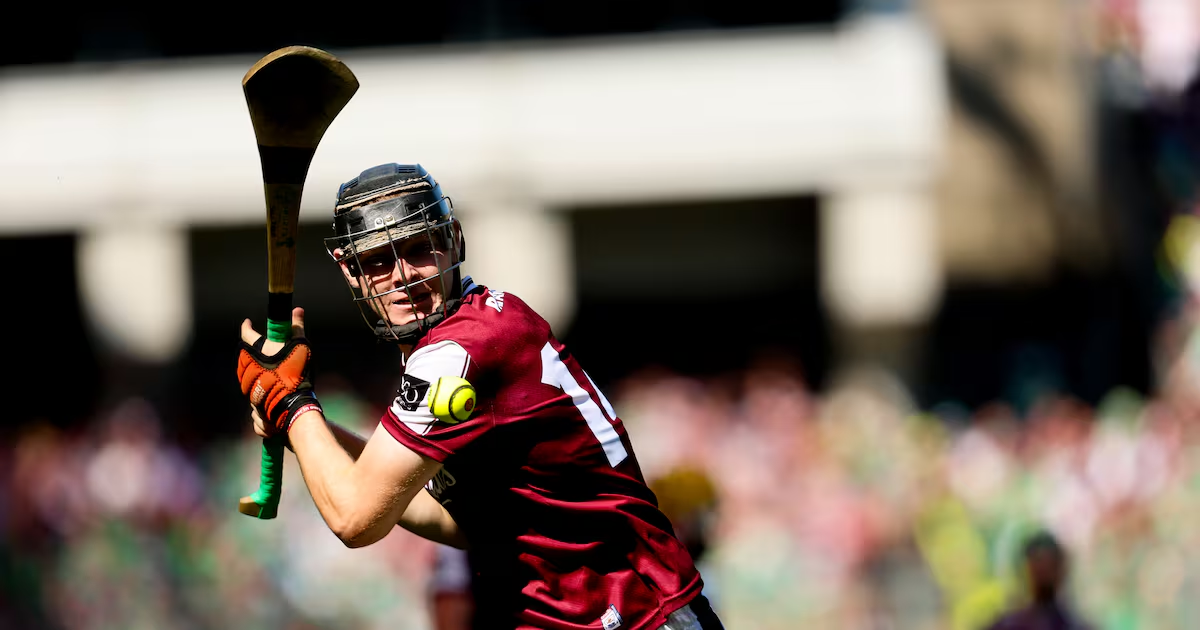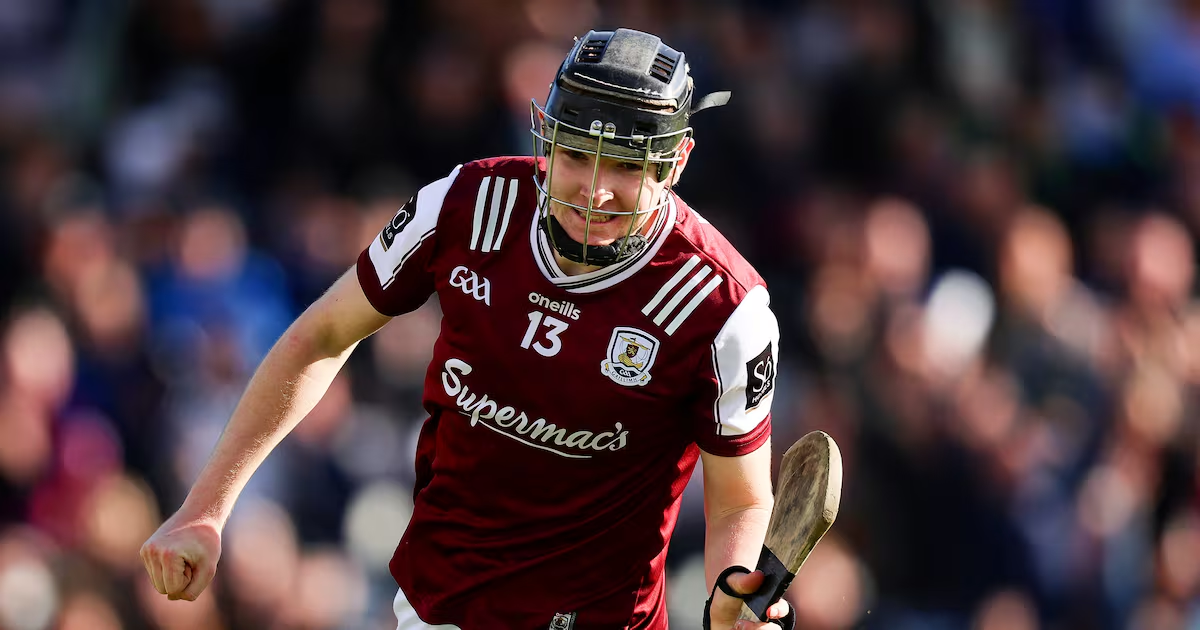
Joe Rabbitte’s catching hand had a life of its own. It was a breadwinner for families of forwards. It lived mostly in the sky so that every dropping ball was met halfway. Keith Richards of the Rolling Stones insured his hands for £1.3 million but no such cover was available to Rabbitte. The claims would have been outlandish.In 1993, when Galway reached the All-Ireland final and Joe won his first All-Star, parts of his catching hand were broken four times. One of his fingers was fractured in two places. For the All-Ireland semi-final against Tipperary he cut a piece from a school lunch box and strapped it to his hand as a protective laminate.By the end of that season, Joe wore a hurling glove on both hands. As a piece of kit, they were in the clunky, prototype phase of their development, like the Nokia 1011. “They were as big as a baseball mitt,” says Pete Finnerty, the former Galway player. “They were massive yokes.”In other ways, though, there was no protection for target men. There was an X on their front and on their back. Every hand that reached towards a dropping ball had the quality of life of a clay pigeon. Big men were expected to survive without a cuddle from the long arm of the law.Finnerty remembers meeting him by chance in a hospital a few days after a game they had played together in Croke Park in the early 1990s. “Joe was limping up the corridor towards me,” he says. “The bone on his ankle had been chipped, and he had broken a bone in his elbow. He had one of these L-shaped crutches that I never saw before for his elbow, and he was hopping up along. He finished that game, but that was the abuse he took.“Now, I would have marked Joe in my day. You’d be getting your retaliation in first.”[ Violence in GAA: ‘The doctors said if my son had continued playing he’d probably have had a heart attack’Opens in new window ]Fergal Healy played with Joe and coached his son Jason. He swears that Jason wears one of his father’s hurling gloves: red with black trim and a long wing covering the fingers.Joe Rabbitte in action for Galway in the 2001 All-Ireland final against Tipperary. Photograph: Billy Stickland/Inpho In the drop-down menu of resemblances between them, though, it is the last thing anybody would notice. Everything else is so striking: the height, the gait, the catching hand, the blind courage of a hero-full-forward.Joe had turned 20 when he was an unused sub for Galway in the 1990 All-Ireland final; Jason will turn 20 later this year. Galway couldn’t wait any longer. On the opening night of the National League against the All-Ireland champions in Thurles, he scored two points and made 1-1 and left a pencil sketch that has been fleshed out over the last six months.It is easy to say now that Jason’s rise has been meteoric, but that trajectory only arrived lately. Healy was manager of the Galway minors for two years, and in the first year Jason didn’t make the panel.“In fairness to Jason, he was very, very, very, very raw,” says Healy. “I can remember him coming to trials in Loughgeorge and he wouldn’t have stood out. He was getting big and I’d say he was in the middle of a growth spurt which would affect your co-ordination and stuff. He was well off what he turned into from a hurling point of view.“But we would have brought the bones of 60 lads together and put them in an athletic programme and kept that going for the full year. Jason was one guy who never missed a session. He wasn’t on the panel for any game in 2022, but he never missed a gym session.“I’ve a good photograph from the gym in Clarinbridge in February 2022 and if you look at Jason in the picture and look at what he’s become, the difference is unreal. [In the picture] he’s like a newborn calf.”Healy tells a story about what should have been his championship debut against Antrim a year later. A few days before the game, while working on the family farm outside Athenry, he speared one of his feet with a pitchfork.Athenry manager Joe Rabbitte celebrates after the win against St Finbarr's in the 2025 All-Ireland Senior Club Camogie final. Photograph: Ryan Byrne/Inpho “He trained with us on the Thursday and didn’t open his mouth about it,” says Healy. “Before the game, 10 minutes before we headed out, he went into Eoin McDonagh [the team doctor] to get it strapped. And Eoin said, ‘Here Jason, you can’t play with that. It’s too risky.’ We had to pull the plug on him, and Jesus he was fully disgusted.“If he didn’t have to get it strapped by the doctor, though, he’d have said nothing at all. He’s just a very quiet young fella and a very shy young fella. He’s not your typical teenager in that regard either.”In the family, high pain thresholds are a genetic hand-me-down. In January, Athenry won the All-Ireland club camogie title with Joe as the manager and his two daughters on the team. In the county final Olwen ruptured her cruciate ligament but somehow returned to play six weeks later and postponed her surgery until the season finished.In the drawn All-Ireland final against St Finbarr’s in December, Sabina broke a bone in her foot in the first 10 minutes but carried on and lined out in the replay in the new year. Over Christmas she repeatedly immersed her foot in a local stream until the chilly midwinter water turned it red. In that group, though, other wounds transcended flesh. In 2022, Joe’s first year managing the team, Kate Moran suffered an accidental head injury in a league match and died. Her father Cathal had played alongside Joe for Athenry and Galway and they were friends, just as their daughters were. As a group they were forced to deal with unfathomable loss. There were no guardrails to guide them. They were starting in the dark.At first, they turned to Iggy Clarke and Justin Campbell, two counsellors and former Galway hurlers. Campbell had hurled for Galway alongside Joe for the guts of 10 years and they had kept in touch.Sabina Rabbitte competing for Galway against Cork's Meadbh Murphy in 2024. Photograph: Natasha Barton/Inpho “Myself and Iggy would have gone to Athenry that time to support the girls,” says Campbell. “There was a terrible level of devastation. A freak accident – it was absolutely shocking. They put a circle around the girls and really looked after them as best they could. Joe was very much aware of the impact it had on the players. He was concerned about their welfare, not just on the field, but off the field. He wanted to be there for others in a time of need.”They plotted a way through the grieving process, putting one foot in front of the other. A couple of weeks after Kate’s death they gathered in the gym, just to be together again, doing something. “That night,” said Joe in an interview with Off The Ball, “there were floods of tears.”They knew it was much too soon to return to camogie, so they found other ways to keep going. A friend of Joe’s who was a soccer coach took them for a session one evening and then they started playing basketball together. Eventually, after more than three months, they returned to the camogie field.“It was terrible in the pitch that evening,” Joe said. “Everyone was crying in every corner. But it was a process of healing that we were trying to do. It was a process that you had to be very careful with because you didn’t want to be pushing girls on to the pitch if they didn’t want to be there. A few might have stepped away but the majority of them didn’t. We let the girls lead us.”[ Joe Canning’s player-by-player guide to Galway’s starting team for the All-Ireland finalOpens in new window ]They lost the semi-final of the Galway championship that year, and in each of the next two years. When they beat Sarsfields in the final last October it was their first title in 16 years.“Those girls have suffered for the last three years,” said Joe on Galway Bay FM after the game. “And in this time of joy I want to remember the Moran family.”[ Nicky English’s player-by-player guide to Limerick’s starting team for the All-Ireland finalOpens in new window ]Athenry’s record in All-Ireland camogie finals was one win from eight attempts. In both games against St Finbarr’s they trailed deep into the second half; in the drawn match they were six points behind with five minutes of normal time remaining. After everything they had been through, nothing was daunting.St Finbarr’s Keeva McCarthy and Olwen Rabbitte of Athenry in last year's All-Ireland Senior Club camogie final. Photograph: James Crombie/Inpho “Joe is massively passionate to win,” says Campbell. “He’s passionate and he’s stubborn as a mule as well thrown into it. That Athenry team looked beaten on a number of occasions but their willingness to fight would be similar to the way Joe hurled. What you saw was what you got with him. Honest and straight. He saw it his way and that was it. Once he was hurling well, the rest of us would be hurling well around him.”In those days, elite players had more licence to behave like normal people. “What was he like? Mad as a hatter,” says Finnerty. “A great character. We drank enough and partied enough and had the craic. But when it came to inside the dressingroom he was a different man.”Joe had a sense of adventure too. He became friendly with Michael Lyster, the late presenter of The Sunday Game, and on a few occasions, he joined Lyster in his rally car, Michael behind the wheel, Joe the navigator.He tells a story from the Galway International Rally one year, where their car left the road coming down from Derrybrian mountain. “I wanted to get out of the car,” said Joe, “but Michael just said, ‘Let’s go again.’” Later in the stage “at the butt of the Corkscrew mountains” a water pipe came off, but in a stroke of luck the car came to a halt outside Linane’s pub in New Quay. They pushed the car around the back and settled in for a few pints.“We sat in there, listening to updates from the rally on Galway Bay FM, and Michael was having mighty craic out of the fact that they were looking for us.”Joe played for Galway for 12 years. In that time, they reached three All-Ireland finals and lost them all. His best performance was in the 1993 final, against Kilkenny. He started that game at full-forward and finished it at centrefield, adrenalising Galway’s comeback with four points, two of them equalisers.“Scoring points is little consolation,” he said in the loser’s dressingroom. “When you lose it doesn’t matter what you get.”Jason Rabbitte eludes a challenge by Damien Cahalane during Galway's win over Cork in this year's All-Ireland semi-final. Photograph: James Crombie/Inpho Jason was RTÉ’s man of the match in the semi-final against Cork a fortnight ago. Three points took his total for the championship to 2-10 from six appearances; on his debut against Kilkenny in April he scored 1-1, starting as he meant to continue.“The following day, he was seen in one of our pitches with a bag of balls, practising on his own,” says John Hardiman, former manager of the Galway minors and under-21s. “But that’s because he likes doing that. He never leaves the hurl out of his hand.”Ten years ago, when his father died, Joe took down all the trophies and medals that had been on display in his parents’ house and put them in the attic. “I didn’t want to keep anything that might put pressure on them [his kids],” he said. “Let them live their own lives.”The comparisons, though, were bound to come. There were no suitable filters. There were too many triggers. As Eoghan Cormican noted, when Sabina came on for Galway in the All-Ireland camogie final last August, one of the first things she did was field a high ball. Of the three siblings, Olwen is the only one that doesn’t wear a hurling glove. The blood of the game courses through them.“You’d know Jason was a cut off Joe by the way he moves around,” says Campbell, “but there’s a lightness on his feet. He’s like a boxer, there’s a bounce in his step and he’s able to get around lads, left and right. Sunday won’t faze him either. He won’t be fazed by that.”The torch was passed.
Something special in the heir: the rise of Jason Rabbitte, son of a Galway hero
The outstanding young hurler of the year, has followed his father’s footsteps into Croke Park
2,132 words~10 min read