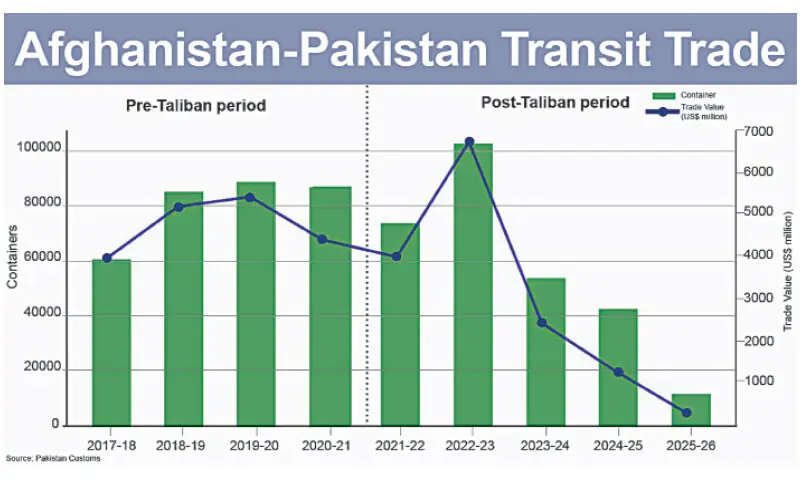
• Falls to 11,592 containers worth $367m in FY26• Afghanistan increasingly relies on Iran, Central Asian trade routes• Reverse transit collapses from $454m in FY25 to just $7m
ISLAMABAD: Afghanistan-Pakistan transit trade has suffered one of its steepest declines, plunging to just 11,592 containers worth $367 million in the outgoing fiscal year from nearly 89,000 containers valued at $5 billion before the Taliban returned to power, as Kabul’s growing reliance on Iranian routes and Pakistan’s border curbs reshaped the decades-old trade corridor.
At first glance, the collapse appears to validate the widely held view that Pakistan’s decision to close its border with Afghanistan in October 2025 over security concerns brought bilateral transit trade to a standstill.
However, while the border closure undoubtedly accelerated the decline, data shows that transit trade had already begun losing momentum well before Islamabad adopted its most strict restrictions.
Trade analysts say the border closure did not initiate Kabul’s search for alternative trade routes. Rather, it marked the culmination of a strategy the Afghan Taliban had already begun to reduce Afghanistan’s dependence on Pakistani ports. Kabul has pursued a deliberate policy of expanding trade through Iran and strengthening commercial links with Central Asian neighbours. Pakistan served for decades as Afghanistan’s cheapest and principal gateway to international markets.