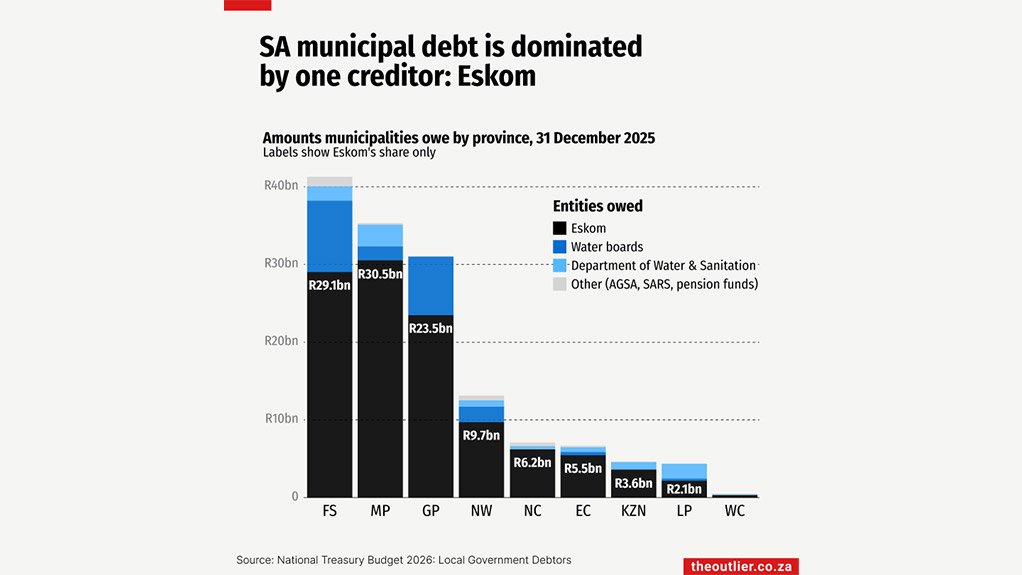
The National Treasury last week temporarily withheld billions of funds from 69 municipalities across South Africa including the cities of Johannesburg, Nelson Mandela Bay, Buffalo City and Mangaung. It’s an audacious step, and many are asking whether the Treasury has gone too far. Or not far enough. Rather than investigating the reasons behind the freeze, our attention should be focused on how these municipalities are run and why they continue, year after year, to be unable to manage the funds that have already been allocated to them.The reality is that the widespread financial mismanagement, weak governance, and lack of accountability often associated with municipality failure are not problems about funding but about capability.Managing a municipality is one of the most demanding leadership roles in South Africa. Municipal executives oversee billions of rand in public funds, maintain critical infrastructure, deliver essential services, and make decisions that influence local economic growth. These are complex organisations that require the same calibre of leadership one would expect in a major listed company.The national conversation needs to shift from how much funding a municipality gets, to the people entrusted to spend that fundingYet we rarely ask whether municipalities are attracting the right level of professional expertise. The national conversation needs to shift from how much funding a municipality gets, to the people entrusted to spend that funding. Instead of asking where the money went when projects fail or conditional grants go unspent, we should instead be asking whether the right people were appointed to manage it in the first place.Infrastructure needs experienced engineers, municipal finances should be overseen by highly qualified accounting professionals, and internal auditors and governance specialists should be empowered to identify risks before they become front-page scandals. These appointments require technical competence, professional judgment and years of practical experience, but unfortunately attracting these professionals to public office has become a challenge. Even I would think twice about a move into local government, not because the work lacks purpose, but because the risks have become difficult to justify. I know too many experienced professionals who see local government as a career-limiting move, thanks to political interference, public suspensions and reputational damage that have created an environment where professionals can find themselves under intense scrutiny simply for insisting on proper governance. Even when allegations are later disproved, careers and reputations are permanently damaged.This reluctance can cost a municipality more than any funding freeze. Without competent or well-qualified professionals, governance inevitably weakens, projects stall, maintenance is delayed, procurement failures multiply and essential infrastructure deteriorates.Weak municipal governance is not only a public sector problem. It is a direct constraint on economic growth, job creation and investor confidence. Business owners depend on functioning municipalities, and when these systems fail, they pay the biggest price through delays, rising costs and lost opportunities.We have seen these consequences play out across the country time and time again. Professionalising local government needs to become a national priority, but it isn’t something the government can do alone.Professional bodies representing accountants, engineers, auditors and other specialists have an important role to play in strengthening municipal capability. This is a call for those organisations to step forward, work alongside the government and become active partners in rebuilding local governmentThis is a call for those organisations to step forward, work alongside the government and become active partners in rebuilding local government. They already set strict professional standards, regulate ethical conduct and develop the very skills municipalities need. Stronger partnerships could create leadership pipelines, mentorship programmes and technical support that strengthen municipal institutions over the long term.Recruitment also requires a fundamental rethink. In the business world, organisations don’t fill executive vacancies just to meet compliance requirements. Instead, they recruit leaders with the experience, judgment and integrity to build resilient institutions, and municipal appointments need to be approached with the same level of care and professionalism.Equally important is creating an environment where professionals are protected when good governance is upheld. Accountability must remain non-negotiable, and professionals who act ethically should not fear becoming collateral damage in political battles.This week’s intervention by the Treasury may go some way in improving compliance in the short term. It may even encourage municipalities to address immediate financial shortcomings, but the long-term consequences are a lot more unclear.Until we make local government a place where the country’s best engineers, finance professionals, planners and governance specialists once again want to build careers, we will continue treating the symptoms while ignoring the disease.After all, money has never built, and never will build, a capable municipality, but competent people can.• Mtwentwe is a certified internal auditor, MD of Vantage Advisory and host of the SAICABIZ Impact Podcast.
LUNCEDO MTWENTWE | The know-how vacuum that’s crippling towns and cities
It’s not a cash shortage that’s to blame for municipal collapse; it’s the absence of professionals to administer the funds and do the work, writes Luncedo Mtwentwe.
772 words~4 min read