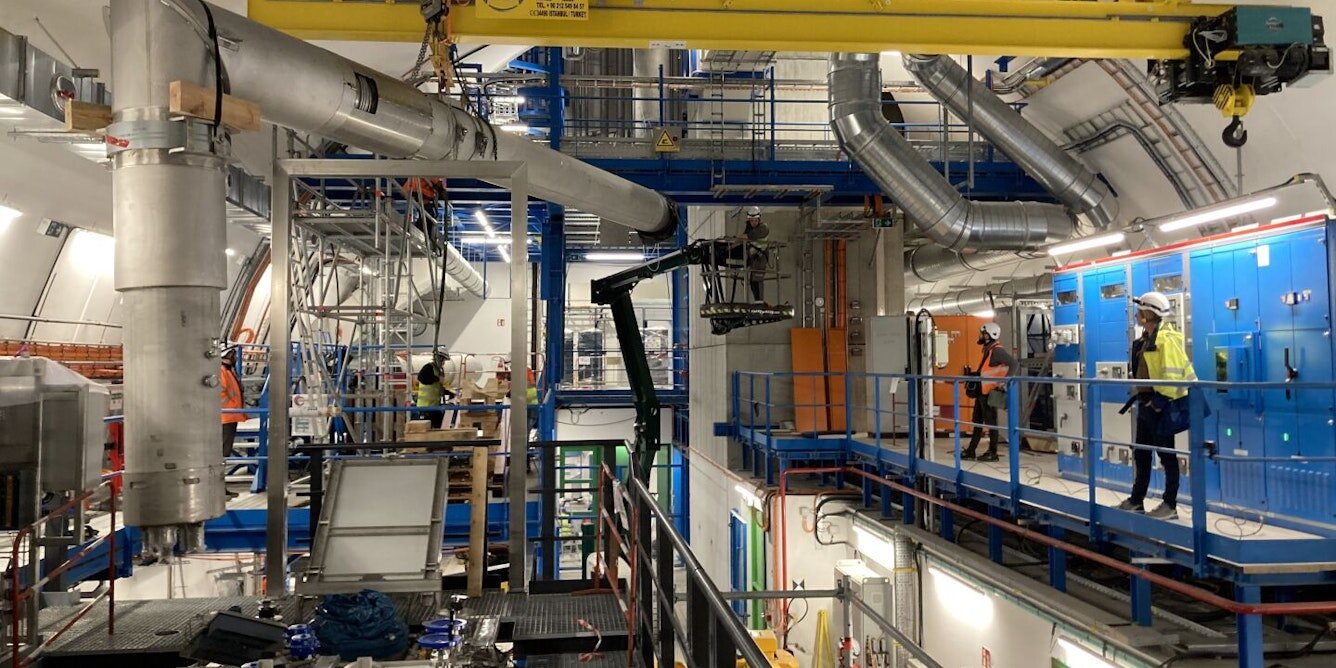
Engineers are dismantling 1.2 kilometers of the Large Hadron Collider to install the new HiLumi LHC equipment. Credit: Joao Batista Lopes / CERN
Deep beneath the French-Swiss border, the world's largest scientific instrument has fallen silent. After years of smashing protons together at nearly the speed of light, CERN's Large Hadron Collider (LHC) has stopped operations and entered a long shutdown.
While no particle collisions are taking place at the LHC, thousands of scientists, engineers and technicians are dismantling parts of the machine, installing new technologies and preparing one of the most ambitious upgrades ever attempted in experimental physics.
When it switches on again, around 2030, it will become the High-Luminosity Large Hadron Collider (HL-LHC), capable of delivering roughly seven times more data than the collider that discovered the Higgs boson.
For me, this shutdown marks another milestone in a project that has shaped much of my scientific life. I first became involved in the High-Luminosity collider long before the Higgs boson was discovered in 2012. Over nearly two decades, I have had the privilege of contributing to the program on both sides of the Atlantic.