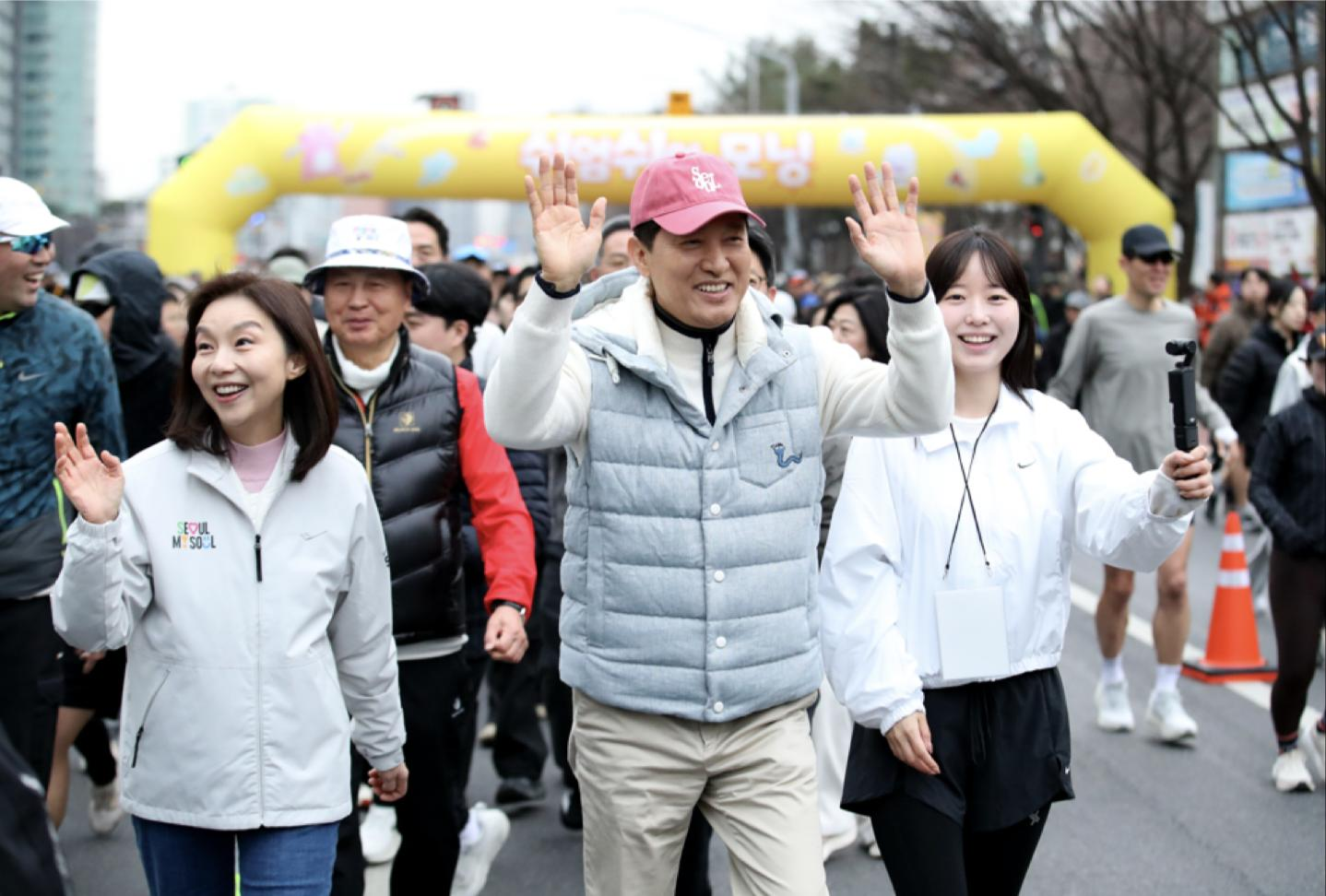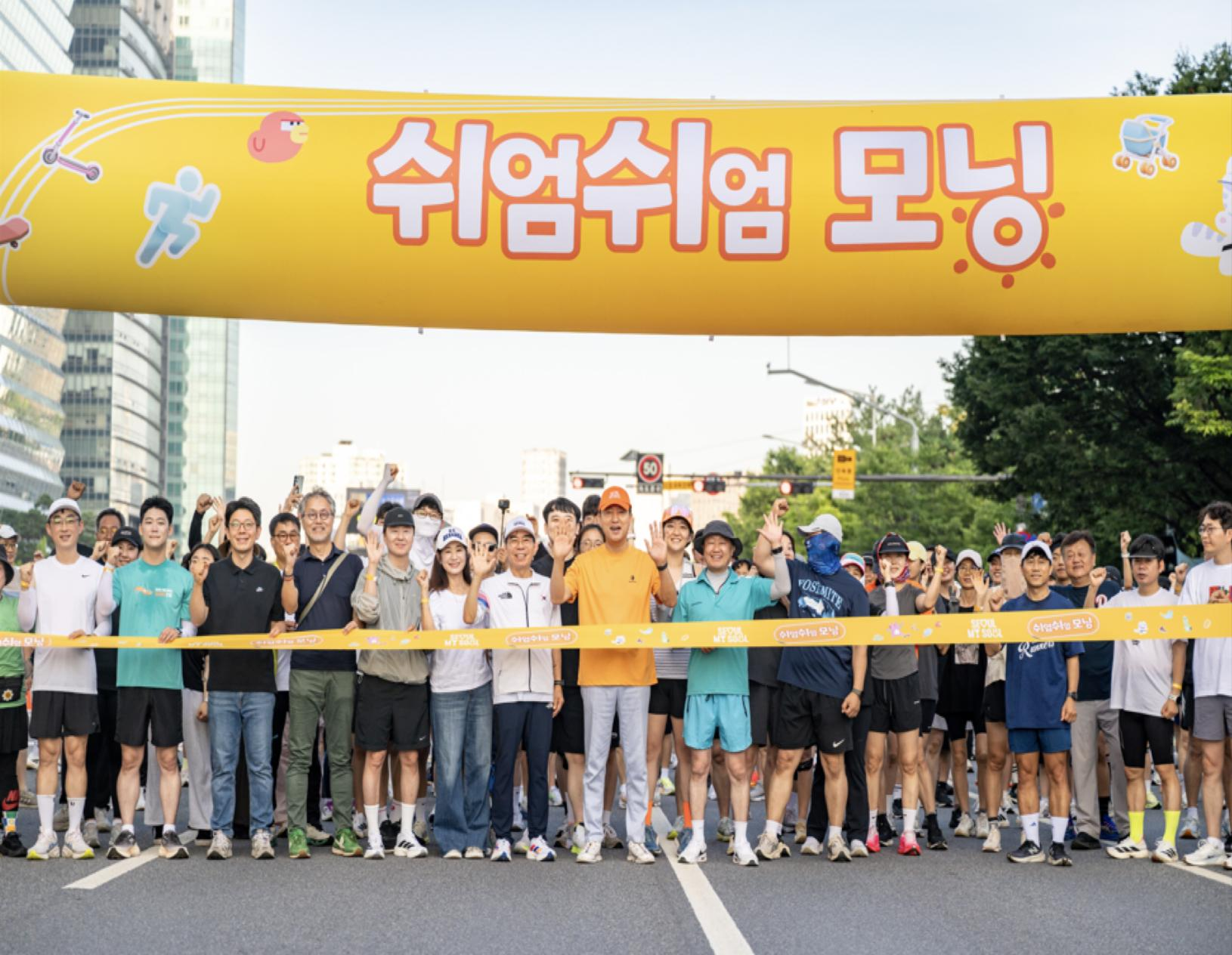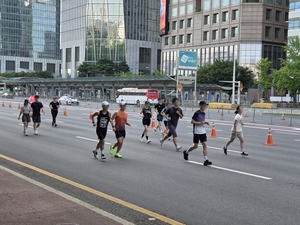
People jog through Yeouido, Seoul, during the My Pace Morning event on Sunday. The event, organized by the Seoul Metropolitan Government, encouraged runners to complete the course at their own pace rather than compete for speed. (Hwang Sun-jun/The Korea Herald) Running has long been associated with chasing faster times and who crosses the finish line first. But a growing number of runners in South Korea are embracing a different philosophy: slowing down.At My Pace Morning, a Seoul Metropolitan Government running program held in Yeouido on Sunday, there were no sprints to the finish. Instead, runners chatted with companions, pushed strollers and jogged at a pace comfortable enough to hold a conversation.Despite the scorching summer heat, about 150 people gathered at the starting line at around 7 a.m. at Yeouido Park's Culture Plaza. Some stretched in performance sportswear, while parents adjusted strollers and dog owners checked their pets' leashes.When the starting signal was given, there was no rush. Faster participants moved ahead, but many kicked off with gentle strokes. The 5-kilometer course followed Yeoui-daero and crossed Mapo Bridge. Some finished in 30 to 40 minutes, while others took their time, enjoying the leisurely morning run at their own pace.Lee Young-sik, 30, told The Korea Herald he was using the event to get himself back into running after several years of taking a break."I decided to run slower than usual and warm my body up as I try to get back in shape," Lee said after he finished his first lap."I used to run 300 kilometers a month, but I often got injured," he added. "I recently found that slowing down significantly reduced the risk of injury."Running itself is not a novel phenomenon, as it has already been one of South Korea's biggest fitness trends for quite some time.Runners can already be seen throughout the day, whether that be along rivers, through parks or around apartment complexes. Some run in teams, others run with family or friends, while some head out alone. People gather at the starting line as they wait for the signal to begin the My Pace Morning event in Yeouido on Sunday. (Hwang Sun-jun/The Korea Herald) For years, much of the culture surrounding the sport appeared fixated on speed. A typical runner might aim to cover 3 kilometers in 15 minutes. Watches, apps and social media collectively fire up the competition of personal bests. But a new trend, slow jogging, is challenging that mindset. Instead of focusing on speed, it encourages runners to move at a pace that allows them to breathe comfortably and hold a conversation. For many, this may mean roughly eight to 9 minutes, perhaps even more, per kilometer, which is just faster than a brisk walk. Kim and Chung, a couple in their mid-30s who joined the event with their dog, said they maintained a pace of about 8 minutes and 30 seconds per kilometer, slower than their usual pace."As we get older, we start worrying more about our joints," Kim said. "Running at a slower pace prevents injuries while bringing health effects similar to running at our usual pace of 6-7 minutes per kilometer."A man with the pseudonym Bang, who is in his 40s, said he usually runs at around 6 minutes per kilometer in competitions but slowed down to 6:30 at the event."I wouldn't say I'm slow jogging, but I'm definitely slowing down," he said. "Slowing down does not mean the workout is insufficient. In fact, a high pace is too difficult to maintain for a long time.""By slowing down, you can exercise, build muscles and still enjoy the experience," he added.Academic sources also reinforce the idea that jogging slowly might not just be about being more comfortable, but could also lead to positive health effects.One study found that 5 to 10 minutes of running a day at speeds below 9.5 kilometers per hour was associated with lower risks of cardiovascular and all-cause mortality.Another 12-week trial found that slow jogging improved aerobic capacity and muscle function among older adults with low muscle mass.
Korea's running craze has a new pace: Slowing down
Running has long been associated with chasing faster times and who crosses the finish line first. But a growing number of runners in South Korea are embracing a
671 words~3 min read