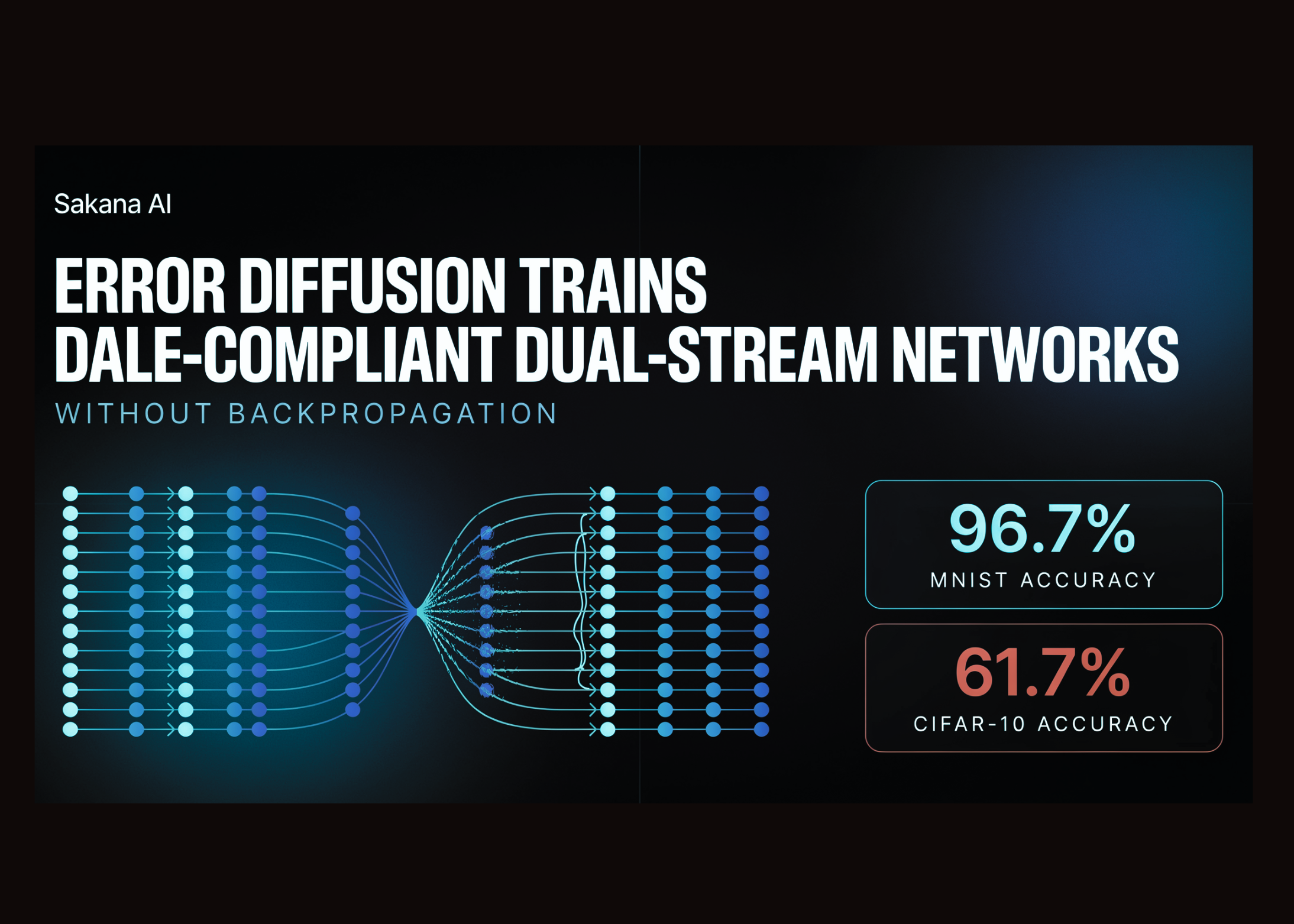
Backpropagation dominates deep learning, yet it uses a mechanism the brain likely cannot. Specifically, the backward pass needs exact transposes of forward weight matrices. This is the weight transport problem. Sakana AI’s new paper, Diffusing Blame, confronts this constraint directly. The research team trains networks that obey Dale’s principle while avoiding weight transport entirely.
What is Error Diffusion?
Error Diffusion (ED) is a local learning rule, first proposed by Kaneko (2000). Each weight update depends on three signals only. These are presynaptic activity, a postsynaptic activation derivative, and a single global error sign. Consequently, ED never transports transposed forward weights or uses random feedback matrices. That locality makes ED naturally compatible with Dale’s principle. However, prior work demonstrated ED only on binary classification and MNIST.
The Dual-Stream Architecture
To satisfy that constraint, the research team split each layer into two streams. One stream is excitatory (p), and the other is inhibitory (n). The forward pass computes excitatory-minus-inhibitory preactivations for each stream: